
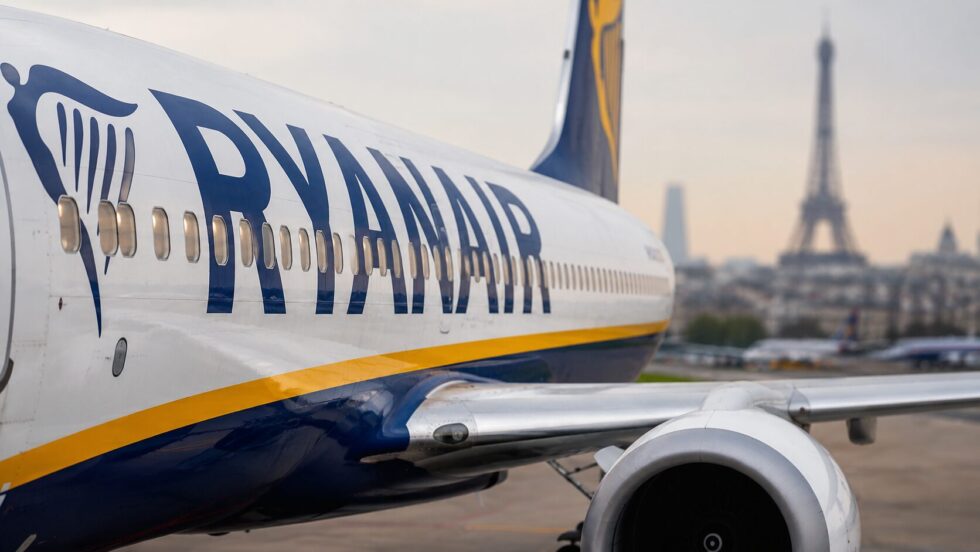
Ryanair Flight FR4007, operating from Manchester to Alicante, was reported to have declared an emergency and diverted to Paris Beauvais Airport on 14 July 2026. The aviation-tracking outlet AIRLIVE reported that the aircraft transmitted squawk 7700 — the international general emergency code — before descending towards Beauvais, and said the jet landed safely after controllers granted it priority. AIRLIVE identified the aircraft as a Boeing 737 MAX 8200 registered EI-ILJ, and stated initially that it was unclear whether the diversion stemmed from a technical fault or a medical emergency on board. No crash, evacuation or damage to the aircraft was reported. That single named source accounts for nearly everything that can be said with confidence about the flight; the details that have travelled furthest do not survive scrutiny, The WP Times reports.
A separate account attributed to the Manchester Evening News holds that Ryanair confirmed a passenger had fallen ill, that medical assistance was requested before landing, and that the flight continued on to Alicante after roughly 40 minutes on the ground. A Manchester Evening News report carrying near-identical details — the same flight number, the same route, a departure from Manchester at about 6.40am, a diversion to Beauvais, an ill passenger, a stop of approximately 40 minutes — was published on 14 January 2015. The correspondence is too close to set aside. It raises a serious possibility that an eleven-year-old article or airline statement has been recirculated, misdated, or merged with fresh tracking data. Until Ryanair issues a newly dated statement, or Manchester Airport, Paris Beauvais or another authority confirms it independently, the medical explanation cannot be reported as settled fact.
Public flight records deepen the problem. Flightradar24's indexed history for FR4007 on 14 July shows a Manchester–Alicante service operated by EI-IJY — not EI-ILJ — with visible data that appears to describe an arrival at Alicante rather than a documented stop at Beauvais. FlightAware's public listing likewise shows the flight landing at Alicante, without establishing whether an intermediate diversion took place. None of this is conclusive: trackers display incomplete or corrected records, aircraft are substituted before departure, and flight numbers recur on the same route across dates. A mismatch does not prove a report false. It does mean the registration, departure time, landing time and sequence of the journey require confirmation that has not yet been supplied.
Squawk 7700 tells controllers that a crew requires priority handling. It does not describe the nature or gravity of the problem, and it does not imply an aircraft in danger of crashing — it covers a sick passenger, smoke or fumes, a technical warning, a pressurisation loss, or any operational concern needing prompt assistance. Nor are crews obliged to continue to their destination once they have declared. They weigh position, fuel, weather, runway length and the availability of fire, engineering or medical services before choosing an airport. Paris Beauvais sits at Tillé, some 80km north of central Paris and well outside the capital it is marketed as serving, but for a flight heading south over northern France it offers a runway capable of taking 737s at an airport Ryanair uses routinely. A landing there establishes nothing about the cause: airport services attend 7700 arrivals as a matter of course, including those that end normally with no intervention required.
Two framings should be resisted. The 737 MAX 8200 is the high-density variant Ryanair operates in quantity and markets as the "Gamechanger", but there is no verified evidence linking the type to the reported diversion, and casting this as a MAX technical incident without confirmation would be misleading. "Emergency landing" carries a similar risk — in common usage it means any unscheduled landing after a 7700 call, yet it implies far more danger than the evidence supports. "Diversion following an emergency declaration" is the accurate formulation while the cause remains open.
For passengers, the distinction that matters is between what tracking shows and what the operator confirms. Tracking data can establish that an aircraft turned, descended or landed elsewhere; it cannot establish that someone fell ill, what warning appeared on the flight deck, or what passed between crew and controllers. That comes from the airline, airport authorities, ATC recordings or a formal investigation, and no French or British aviation authority has so far issued a public notice on FR4007. Nor has any independently verified statement been located on the condition of the allegedly unwell passenger, and there is no evidence of injuries to anyone else on board. Should a passenger illness be formally confirmed, the crew's decision to land would be consistent with standard procedure: cabin crew are first-aid trained and carry emergency medical equipment, but they cannot deliver the diagnosis and treatment available on the ground, and a captain may divert when symptoms appear serious, are worsening, or cannot be safely managed for the remainder of the flight — even with the aircraft fully serviceable. Once a patient is transferred to medics and operational checks are complete, the same aircraft may be cleared to resume its journey.
Passengers delayed by a genuine medical emergency should not assume automatic compensation under UK261. A traveller's sudden illness would ordinarily fall outside the airline's reasonable control. Duty-of-care obligations may still apply during a qualifying delay, but cash compensation turns on the circumstances and the eventual arrival time. Those affected should retain booking confirmations, boarding passes and receipts for reasonable expenses, since the airline's own disruption notice and the final operational record will carry more weight than screenshots or early social-media reports. The defensible position is narrower than the circulating coverage suggests. A diversion was reported by AIRLIVE. A safe landing was reported. The cause has not been independently established through any accessible primary source, and the three details most widely repeated — the medical explanation, the registration EI-ILJ, and the 11.10am onward departure — trace to reporting that closely mirrors a confirmed FR4007 medical diversion from January 2015. That duplication is not a footnote to be tidied away. It is the story's central unresolved question, and it should be disclosed rather than quietly converted into a new account.
Read about the life of Westminster and Pimlico district, London and the world. 24/7 news with fresh and useful updates on culture, business, technology and city life: What is known about the Ryanair plane emergency after a passenger was pulled through a broken window in flight
Materials used: AIRLIVE, Flightradar24, FlightAware, Manchester Evening News archive, Ryanair route information.