
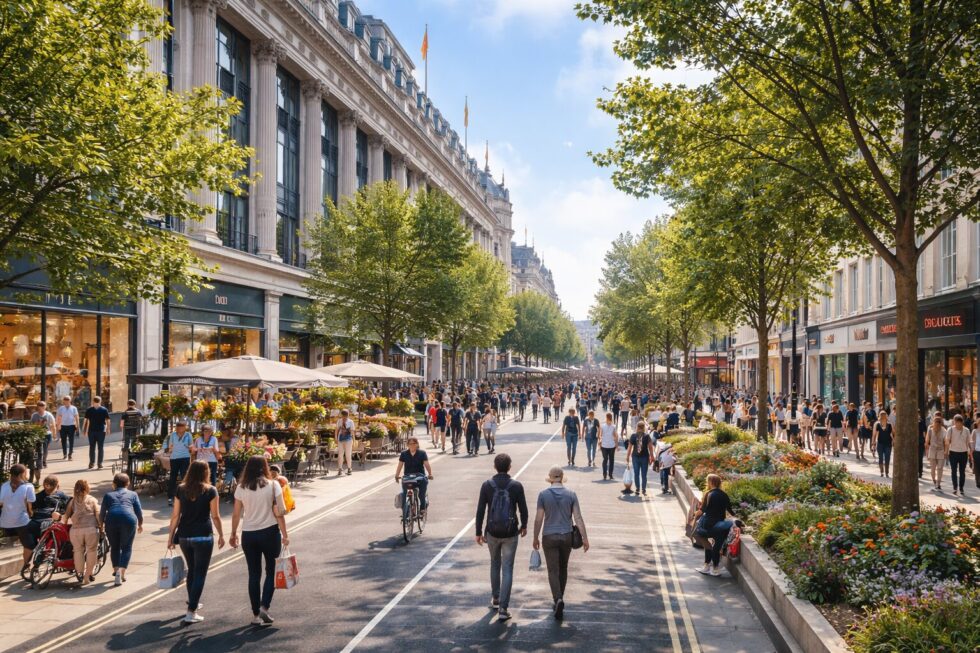
Oxford Street pedestrianisation has received final approval from the Mayor of London, Sadiq Khan, with vehicles set to be banned from much of the capital’s busiest shopping street as early as September 2026. The decision follows two public consultations and confirms that a stretch from Marble Arch to Tottenham Court Road will be transformed into a largely car-free zone. Sixteen bus routes will be diverted, new cycle routes constructed and infrastructure works launched in the coming months, continuing until late 2027. City Hall says a majority of respondents backed the scheme, with 63 percent supporting the proposal in an earlier consultation. This is reported by The WP Times, via BBC.
Oxford Street pedestrianisation timeline and legal approval process
Oxford Street pedestrianisation has been under consideration since 2017, when Mayor Sadiq Khan first set out a long-term ambition to remove through-traffic from the central shopping corridor. Formal proposals were unveiled in 2024 by the Greater London Authority (GLA) in coordination with Transport for London (TfL) and Westminster City Council.
On 26 February 2026, the Mayor granted final approval following two rounds of statutory consultation. The first consultation, conducted in summer 2025, focused on the principle of pedestrianisation and recorded 63 percent support among respondents. The second consultation, which concluded earlier in 2026, examined detailed traffic diversion proposals and bus rerouting plans. Approximately 2,700 responses were submitted to TfL regarding traffic diversions.
The scheme will be implemented using Traffic Regulation Orders (TROs) under the Road Traffic Regulation Act 1984. These legal instruments allow TfL to restrict vehicle access, redirect bus services and adjust loading and servicing arrangements. Once TROs are formally sealed and published, enforcement can begin through existing road traffic legislation.
Works are scheduled to begin in spring 2026. According to BBC reporting, the vehicle ban could come into force by September 2026, with phased infrastructure changes continuing until late 2027.

What will change on Oxford Street: vehicle ban, buses and cycling routes
Oxford Street pedestrianisation will apply to a central section between Marble Arch and Tottenham Court Road. Private vehicles, taxis and through-traffic will be prohibited from entering the designated pedestrian zone. Deliveries and servicing arrangements will operate under restricted access windows, subject to TfL regulation.
Sixteen bus routes currently using Oxford Street will be diverted. Among the confirmed routes affected are numbers 7, 94 and 98. All buses serving the corridor will be redirected primarily via Wigmore Street and Henrietta Place. TfL will publish updated route maps and timetables on its official website, www.tfl.gov.uk, ahead of implementation.
Additional cycle infrastructure will be constructed around the shopping district to maintain east-west connectivity. The design aims to separate pedestrian flows from cycling traffic to reduce conflict points. TfL has indicated that new cycle lanes will link to existing Cycleway routes in central London.
City Hall states that the objective is to reduce congestion, improve air quality and increase footfall for retail and leisure businesses. Oxford Street is estimated to attract around half a million visitors per day at peak times, making it one of Europe’s busiest shopping streets.
Public consultation results and Londoners’ responses
Public engagement has been a central component of the Oxford Street pedestrianisation process. The initial consultation indicated majority public support, while the second consultation addressed operational details such as bus rerouting and traffic redistribution.
According to City Hall, a majority of the 2,700 respondents to TfL’s traffic diversion consultation agreed with the proposals. However, consultation feedback also included concerns about displacement of traffic into surrounding residential streets, increased congestion on parallel routes and potential impacts on disabled access.
Westminster City Council Leader Adam Hug stated that the council secured adjustments to ensure better deliverability and alignment with local development plans. These include commitments that the Oxford Street East transformation will retain bus access in line with Westminster’s earlier framework and that strategic development funding remains under council control.
Formal consultation documents and response summaries are expected to be published on the Greater London Authority website at www.london.gov.uk and on TfL’s consultation portal.
Impact on public transport and bus route diversions
Oxford Street pedestrianisation will have significant implications for central London bus operations. The following structured overview summarises confirmed transport changes:
Confirmed transport changes (as of February 2026)
| Element | Current Situation | After Implementation (from Sept 2026 expected) |
|---|---|---|
| Private vehicles | Permitted along Oxford Street | Prohibited in pedestrian zone |
| Bus routes | 16 routes operate via Oxford Street | Diverted via Wigmore Street and Henrietta Place |
| Routes affected | Includes 7, 94, 98 | Rerouted; updated timetables to be issued |
| Cycle access | Mixed traffic conditions | Additional cycle routes around district |
| Delivery access | Standard road access | Restricted time-window access |
TfL has advised passengers to check live updates via the TfL Go app or the Journey Planner tool at tfl.gov.uk before travelling. Updated bus stop locations will be communicated in advance of the vehicle ban.
Passengers requiring step-free access can verify accessible route information through TfL’s accessibility page. Businesses along Oxford Street will receive operational guidance regarding loading bays and delivery schedules.
Governance, funding and institutional roles
The Oxford Street pedestrianisation project involves multiple public bodies:
- Greater London Authority (GLA) – strategic oversight
- Mayor of London – final approval authority
- Transport for London (TfL) – transport planning and enforcement
- Westminster City Council – local planning coordination
Funding mechanisms include GLA transport budgets and strategic development funding retained by Westminster City Council. Precise capital expenditure figures have not been publicly itemised in the final announcement; however, large-scale pedestrianisation projects typically involve multi-million-pound public investment in paving, drainage, street furniture and lighting.
TfL will manage enforcement of traffic restrictions under existing road safety and congestion legislation. Penalty Charge Notices (PCNs) will apply to unauthorised vehicles entering the restricted zone.
What residents, businesses and visitors need to do
Oxford Street pedestrianisation introduces operational adjustments for several groups. The following structured list outlines practical steps:
For bus passengers
- Check revised routes on www.tfl.gov.uk.
- Confirm updated stop locations before travel.
- Allow additional journey time during the transition period.
For businesses
- Register delivery schedules within TfL’s designated time windows.
- Review servicing access requirements via Westminster City Council’s website (www.westminster.gov.uk).
- Inform suppliers about new access restrictions.
For drivers
- Avoid entering the pedestrian zone once restrictions are active.
- Use designated alternative routes via Wigmore Street and surrounding corridors.
- Monitor official TfL announcements regarding enforcement dates.
For residents
- Review consultation summaries for traffic redistribution measures.
- Report access issues through Westminster Council’s reporting portal.
- Stay informed via City Hall updates.
Failure to comply with traffic restrictions after enforcement begins may result in fines under standard London road enforcement procedures.
Economic and urban development implications
Oxford Street pedestrianisation is positioned as a long-term urban regeneration initiative. Oxford Street has faced retail challenges in recent years, including vacancy rates and changing consumer patterns. City Hall has argued that enhanced public realm design could increase dwell time and retail footfall.
The September 2025 trial day, during which the street was closed to vehicles and hosted food stalls and live music, served as a demonstration event. According to City Hall communications at the time, the trial was intended to test crowd management and logistical feasibility.
Urban planning experts often evaluate pedestrianisation projects based on metrics such as footfall data, air quality readings and retail turnover. TfL and the GLA are expected to publish performance indicators following implementation.
Accessibility, safety and enforcement mechanisms
A core operational consideration is balancing pedestrian access with emergency vehicle requirements. Emergency services will retain controlled access through designated routes. Detailed access protocols will be coordinated with the Metropolitan Police Service and London Fire Brigade.
Accessibility provisions for disabled visitors are to be addressed through designated drop-off points near the pedestrian zone perimeter. TfL guidance will outline specific locations once final designs are confirmed.
Enforcement will rely on Automatic Number Plate Recognition (ANPR) cameras, consistent with other restricted traffic zones in London. Signage will be installed in advance of activation to ensure compliance.
Read about the life of Westminster and Pimlico district, London and the world. 24/7 news with fresh and useful updates on culture, business, technology and city life: Charing Cross and Waterloo East Close for 22 Days in Summer 2026 for Major London Track Upgrades