
Apple Newsroom has unveiled a new generation of its flagship professional laptop, introducing updated 14-inch and 16-inch MacBook Pro models powered by the M5 Pro and M5 Max chips. The announcement, issued from Cupertino, California on 3 March 2026, positions the new MacBook Pro as a substantial architectural upgrade focused on professional compute performance and on-device artificial intelligence processing.
According to the official Apple Newsroom press release, the M5 Pro and M5 Max chips have been engineered to deliver up to four times faster AI performance compared with the previous generation, and up to eight times faster AI performance compared with M1-based MacBook Pro models, based on Apple’s internal testing conducted in January and February 2026. The company states that the redesigned CPU and next-generation GPU — featuring a Neural Accelerator integrated into each core — are intended to enable advanced large language models (LLMs), AI image generation and high-bandwidth creative workflows to run locally on the device rather than relying on cloud infrastructure.
Apple further claims that the new architecture maintains extended battery life of up to 24 hours, while increasing unified memory bandwidth and SSD throughput. The models also introduce Wi-Fi 7 and Bluetooth 6 support via Apple’s new N1 wireless chip.
As reported by , Apple frames the release as a significant generational shift for professional users working in AI development, software engineering, high-resolution video production and 3D rendering.
Pre-orders begin on 4 March 2026, with retail availability starting on 11 March 2026. The new MacBook Pro models will be available in space black and silver.
MacBook Pro M5 Pro and M5 Max: architecture built explicitly for on-device AI performance
In its 3 March 2026 press release, Apple places the technical emphasis of the new MacBook Pro squarely on the underlying silicon. The company states that both M5 Pro and M5 Max are built using a newly developed, Apple-designed “Fusion Architecture”, which combines two dies into a single system on a chip. Apple describes this design as being engineered “from the ground up for AI”, signalling that artificial intelligence workloads were a primary consideration rather than an afterthought in the chip’s layout and data pathways.
At the CPU level, Apple specifies that M5 Pro and M5 Max feature up to an 18-core configuration. This consists of six so-called “super cores” and twelve newly designed performance cores. In the wording of the press release, the super core is described as the world’s fastest CPU core. The broader CPU structure, Apple says, is optimised for power-efficient, multithreaded professional workloads — the types of sustained computational tasks associated with software compilation, simulation modelling, large image libraries and complex data processing.
Apple claims that, under its internal testing conditions conducted in January and February 2026, the new architecture delivers up to 30 per cent faster performance compared with the previous generation of MacBook Pro. The company notes that these figures are based on specific benchmark configurations and comparisons with prior 16-inch MacBook Pro models equipped with M4 Pro and M4 Max chips.
In positioning terms, Apple draws a distinction between the two variants. M5 Pro is presented as designed for users handling demanding but broadly distributed professional workflows — including coders optimising algorithms and photographers processing substantial image archives. M5 Max, by contrast, is framed as intended for users operating at the upper limits of portable performance, such as engineers running rigorous simulations or professionals managing highly compute-intensive environments. The language of the release makes clear that Apple’s objective is not merely incremental speed gains, but a recalibration of the MacBook Pro as a system capable of sustained AI processing and high-bandwidth compute within a mobile form factor.
GPU with Neural Accelerator in each core: LLM processing and AI image performance
One of the most significant architectural changes described in Apple’s 3 March 2026 press release concerns the graphics subsystem. According to the company, both M5 Pro and M5 Max feature a next-generation GPU that includes a Neural Accelerator integrated into each GPU core. Apple presents this as a structural shift aimed specifically at accelerating artificial intelligence workloads directly on the device.
In the release, Apple states that this GPU design delivers:
- Up to 4× faster LLM prompt processing compared with MacBook Pro models equipped with M4 Pro and M4 Max.
- Up to 8× faster AI image generation compared with MacBook Pro models equipped with M1 Pro and M1 Max.
- Up to 50% higher overall graphics performance compared with M4 Pro and M4 Max.
All figures are described by Apple as “up to” results based on internal testing conducted in January and February 2026 using specific system configurations.
Apple links these performance gains directly to practical use cases. The company states that the new GPU architecture allows AI researchers and developers to train custom models locally on MacBook Pro, rather than relying exclusively on remote cloud infrastructure. In parallel, Apple positions the improvements for creative professionals working with AI-assisted tools in video editing, music production and design applications.
The press release also notes that the GPU enhancements operate in conjunction with a faster and more power-efficient Neural Engine, as well as increased unified memory bandwidth. Apple argues that this combined architecture — GPU-level Neural Accelerators, updated Neural Engine and higher memory throughput — enables more advanced on-device AI capabilities, including faster token generation in large language models and improved responsiveness in AI-driven creative workflows. By distributing AI acceleration across each GPU core rather than concentrating it in a single processing block, Apple frames the M5 Pro and M5 Max as designed for sustained AI processing at scale within a portable system.
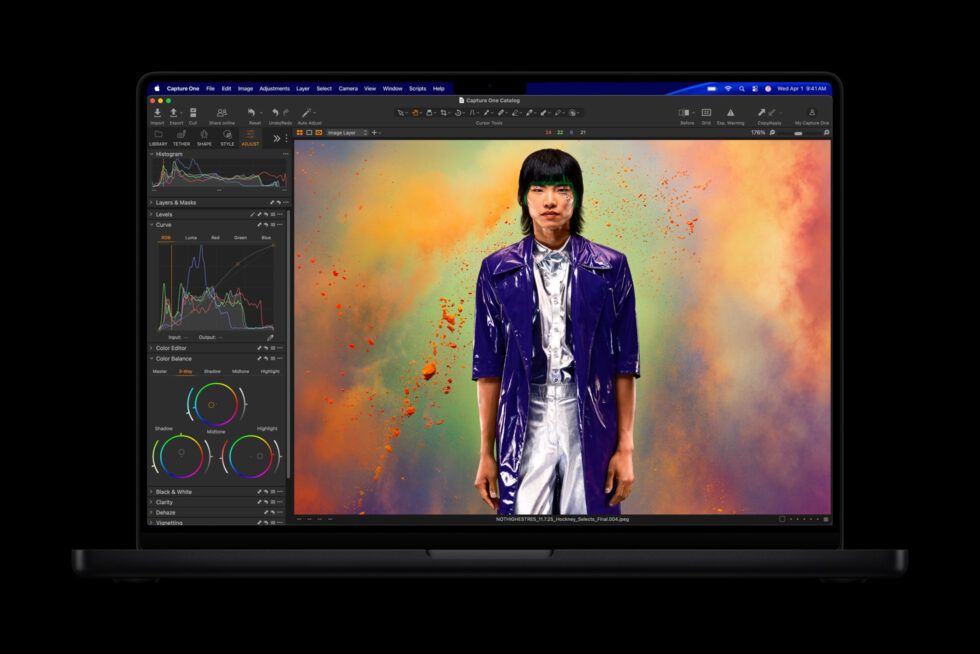
Unified memory and bandwidth: up to 128GB and 614GB/s in the M5 Max configuration
In its 3 March 2026 press release, Apple places particular emphasis on unified memory bandwidth as a foundational element of the new MacBook Pro’s performance profile. Rather than focusing solely on CPU or GPU core counts, the company explicitly links memory throughput to real-world AI and high-resolution media workflows. According to Apple’s stated specifications:
- M5 Pro supports up to 64GB of unified memory with up to 307GB/s of memory bandwidth.
- M5 Max supports up to 128GB of unified memory with up to 614GB/s of memory bandwidth.
Apple presents these figures as enabling more demanding computational tasks, including intensive AI model training and large-scale 4K and 8K video production. In the context of the press release, higher unified memory bandwidth is described as critical for complex workflows that require rapid data exchange between CPU, GPU and Neural Engine components.
The company specifically connects increased memory bandwidth to AI processing efficiency, noting that it supports more advanced on-device large language model (LLM) workloads. By expanding both the memory ceiling and the data transfer rate, Apple argues that the new architecture facilitates higher token generation throughput in LLM tasks, as well as smoother real-time rendering in complex 3D scenes.
Unlike traditional discrete memory architectures, Apple’s unified memory design allows CPU, GPU and Neural Engine components to access the same memory pool. The company frames the increase to 614GB/s in the M5 Max configuration as a structural enhancement intended to reduce bottlenecks in data-intensive professional scenarios, particularly those involving AI inference, AI-assisted content creation and high-resolution visual production. All memory capacity and bandwidth figures are drawn from Apple’s official release and reflect the maximum supported configurations of the M5 Pro and M5 Max chips.
Detailed performance comparisons: MacBook Pro with M5 Pro
In its 3 March 2026 press release, Apple provides workload-specific benchmarks for the 14-inch and 16-inch MacBook Pro models equipped with M5 Pro. The company presents these figures as evidence of generational gains across artificial intelligence processing, 3D rendering and graphics-intensive gaming, while noting that all measurements are based on internal testing conducted in January and February 2026 under defined laboratory conditions. According to Apple, MacBook Pro with M5 Pro delivers:
- Up to 7.8× faster AI image generation compared with MacBook Pro models equipped with M1 Pro.
- Up to 3.7× faster AI image generation compared with MacBook Pro models equipped with M4 Pro.
- Up to 6.9× faster LLM prompt processing compared with MacBook Pro models equipped with M1 Pro.
- Up to 3.9× faster LLM prompt processing compared with MacBook Pro models equipped with M4 Pro.
- Up to 5.2× faster 3D rendering in Maxon Redshift compared with MacBook Pro models equipped with M1 Pro.
- Up to 1.6× faster gaming performance with ray tracing in Cyberpunk 2077: Ultimate Edition compared with MacBook Pro models equipped with M4 Pro.
Apple clarifies that comparisons against M1 Pro systems refer to earlier 14-inch and 16-inch MacBook Pro models using first-generation Apple silicon, while comparisons against M4 Pro refer to the immediately preceding generation. The company identifies specific workloads, including AI image generation tasks, large language model (LLM) prompt processing and rendering within Maxon Redshift.
As in previous Apple silicon announcements, all performance figures are expressed as “up to” results, indicating peak measured improvements under selected benchmark conditions rather than average performance across all scenarios. Apple states that tests were conducted using specific system configurations and directs readers to apple.com/macbook-pro for additional methodological information. Taken together, the data suggests that the most substantial generational gains over M1 Pro appear in AI image generation and LLM throughput, while improvements over M4 Pro are presented as more incremental but still measurable in AI and graphics-focused workloads.
Detailed performance comparisons: MacBook Pro with M5 Max
Apple provides a separate performance breakdown for MacBook Pro models configured with M5 Max, positioning this variant as optimised for more extreme professional workloads, particularly in AI acceleration and high-end video production. According to the company, MacBook Pro with M5 Max delivers:
- Up to 8× faster AI image generation compared with MacBook Pro models equipped with M1 Max.
- Up to 3.8× faster AI image generation compared with MacBook Pro models equipped with M4 Max.
- Up to 6.7× faster LLM prompt processing compared with MacBook Pro models equipped with M1 Max.
- Up to 4× faster LLM prompt processing compared with MacBook Pro models equipped with M4 Max.
- Up to 5.4× faster video effects rendering in Blackmagic DaVinci Resolve Studio compared with MacBook Pro models equipped with M1 Max.
- Up to 3× faster video effects rendering compared with MacBook Pro models equipped with M4 Max.
- Up to 3.5× faster AI video-enhancing performance in Topaz Video compared with MacBook Pro models equipped with M4 Max.
Apple states that testing was conducted in January and February 2026 using defined hardware configurations. In footnotes accompanying the release, the company specifies that comparisons were made against prior-generation 16-inch MacBook Pro systems using M4 Max (16-core CPU, 40-core GPU, 128GB unified memory) and M1 Max models.
The M5 Max figures place greater emphasis on professional video workflows, referencing Blackmagic DaVinci Resolve Studio and Topaz Video, both commonly used in post-production environments. As with the M5 Pro results, all claims are qualified as “up to” performance improvements measured under controlled conditions.
Collectively, Apple frames M5 Max as delivering its most pronounced gains over M1 Max in AI generation tasks, while improvements over M4 Max are positioned as meaningful but evolutionary — particularly in AI-assisted video processing and LLM token throughput.
SSD speed and base storage: up to 14.5GB/s and higher defaults
Apple reports that the new MacBook Pro delivers up to 2× faster read and write performance compared with the previous generation, reaching speeds of up to 14.5GB/s under its testing methodology. In addition to speed increases, base storage has been raised:
- MacBook Pro with M5 Pro now starts at 1TB.
- MacBook Pro with M5 Max now starts at 2TB.
- The 14-inch MacBook Pro with M5 now also comes standard with 1TB of storage.
Apple links these changes to workflows involving 4K and 8K video, large language models and complex datasets.
Connectivity and wireless: Thunderbolt 5 and Wi-Fi 7
The new MacBook Pro includes three Thunderbolt 5 ports, HDMI supporting up to 8K resolution, an SDXC card slot and MagSafe 3 with fast-charge capability.
Apple also introduces the N1 wireless networking chip, enabling Wi-Fi 7 and Bluetooth 6. The company states that this improves performance and reliability of wireless connections.
According to the press release:
- M5 Pro models support up to two high-resolution external displays.
- M5 Max models support up to four high-resolution external displays.
Battery life and fast charging: up to 24 hours
Apple states that the new MacBook Pro offers up to 24 hours of battery life. The company claims that users upgrading from Intel-based MacBook Pro models may gain up to 13 additional hours, while those upgrading from M1 models may gain up to three additional hours. Fast charging can bring the battery to up to 50% in approximately 30 minutes using a 96W or higher USB-C power adapter. Apple also emphasises that the MacBook Pro maintains high performance whether plugged in or operating on battery power.
Display, camera and audio system
The MacBook Pro retains the Liquid Retina XDR display with:
- Up to 1600 nits peak HDR brightness.
- Up to 1000 nits brightness for SDR content.
- Optional nano-texture glass.
The system also includes:
- A 12MP Center Stage camera with Desk View support.
- Studio-quality microphones.
- An immersive six-speaker sound system with support for Spatial Audio.
macOS Tahoe and Apple Intelligence features
Apple states that macOS Tahoe enhances productivity through major updates to Spotlight, allowing users to take action directly from search results. Apple Intelligence integrates with Shortcuts, Messages, FaceTime and the Phone app, providing Live Translation for text and audio across languages. Developers can access Apple Intelligence capabilities through the Foundation Models framework. Apple notes that Apple Intelligence is available in beta and that some features may vary by region and language.
Technical comparison table: MacBook Pro M5 Pro vs M5 Max
| Specification | M5 Pro | M5 Max |
|---|---|---|
| CPU (max) | Up to 18 cores | Up to 18 cores |
| Unified memory (max) | 64GB | 128GB |
| Memory bandwidth (max) | 307GB/s | 614GB/s |
| SSD speed (claimed) | Up to 14.5GB/s | Up to 14.5GB/s |
| Base storage | 1TB | 2TB |
| External displays | Up to 2 | Up to 4 |
| AI image generation vs M1 | Up to 7.8× | Up to 8× |
| LLM processing vs M1 | Up to 6.9× | Up to 6.7× |
(All performance claims are based on Apple’s internal testing as stated in the press release.)
Frequently Asked Questions about the MacBook Pro with M5 Pro and M5 Max
Following Apple’s 3 March 2026 announcement, interest around the new 14-inch and 16-inch MacBook Pro models has centred on several recurring themes: release date, AI performance gains, unified memory limits, SSD speed, wireless connectivity and real-world professional use cases. In its official press release, Apple positions the M5 Pro and M5 Max generation as a significant architectural step forward, particularly for on-device artificial intelligence processing and high-bandwidth creative workflows. Below are the most common questions based on Apple’s published specifications and performance claims.
When can customers buy the new MacBook Pro with M5 Pro and M5 Max
Apple states that pre-orders began on 4 March 2026, with general retail availability starting on 11 March 2026. The models are available through Apple’s online store, the Apple Store app and authorised resellers in selected regions. The new generation is offered in both 14-inch and 16-inch sizes, in space black and silver.
What is the main improvement in the M5 Pro and M5 Max generation
According to Apple’s press release, the defining advancement is artificial intelligence performance. The company highlights:
- Up to 4× faster AI performance compared with the previous generation.
- Up to 8× faster AI performance compared with M1-based MacBook Pro models.
- Faster LLM (large language model) prompt processing.
- Significantly accelerated AI image generation.
- A next-generation GPU featuring a Neural Accelerator integrated into each core.
Apple states that the architecture was engineered “from the ground up for AI”, with increased unified memory bandwidth and a more power-efficient Neural Engine supporting advanced on-device AI workloads.
How much unified memory does M5 Pro and M5 Max support
Apple specifies the following maximum configurations:
- M5 Pro: up to 64GB of unified memory with up to 307GB/s memory bandwidth.
- M5 Max: up to 128GB of unified memory with up to 614GB/s memory bandwidth.
The company states that higher memory ceilings and bandwidth are designed to support intensive AI model training, high token throughput in LLM tasks and large-scale 4K and 8K video workflows.
Does the new MacBook Pro support Wi-Fi 7 and Bluetooth 6
Yes. Apple confirms that the new models include the Apple-designed N1 wireless chip, which enables support for Wi-Fi 7 and Bluetooth 6. The company says this improves wireless throughput, stability and reliability compared with earlier generations.
How fast is the SSD in the new MacBook Pro
Apple claims the new MacBook Pro delivers up to twice the SSD read and write performance compared with the previous generation, reaching speeds of up to 14.5GB/s under internal testing conditions. In addition, Apple has increased base storage:
- MacBook Pro with M5 Pro now starts at 1TB.
- MacBook Pro with M5 Max starts at 2TB.
- The 14-inch MacBook Pro with M5 also starts at 1TB.
All performance figures are described by Apple as “up to” results based on internal testing conducted in January and February 2026 using specified system configurations.
Read about the life of Westminster and Pimlico district, London and the world. 24/7 news with fresh and useful updates on culture, business, technology and city life: Apple Faces Online Scorn After Unveiling iPhone Pocket Accessory Priced at Nearly £220
Photo: Apple Newsroom