
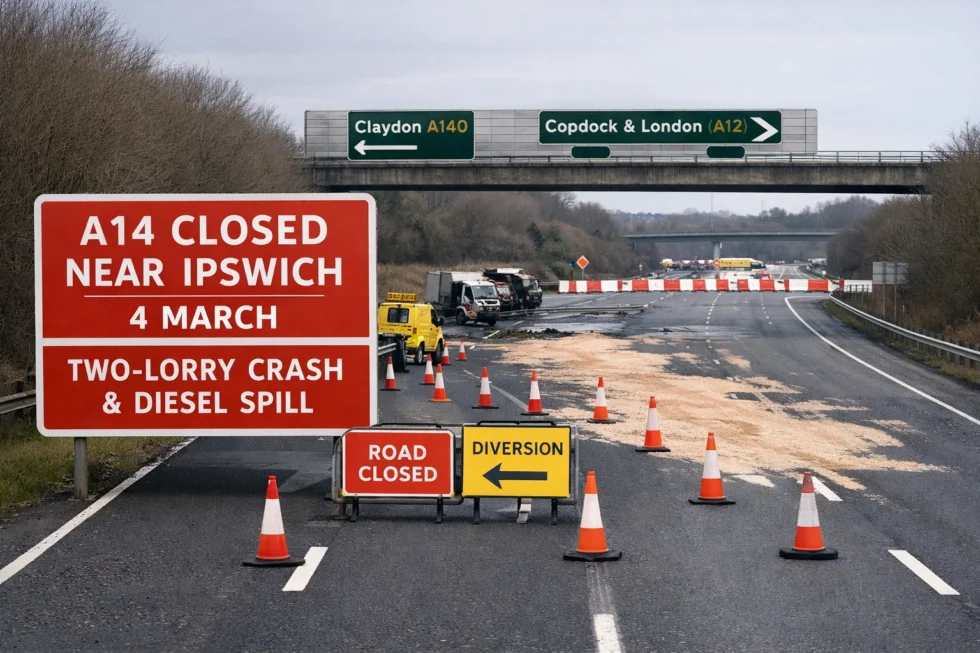
Drivers in Suffolk faced major disruption on Wednesday, 4 March, after a serious overnight collision forced the closure of a section of the A14 near Ipswich. The incident occurred late on Tuesday evening and continued to affect traffic conditions nearly ten hours later, with emergency services and highway teams still dealing with the aftermath.
The crash happened on the A14 between the junctions serving Claydon and Copdock, a key section of one of eastern England’s most important transport routes. Emergency services were called to the scene at approximately 8pm on Tuesday night following reports of a collision involving two heavy goods vehicles. Initial response teams included police, road response units and medical crews. About this reports The WP Times.
crash involved two heavy goods vehicles
According to police, the incident involved two lorries travelling along the A14 corridor west of Ipswich. The road is a major freight route linking the Port of Felixstowe with the Midlands motorway network, meaning it regularly carries large volumes of heavy goods traffic. When collisions occur between large freight vehicles, recovery operations often take considerably longer than standard incidents because of the size and weight of the vehicles involved. Authorities initially closed the A14 in both directions to allow emergency crews safe access to the scene and to assess the scale of the incident.
air ambulance attended the scene
Emergency services responding to the crash included an air ambulance, which was dispatched alongside ground emergency teams. Air ambulances are typically deployed to serious road traffic incidents where there is a potential risk of severe injury or where rapid medical transport may be required. At this stage, however, officials have not confirmed the number or severity of injuries linked to the collision.Police said the extent of any injuries remains unknown.
diesel spill caused major road safety risk
One of the key factors prolonging the road closure was a significant diesel spillage resulting from the crash. Reports indicate that fuel leaked from the vehicles across both lanes of the carriageway. Diesel spills pose a serious hazard to motorists because fuel creates extremely slippery road surfaces, particularly on high-speed roads such as the A14. Specialist highway teams are required to absorb the fuel, remove contaminated materials and ensure the road surface is safe before traffic can return. Because of these procedures, closures after fuel spills can last several hours.
westbound carriageway expected to remain closed
National Highways confirmed that the westbound carriageway of the A14 is expected to remain shut for several hours while clean-up and recovery work continues. Traffic management teams typically carry out several stages during such incidents, including:
- removing damaged vehicles
- clearing debris from the road
- treating the road surface to remove diesel contamination
- inspecting barriers or infrastructure
- reopening lanes gradually once conditions are safe
These procedures are designed to prevent secondary accidents once the road reopens.
importance of the A14 freight corridor
The A14 plays a central role in Britain’s national logistics network. It links the Port of Felixstowe — the UK’s busiest container port — with major motorway routes across the Midlands and beyond. Because of this strategic role, incidents on the A14 can have a wider impact on freight movement and regional traffic flows. Transport analysts often describe the road as one of the most important east-west freight corridors in England, with thousands of lorries using the route daily to transport goods between ports, warehouses and distribution centres.
disruption for drivers around Ipswich
Motorists travelling near Ipswich on Wednesday morning experienced delays as traffic was diverted away from the closed stretch of the A14. Diversions typically route vehicles onto nearby local roads while recovery work continues. However, these roads are not designed to handle large volumes of freight traffic, which can quickly lead to congestion. Drivers travelling between Suffolk and the Midlands were advised to check traffic updates and allow additional travel time. Traffic monitoring services indicated that delays could persist until recovery operations and diesel clean-up are fully completed.
why lorry crashes often cause long closures
Transport specialists note that collisions involving heavy goods vehicles can lead to prolonged road closures. Several factors contribute to this:
- the size and weight of lorries require specialist lifting equipment
- diesel or cargo spills must be safely removed
- road surfaces may need to be cleaned or resurfaced
- accident investigators may need to examine the scene
All of these steps must be completed before a major road such as the A14 can safely reopen to traffic.
As of the morning of Wednesday, 4 March, part of the A14 near Ipswich remains closed while crews continue recovery operations and clear diesel contamination from the carriageway. Drivers are advised to monitor live traffic information and follow official diversion routes until the road is fully reopened. Further updates are expected from police and National Highways as the situation develops.
Read about the life of Westminster and Pimlico district, London and the world. 24/7 news with fresh and useful updates on culture, business, technology and city life: Which erotic exhibitions will define 2026 — from London and Berlin to New York and Scandinavia