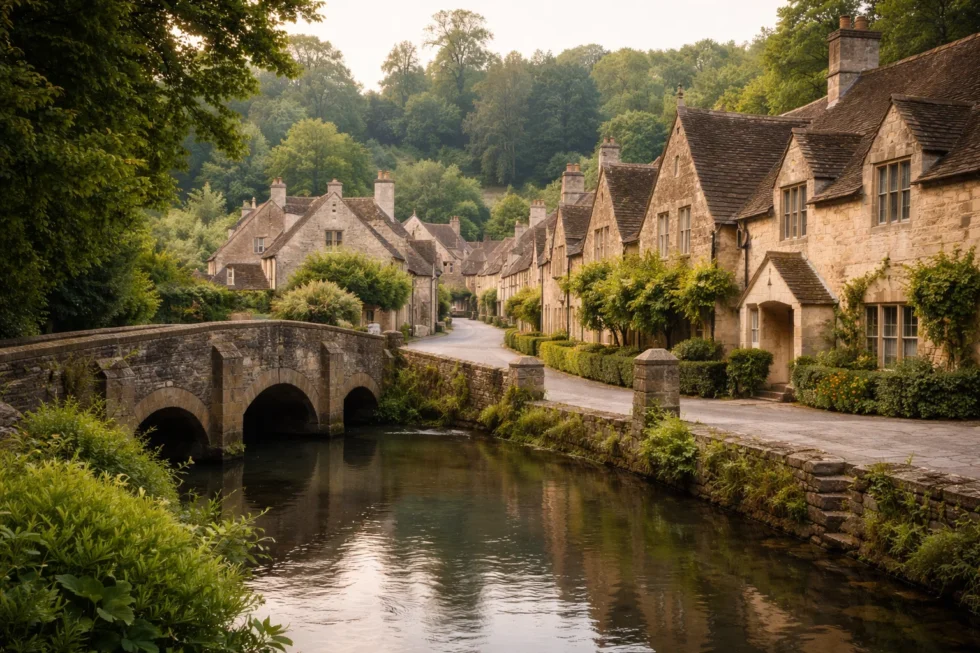
Castle Combe is drawing global attention in April 2026 after being named among the most beautiful small towns in the world, with its уникальное правило — no new houses built since the 17th century — placing it in a rare category of preserved heritage destinations. Located on the southern edge of the Cotswolds in Wiltshire, the village represents a living example of traditional English architecture and planning. As reported by The WP Times, citing international travel rankings including Condé Nast Traveller, Castle Combe was the only UK location included among 53 global destinations. The significance of this recognition lies not only in visual beauty but in long-term conservation discipline. Unlike many rural destinations that expand to meet tourism demand, Castle Combe has remained structurally unchanged for more than four centuries. The absence of new buildings since the 1600s is the result of strict preservation policies designed to protect the village’s historical integrity, architectural coherence and landscape balance.
At the heart of Castle Combe stands the Market Cross, a 14th-century stone structure that once functioned as the centre of the local wool trade. This monument reflects the village’s economic past, when it was part of England’s thriving textile network. Surrounding it are narrow lanes, traditional cottages built from characteristic Cotswold stone and carefully maintained facades that have not been altered by modern materials or design trends.
One of the most recognisable views in the village is found along Water Lane. This narrow street, leading towards the River Bybrook, offers a composition of stone houses, greenery and flowing water that has become iconic in travel photography. The historic stone bridge crossing the river is widely considered the most photographed location in Castle Combe, providing a symmetrical perspective that defines the village’s postcard reputation. Castle Combe’s authenticity has also made it attractive to filmmakers. The village has appeared in major productions including War Horse directed by Steven Spielberg, as well as Stardust and the original Dr Dolittle. Its preserved environment allows filmmakers to recreate historical settings without the need for extensive digital modification, further reinforcing its value as a cultural asset.
For visitors, the most effective way to experience Castle Combe is through a structured walking route. Entering the village early in the morning helps avoid peak tourist flows. A typical route includes arrival near the main parking area, a walk to the Market Cross, continuation through Water Lane and a final stop at the Bybrook bridge. This sequence allows for a complete visual and spatial understanding of the village within a relatively short timeframe.
However, practical considerations are essential. Castle Combe is not designed for high-volume tourism. Parking is limited, accommodation within the village is minimal, and commercial development is tightly controlled. Travellers are advised to stay in nearby towns such as Chippenham or Bath and plan their visit during off-peak hours. This approach not only improves the experience but also supports sustainable tourism practices. Economically, Castle Combe represents a different model of rural success. Instead of relying on expansion, it maintains value through exclusivity and preservation. The controlled environment increases demand while limiting supply, positioning the village as a premium heritage destination. This strategy aligns with broader UK tourism trends, where authenticity and historical depth are increasingly prioritised over mass accessibility.
At the same time, this model creates tension between visibility and protection. As global recognition grows, local authorities must balance tourism revenue with conservation. Visitors play a critical role in this balance by respecting guidelines: avoiding private property intrusion, limiting noise, refraining from drone usage and supporting local businesses such as traditional pubs and small cafés. Castle Combe’s inclusion in global rankings in 2026 reflects more than aesthetic appeal. It highlights a long-term commitment to heritage management, urban restraint and cultural continuity. In a travel landscape often defined by rapid development, the village stands as an exception — a place where time is preserved by design rather than chance.
How to get to Castle Combe from London: routes, timings and parking advice
Castle Combe, in Wiltshire on the edge of the Cotswolds, is one of England’s best-preserved villages, with no new homes built since the 17th century. As reported by Renewz, citing Condé Nast Traveller, it has been named among the most beautiful villages in the world. For visitors travelling from London, access is straightforward but requires accurate navigation and timing due to limited infrastructure.
The correct destination is Castle Combe Car Park, SN14 7HN. Driving directly into the village centre is not advised, as roads are narrow and access is restricted.
Travel options from London
| Option | Route / Steps | Time | Cost (approx.) | Notes |
|---|---|---|---|---|
| Car | M4 → Junction 17 (Chippenham) → B4039 → Castle Combe Car Park | 2–2.5 hours | £50–£80 return | Most practical, limited parking |
| Train + Taxi | London Paddington Station → Chippenham → taxi | 1.5–2 hours | £40–£100 return | Fast but requires coordination |
- There is one main visitor car park only
- Postcode: SN14 7HN
- Cost: typically £5–£10
What to expect
- Before 09:30 — usually easy to park
- 10:30–13:00 — high demand, possible waiting
- After 13:00 — often full, short queues common
Practical tips:
- Arrive early to avoid stress
- Do not park in residential areas
- If full, wait — turnover is relatively quick
- Avoid weekends if possible
Key advice for visitors
- Plan a short visit (1.5–3 hours is sufficient)
- Walk from the car park into the village (5–7 minutes downhill)
- Visit early morning for the best experience
- Expect limited cafés and services
Castle Combe is a controlled heritage environment rather than a typical tourist destination. A well-timed arrival and correct parking strategy make a significant difference to the overall experience.
Read about the life of Westminster and Pimlico district, London and the world. 24/7 news with fresh and useful updates on culture, business, technology and city life: Extreme Easter Storm: Met Office Issues Yellow Warning as 90mph Winds Threaten UK Travel