Crime 101 on Prime Video has quietly become one of the most-watched films in the world — and the surge in search demand now converges on a single question: What is Crime 101 cast and why is the Crime 101 movie trending again on Prime Video in April 2026? As of 4 April 2026, 18:00 BST (London time), Bart Layton’s crime thriller Crime 101 — released in cinemas in February 2026 with an estimated $90 million production budget — has staged an unexpected resurgence, climbing to No.1 across major markets including the United Kingdom and the United States within days of its digital debut. The film’s shift from theatrical underperformance to streaming dominance underscores a wider transformation in viewing habits, where tightly constructed, precision-driven crime stories are no longer defined by box office returns but by their ability to find sustained, algorithm-driven audiences online, reports The WP Times.
Crime 101 cast: structure, roles and character dynamics
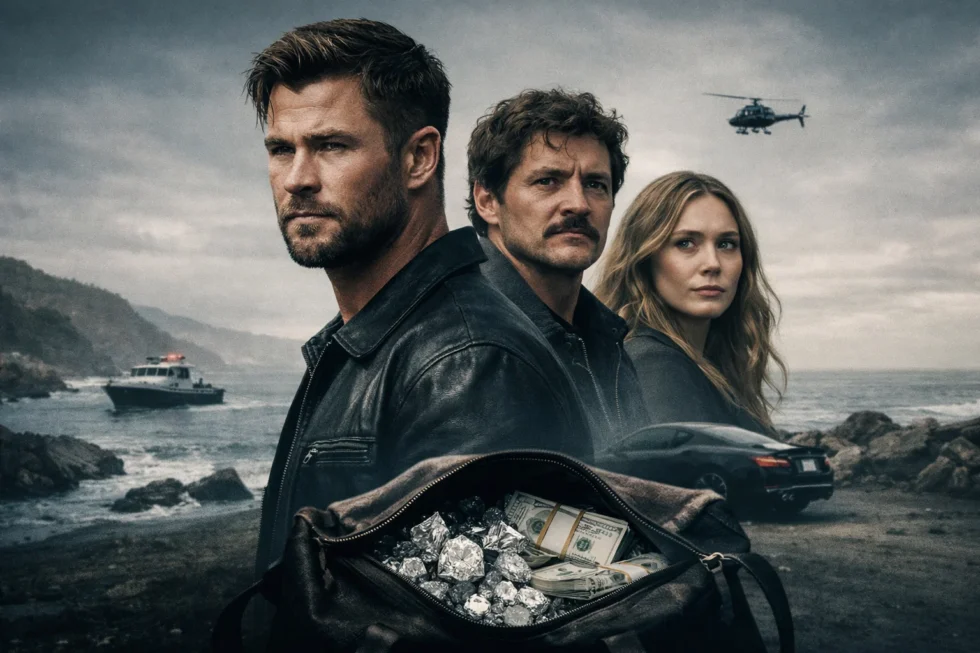
The Crime 101 cast is constructed as a multi-layered system rather than a traditional star vehicle, with each character representing a functional role within the narrative architecture.
- Chris Hemsworth — Mike Davis
A highly disciplined jewel thief operating along California’s Route 101 corridor. His methodology is defined by strict rules: no unnecessary violence, minimal exposure, and repeatable patterns. Davis is not portrayed as impulsive but as an operator managing risk, time and human variables. His arc centres on a final, high-value diamond heist intended to exit the system permanently. - Mark Ruffalo — Detective Lou Lubesnick
A Los Angeles investigator specialising in pattern recognition. Lubesnick identifies a signature across multiple robberies — timing, location and execution — and builds a case not through action but through data and behavioural analysis. His personal storyline introduces fatigue, isolation and professional obsession. - Halle Berry — Sharon
An insurance sector insider whose role becomes critical once the scale of the final heist increases. She provides access to logistical information — security systems, valuation structures and internal vulnerabilities — positioning her as a bridge between legal infrastructure and criminal planning. - Barry Keoghan — Ormon
A destabilising variable. Unlike Davis, Ormon operates without discipline or long-term strategy. His presence introduces volatility into an otherwise controlled environment, shifting the narrative from precision to risk escalation.
This configuration transforms the film into a system of competing logics: control vs investigation vs access vs chaos.
What is the Crime 101 movie about
The Crime 101 movie is built less as a conventional action thriller than as a tightly controlled chain of criminal moves, counter-moves and miscalculations. Rather than hinging on one spectacular robbery, the film develops through a sequence of interlinked operations along Route 101 in Los Angeles, where a string of high-value jewel thefts begins to attract quiet but growing attention. Each robbery carries the same signature: no bodies, almost no usable forensic trace, disciplined timing and a clear preference for portable luxury assets, particularly diamonds. At first, the authorities do not read the crimes as part of a unified campaign. They appear clean, isolated and professionally contained.
That changes once Detective Lou Lubesnick begins to study not only what has been taken, but how the robberies have been executed. He sees a pattern where others see coincidence: geographic concentration along the same corridor, near-identical entry and exit windows, and a level of operational discipline that suggests a single intelligence behind the thefts. This is where Crime 101 separates itself from more conventional heist films. The tension does not initially come from gunfire or pursuit, but from analysis. The investigation becomes an exercise in decoding behaviour, routine and method. The film shifts from a story about stolen diamonds to a story about recognition — about the moment when a criminal system becomes visible.
At the centre of that system is Mike Davis, played by Chris Hemsworth, a thief defined not by chaos but by precision. Davis is not written as an impulsive outlaw; he is an operator, someone who survives by controlling variables, limiting exposure and treating crime like a disciplined profession. His ambition is not endless accumulation but exit. As the net begins to tighten, he starts preparing a final heist — larger, riskier and far more complex than the robberies that came before. The scale rises, the asset value increases, and the operation begins to depend on information from inside legitimate financial and insurance structures, drawing Sharon into the mechanism.
This escalation is where the film deliberately begins to destabilise its own architecture. Lubesnick is getting closer. The police are no longer reacting to isolated incidents but moving towards a connected understanding of the man behind them. At the same time, the involvement of Ormon introduces the one element Mike Davis cannot fully manage: volatility. Until then, the film has been driven by discipline, timing and professional restraint. Ormon changes the chemistry. His presence brings risk, emotional instability and the possibility that even the most carefully built operation can collapse once one part of the system stops obeying its own rules.
That is the core of Crime 101: not spectacle, but erosion. The film generates suspense through coordination, pressure and gradual loss of control. Its most effective passages are built around timing windows, procedural detail, surveillance, trust and misjudgement. In that sense, it belongs to a recognisable line of American crime cinema associated with films such as Heat and Thief, where professionalism itself becomes drama. But Crime 101 is more restrained than many of its predecessors. It is less interested in iconic set-pieces than in the machinery of crime — how it is planned, how it is sustained and how it begins to fail.
Why the theatrical release struggled in February 2026
Despite the strength of the Crime 101 cast, the film found limited momentum during its original cinema run in February 2026. The problem was not a lack of recognisable names, but a mismatch between the film and the current theatrical market. It was sold in part as a throwback heist picture, a polished crime thriller in the mould of older studio dramas, yet that positioning lacked a sharp contemporary hook. In a theatrical environment still dominated by franchise logic, spectacle and brand familiarity, Crime 101 asked audiences to turn up for tone, structure and star-led gravitas rather than event cinema. That is now a much harder proposition.
The film’s pacing also worked against it at the box office. This is a slow-burn thriller that asks viewers to pay attention to method, pattern and character behaviour rather than constant action. In cinemas, where audience expectations increasingly lean towards scale and immediacy, that restraint may have looked like a weakness. The result was a soft start and limited theatrical traction, despite the pedigree of the cast and the evident craft behind the production.
Why Prime Video changed the film’s fortunes in April 2026
The move to Prime Video in April 2026 did more than give Crime 101 a second life; it gave the film the viewing context it arguably needed from the start. On streaming, its strengths became easier to appreciate. Recommendation systems placed it in front of viewers already inclined towards crime thrillers, procedural dramas and star-driven adult cinema. Search demand around “crime 101 cast” and “crime 101 movie” rose as the title surfaced more widely, and within roughly 48 to 72 hours it had become a Top 10 global title, reaching No.1 in several territories.
That shift makes sense. At home, audiences are more patient with layered storytelling. They can pause, rewatch and absorb procedural detail in a way that suits a film like this. The absence of relentless spectacle is less of a liability on streaming than in cinemas. On Prime Video, Crime 101 no longer had to compete as an event; it only had to find the right viewers. Once it did, the film’s disciplined construction, strong performances and old-school crime architecture began to work in its favour.
Where Crime 101 fits in modern cinema
Crime 101 sits within a tradition of American crime filmmaking built on duality: criminal versus investigator, control versus obsession, system versus collapse. Its DNA recalls Heat in the structural opposition between thief and detective, and Thief in its fascination with professionalism, isolation and criminal code. Yet the film is also distinctly contemporary in what it reveals about the market around it. It is not designed as a franchise starter, nor as an awards-season prestige piece, nor as an action-heavy theatrical machine. It is a mid-budget adult thriller released into an industry that no longer reliably knows what to do with such films on the big screen.
That is why Crime 101 matters beyond its plot. It demonstrates that theatrical performance is no longer the only serious measure of value. Streaming now shapes visibility, discussion and cultural afterlife. Audience engagement is increasingly behaviour-driven rather than marketing-driven. Viewers discover, sample and elevate titles according to mood, platform surfacing and genre appetite, not simply opening-weekend noise.
Final perspective
The Crime 101 cast delivered exactly the kind of controlled, intelligent crime drama that Hollywood once released far more regularly. The Crime 101 movie did not initially connect with the theatrical marketplace, but its later success on Prime Video suggests that the failure was at least partly contextual rather than creative. In 2026, that distinction matters. A film like Crime 101 no longer lives or dies solely on cinema receipts. It survives by finding its natural audience — and in this case, it did.
Read about the life of Westminster and Pimlico district, London and the world. 24/7 news with fresh and useful updates on culture, business, technology and city life: Coronation Street Sunday shift April 2026: timeline, content impact and audience reaction across ITV