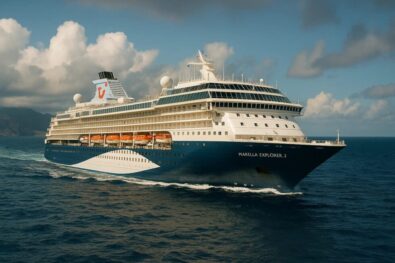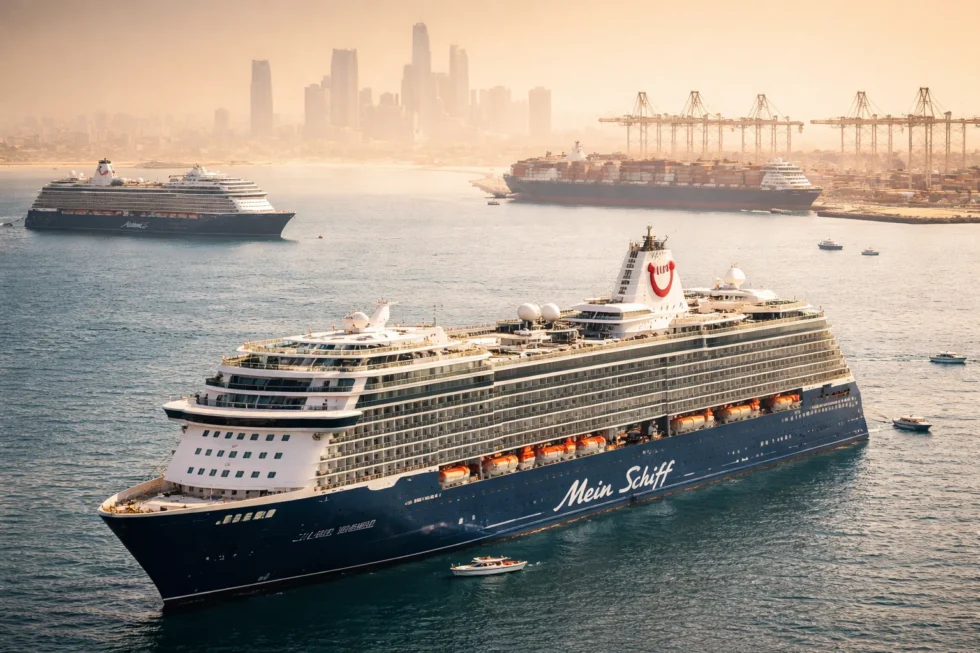
TUI Cruises has moved into a reduced-operations mode after two of its cruise ships became effectively stranded in the Middle East, with staffing levels cut to a fraction of normal capacity as the company navigates ongoing regional disruption and delayed redeployment into Europe’s summer season. The vessels — Mein Schiff 4 in Abu Dhabi and Mein Schiff 5 in Doha — have been out of active service since late February 2026 and are now operating with skeleton crews focused solely on safety, engineering and technical continuity, reports The WP Times.
At the centre of the situation is TUI Cruises, which has been forced to pause its standard seasonal transition from winter routes to Mediterranean deployments. According to industry reporting, Mein Schiff 4 currently has just 59 crew members onboard, compared with a usual complement of around 900 — a reduction that underscores the scale of the operational downgrade. The remaining personnel are limited to core functions: bridge operations, engine room management, safety systems and essential maintenance. A crew member familiar with the situation described the setup as “a technical standby rather than a guest operation”, noting that “everything not directly tied to keeping the ship operational has been suspended”. Another source in cruise operations added that such configurations are “designed to keep vessels deployable within days, not weeks, once clearance is given”.
The ships remain under full command structures, with nautical leadership intact — including Captain Jan Fortun onboard Mein Schiff 4 — ensuring compliance with maritime regulations despite the absence of passengers and hotel staff. This aligns with a standard “warm lay-up” strategy widely used across the cruise sector during periods of uncertainty.
Parallel conditions are believed to apply to Mein Schiff 5, currently docked in Doha, where similar reductions have been implemented following its withdrawal from service in late February. Both vessels were originally scheduled to reposition to Europe but were unable to proceed due to instability affecting key transit routes in the wider region. The disruption is not isolated. Other operators have also paused vessels across Gulf ports, including Celestyal Cruises and MSC Cruises, with multiple ships laid up in Doha and Dubai since the escalation of regional tensions. This clustering of inactive vessels reflects a broader industry response rather than a company-specific issue.
Operationally, three drivers define the current strategy:
- maintaining safety compliance with minimal crew
- reducing cost exposure during inactive periods
- preserving rapid restart capability ahead of summer schedules
Despite the constraints, both TUI ships remain scheduled to resume service on 1 May 2026. Mein Schiff 4 is expected to restart from Palma de Mallorca, while Mein Schiff 5 is planned to relaunch from Greece, signalling a coordinated return to the European cruise market. From a structural standpoint, cruise operations depend on fixed seasonal deployment cycles, pre-approved port access and uninterrupted transit corridors between regions. When vessels are unable to reposition as scheduled, operators must pause itineraries and adjust fleet allocation in real time.
In this case, both ships remain in a controlled “warm lay-up” condition: propulsion, navigation and safety systems are active; technical and nautical crews are onboard; hotel operations are suspended. This allows operators to reduce costs while preserving full readiness. Once routing conditions stabilise, the ships can depart without requiring reactivation procedures, enabling a faster return to scheduled service.
Read about the life of Westminster and Pimlico district, London and the world. 24/7 news with fresh and useful updates on culture, business, technology and city life: LEGO Unveils 2026 Easter Collection: High-Performance Ferrari Models and Pixar Icons Under £20