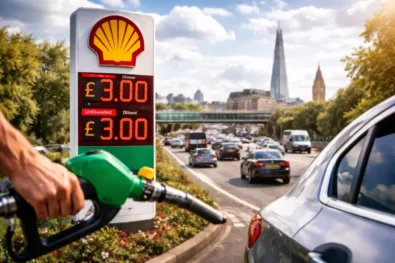
The fuel and broader oil prices today dynamic shifted decisively on 8 April 2026, as a ceasefire linked to the US-Iran conflict triggered a coordinated repricing across the stock market today, pushing the crude oil price lower, lifting equities and driving the strongest municipal bond rally in a year, as investors rapidly reassessed inflation risk, interest rate expectations and global supply stability — reported by The WP Times, citing Bloomberg and BBC.
The immediate market response centred on energy. The brent crude price and wider crude oil prices dropped as traders unwound the geopolitical risk premium built during weeks of disruption in the Gulf. The price of oil moved lower not because supply had fully recovered, but because the probability of a prolonged blockade through the Strait of Hormuz — a key global chokepoint — was suddenly reduced.
“Markets are pricing out the extreme risk scenario rather than pricing in full recovery,” analysts said, underlining that oil prices today remain above pre-conflict baselines. In other words, the fall in the brent oil price reflects expectation shifts, not a completed normalisation of supply. That shift fed directly into bond markets. US municipal bonds rallied sharply, with benchmark yields falling by roughly 9 basis points to around 2.9%, marking the biggest move in a year. The scale of this rally is critical: it signals that investors now expect easing pressure on inflation, which in turn affects the trajectory of interest rate decisions. Lower oil prices reduce cost pressure across transport, manufacturing and food systems. As a result, bond markets moved first, locking in yields before any formal policy change from central banks.
The repricing was visible across all major asset classes
| Indicator | Direction | What changed | Market meaning |
|---|---|---|---|
| Brent crude price | ↓ | Sharp drop after ceasefire | Risk premium reduced |
| Crude oil price | ↓ | Below recent highs | Inflation pressure easing |
| Muni bond yields | ↓ to ~2.9% | Biggest fall in a year | Strong demand for safety |
| Dow Jones | ↑ | Industrial stocks supported | Lower energy costs |
| Nasdaq | ↑ | Yield-driven rally | Rate expectations easing |
| Fuel prices | ↔ / slow ↓ | Still elevated | Lag vs oil markets |
Equities followed. The Dow Jones advanced as lower energy costs improved outlooks for industrial companies, while the Nasdaq benefited from falling yields that support higher valuations in growth sectors. In Europe, FTSE futures and FTSE 100 futures pointed higher, confirming that the move was global rather than localised.
Across the broader stock market, the pattern was consistent: sectors most exposed to energy costs — airlines, logistics, manufacturing — saw the strongest sentiment shift. Lower crude oil prices directly translate into improved margins for these industries, even if only on expectation. However, the real economy tells a slower story. Despite the drop in oil price today, fuel prices for consumers are unlikely to fall immediately. Supply chains remain disrupted, infrastructure in the Gulf has sustained damage, and shipping flows are only gradually resuming.
“There is still huge uncertainty for drivers,” said RAC policy head Simon Williams. “A sustained lower price over several weeks is needed before wholesale costs come down.” This highlights the structural lag between financial markets and real-world pricing. The aviation sector illustrates this gap clearly. Jet fuel remains significantly above pre-conflict levels, and airlines continue to adjust routes and fares accordingly. Willie Walsh of the International Air Transport Association noted that even if flows resume, “it will take months” for supply chains to stabilise fully.
The impact extends beyond fuel. A large share of global fertiliser shipments also passes through the same region, and disruptions have already increased agricultural costs. This feeds into food inflation, which is expected to remain elevated despite falling oil benchmarks.
“It will take weeks, not days, for logistics and refining systems to return to normal,” said Alan Gelder of Wood Mackenzie. His assessment reflects a broader consensus: while markets react instantly, physical systems recover slowly. Data tracked via platforms such as Yahoo Finance shows the alignment clearly — falling oil prices today, rising equities and declining yields — but this alignment is based on expectations rather than completed recovery.
The key variable now is stability. If the ceasefire holds and energy flows normalise, the current trend — lower fuel risk, softer inflation expectations and stronger bond demand — could extend. If disruptions return, the crude oil price and wider stock market today could reverse just as quickly. For now, markets are pricing in relief. But the underlying system — from production to shipping to refining — remains in transition, meaning the trajectory of fuel prices, interest rate expectations and global markets is still highly sensitive to developments in the weeks ahead.
Read about the life of Westminster and Pimlico district, London and the world. 24/7 news with fresh and useful updates on culture, business, technology and city life: What is happening in the british gas energy bill update as 4.7 million homes in England face severe energy hardship in 2026