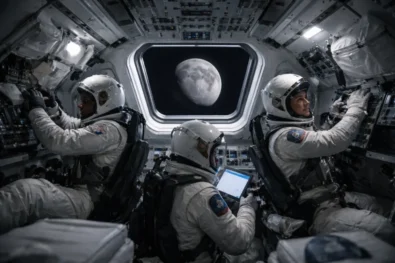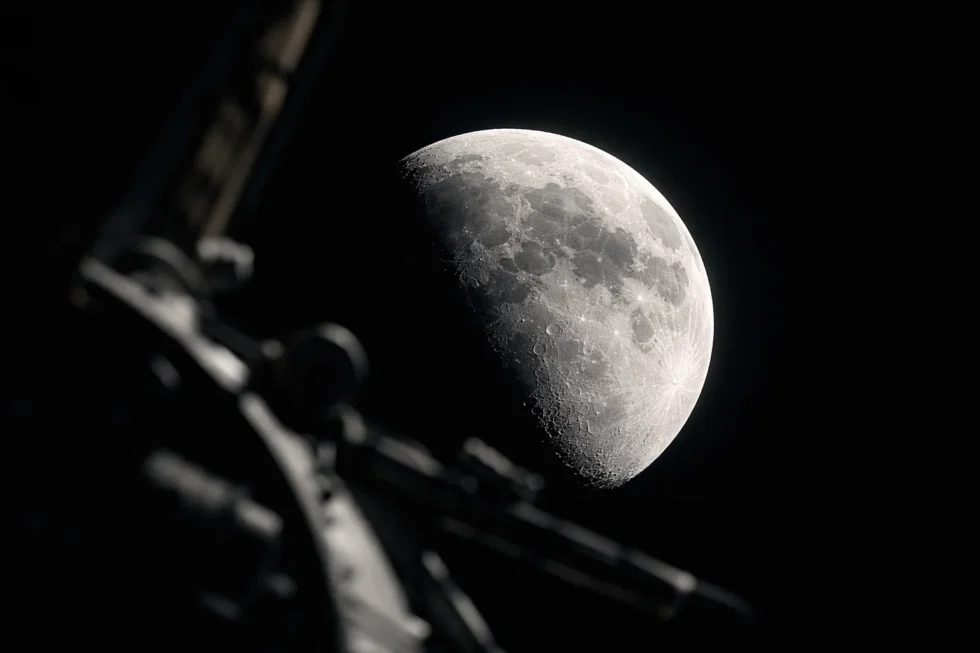
The latest nasa artemis ii updates show that astronauts aboard NASA’s Artemis II mission have witnessed one of the most extraordinary visual phenomena ever recorded in human spaceflight — a solar eclipse seen from deep space during a high-speed Moon fly-by, alongside a series of high-resolution artemis 2 pictures capturing Earth, the Moon and distant planets in a single frame, a moment that confirms both the scientific breakthrough and operational stakes of the mission, reported by The WP Times, citing BBC, The Telegraph and live broadcast feeds including sky news live.
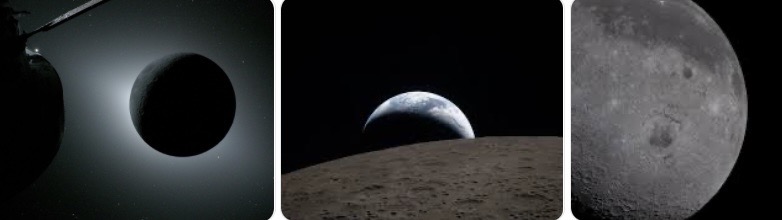
The images released by NASA show the Moon backlit by the Sun, with a thin crescent edge illuminated while the rest of the surface remains in shadow. A faint glow — known as Earthshine — reveals subtle details of the lunar terrain. In the same frame, bright points identified as Mars and Saturn are visible, while parts of the Orion spacecraft solar array structure appear in the foreground (NASA image release, 6 April 2026). This configuration is only possible due to the spacecraft’s unique position beyond low Earth orbit, allowing astronauts to observe celestial alignment from a perspective unavailable on Earth.
“What Artemis II astronauts saw in Moon fly-by is something no human has ever experienced in quite this way,” NASA officials said in a mission briefing, noting that the eclipse occurred as Orion moved behind the Moon relative to the Sun (NASA mission commentary, April 2026). The agency confirmed that the phenomenon was captured using cameras mounted on the spacecraft’s solar array wings, designed to monitor both structural integrity and environmental conditions.
The mission itself marks the first crewed journey beyond low Earth orbit since the Apollo era. Artemis II astronauts have travelled more than 250,000 miles from Earth, placing them farther than any humans have been in over five decades (The Telegraph, 8 April 2026). The flight path includes a high-speed lunar fly-by intended to test navigation systems, life-support infrastructure and communication capabilities under deep space conditions.
According to nasa artemis ii updates, the images collected during this phase are not only symbolic but operational. Engineers are analysing how light behaves across the spacecraft’s sensors, how imaging systems respond to extreme contrast between sunlight and shadow, and how navigation algorithms interpret real celestial positioning (NASA technical briefing, April 2026). These datasets will directly influence the design and execution of future missions, including Artemis III, which aims to land astronauts on the Moon.
The release of artemis 2 pictures has also triggered intense public and media interest. Broadcasters including sky news live have carried continuous updates, focusing on both the visual impact of the images and the broader implications of the mission. Analysts note that the ability to capture such imagery in real time reflects a shift from experimental exploration to operational deep-space capability. Despite these achievements, mission specialists emphasise that the most dangerous phase is still ahead. The Orion capsule must re-enter Earth’s atmosphere at extremely high velocity, facing temperatures of approximately 2,760°C — conditions that place unprecedented stress on its heat shield (The Telegraph, Sarah Knapton, 8 April 2026). “The most dangerous part of their journey is yet to come,” Knapton wrote, highlighting concerns that the heat shield has not yet been fully validated under real deep-space return conditions.
NASA engineers have acknowledged this risk. The re-entry sequence will test multiple systems simultaneously, including thermal protection, aerodynamic stability and communication resilience during blackout periods caused by plasma formation around the capsule (NASA engineering briefing, April 2026). Any failure in these systems could have catastrophic consequences, making Artemis II a critical validation mission rather than a routine flight. At the same time, the mission carries broader strategic significance. Artemis II is not only a technical exercise but a geopolitical signal. By advancing crewed lunar missions, the United States is reinforcing its leadership in space exploration while laying the groundwork for sustained human presence beyond Earth orbit. International partners and commercial contractors are closely watching the mission, as its success will shape investment, collaboration and future mission architecture.
The astronauts themselves have remained central to the story. Inside the Orion spacecraft, they are operating in conditions far removed from Earth, relying on advanced automation but still performing critical manual tasks. The psychological and physiological demands of deep space travel are being closely monitored, providing data that will inform longer missions, including potential journeys to Mars. Public fascination with the mission has been driven in part by the imagery itself. The combination of scientific precision and visual impact has made the Artemis II mission one of the most widely followed space events in recent years. Searches for nasa artemis ii updates, artemis 2 pictures and “What Artemis II astronauts saw in Moon fly-by” have surged as audiences seek to understand both the experience and its implications.
What emerges from these updates is a mission defined by contrast. On one hand, it delivers some of the most breathtaking images ever captured in space. On the other, it confronts engineers and astronauts with one of the most dangerous re-entry scenarios ever attempted. The success of Artemis II will depend not on what has already been seen, but on whether the spacecraft and its crew can safely complete the journey back to Earth.
Read about the life of Westminster and Pimlico district, London and the world. 24/7 news with fresh and useful updates on culture, business, technology and city life: Artemis II Surpasses Apollo 13 Record: Humanity Reaches a New Deep Space Milestone in 2026