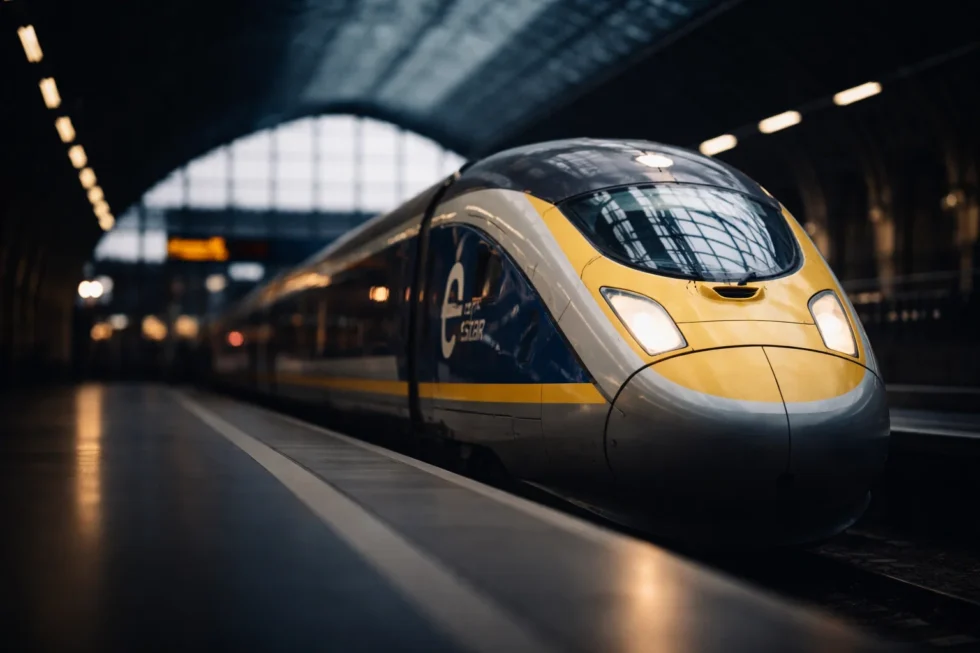
The latest Eurostar sale is not merely a seasonal promotion but a decisive pricing reset in Europe’s short-haul travel market, introducing one-way fares from £35 between London and key continental hubs including Paris, Amsterdam and Brussels, at a time when airlines remain under sustained pressure from rising costs, emissions scrutiny and airport congestion. The five-day flash sale, launched on 8 April 2026 and running until 13 April at 22:59, opens a clearly defined travel window from late April through early July, directly targeting spring and early summer city-break demand — reported by The WP Times, citing Evening Standard, Glamour UK and industry travel data.
What makes this sale structurally important is not just the headline price, but the broader shift it reflects: rail is increasingly competing directly with low-cost airlines on price, convenience and sustainability, while passenger behaviour across Europe shows a measurable pivot towards train travel. According to travel operator insights cited alongside the sale, rail bookings have risen by around 25% year-on-year in 2026, with a sharp acceleration in the last quarter, suggesting that the Eurostar pricing move is designed not only to fill seats, but to capture long-term market share.
What exactly is included in the Eurostar £35 sale
At the centre of the promotion is a simple but highly controlled pricing model. The £35 fare applies to one-way journeys on direct Eurostar routes from London’s St Pancras International to five core destinations:
- Paris (Gare du Nord)
- Brussels (Midi/Zuid)
- Amsterdam (Centraal)
- Rotterdam (Centraal)
- Lille (Europe)
These routes represent the backbone of the Eurostar network and are among the highest-demand corridors in European rail travel. However, there is a crucial limitation that many travellers overlook: the lowest promotional fare is only available on direct routes. Cities such as Cologne or Düsseldorf — although reachable via connections — are not included in the £35 pricing tier, meaning passengers must either pay more or combine tickets. In practical terms, this means the sale is highly optimised for classic city breaks rather than complex itineraries.
Travel window and why timing matters
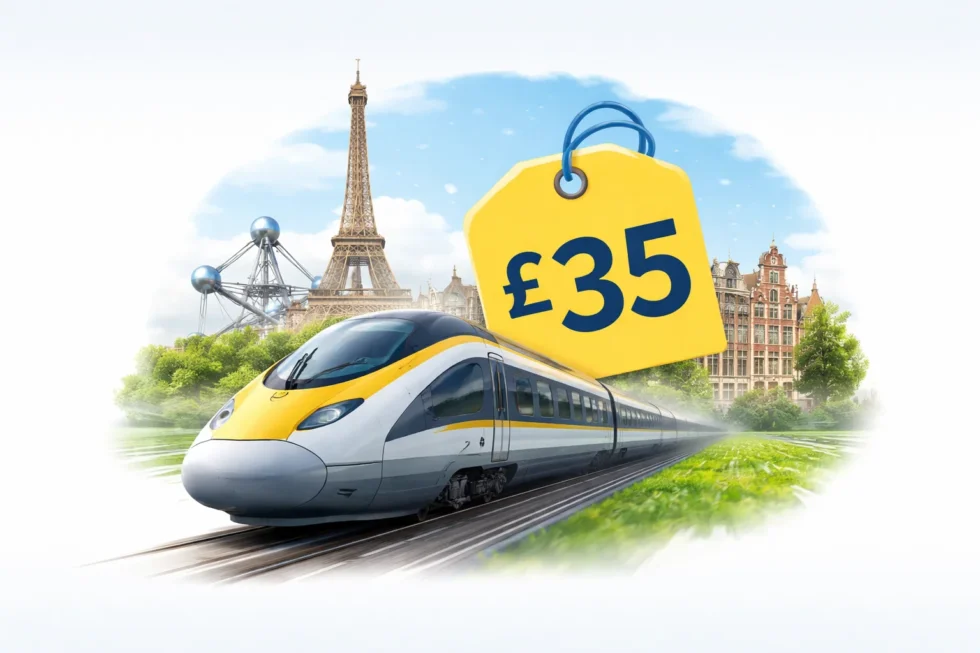
The discounted tickets are valid for travel between 22 April and 8 July 2026 — a period that captures:
- late spring leisure travel
- early summer tourism
- shoulder-season pricing before peak holiday inflation
This timing is not accidental. It allows Eurostar to smooth demand outside peak holiday spikes while still capturing high-value travellers planning ahead. However, the system includes strict “blackout dates” — specific days when the promotional fares do not apply. These are concentrated around:
- UK bank holidays
- long weekends
- high-demand travel days in May and June
This reflects a classic yield management strategy: low prices to fill quiet trains, full pricing where demand is guaranteed.
Full blackout structure and operational logic
The blackout dates vary by route but follow a clear pattern: outbound and return flows are managed separately to avoid capacity imbalances. For example:
- London → Paris blackout dates include 1–3 May, 10 May, 16–17 May, 22–25 May and 21 June
- Paris → London includes 1 May, 4 May, 8 May, mid-May peaks and end-of-May weekend surges
- Similar patterns apply across Brussels and Amsterdam routes
From an operational perspective, this ensures:
- trains remain evenly loaded in both directions
- pricing integrity is maintained on peak demand days
- revenue is protected without removing promotional visibility
For travellers, the implication is simple but critical: flexibility determines whether you pay £35 or £120+.
How much can you actually save
A standard Eurostar ticket between London and Amsterdam or Paris often ranges from £70 to £190 one-way depending on demand and booking timing. At £35, the discount can reach:
- 50% off typical mid-range fares
- up to 70–80% off peak pricing
A return journey, if both legs qualify, can cost as little as £70 — a level that brings rail travel into direct competition with budget airlines. But there is a key nuance: availability is limited. The cheapest tickets are released in controlled batches, meaning early booking is essential.
Why this sale matters beyond price
The current pricing move by Eurostar should be read not as a short-term promotion, but as a strategic signal of how competition in European travel is being redefined. The £35 fare is the visible headline; the underlying story is structural.
1. Rail is now a direct competitor to short-haul aviation
For years, rail positioned itself as a slower but more comfortable alternative to flying. That distinction is eroding. On core corridors such as London–Paris or London–Brussels, rail is increasingly competitive not only on experience but on total journey time when airport transfers, security queues and delays are factored in.
At the same time, aviation faces tightening pressure:
- environmental regulation and carbon scrutiny
- constrained airport capacity in major hubs
- rising fuel and operational costs
Rail, by contrast, offers a more stable cost base and operational predictability. The result is a convergence point where price becomes the final barrier — and promotions at £35 are designed to remove it.
2. Traveller priorities have shifted — measurably
Post-pandemic travel patterns show a recalibration in what passengers value. The decision is no longer driven purely by speed or headline ticket price, but by a combination of control, comfort and reliability. Passengers are increasingly choosing:
- door-to-door simplicity over nominally faster flights
- predictability over exposure to delays and cancellations
- reduced friction — fewer queues, fewer checkpoints, fewer unknowns
Rail aligns with these preferences in a way aviation structurally cannot. The sale, therefore, is not creating demand — it is capturing demand that has already shifted.
3. “Slow travel” is becoming a premium, not a compromise
What was once framed as a trade-off — longer journeys by train — is now being repositioned as a value proposition. The idea of travel as part of the experience is gaining traction across European markets. Operators and travel companies report growing interest in:
- scenic, uninterrupted routes
- the ability to work or relax in transit
- lower-stress alternatives to airport travel
In this context, Eurostar is not simply selling transport; it is selling a different model of mobility — one that blends efficiency with experience.
Eurostar Snap: the hidden pricing layer
Alongside the headline sale, Eurostar is quietly expanding the role of its “Snap” product — a secondary pricing mechanism designed to monetise unsold capacity with minimal visibility impact on standard fares. The mechanics are straightforward but deliberately asymmetric:
- passengers select a date and broad time window
- the exact departure is allocated up to 48 hours before travel
- discounts can reach up to 50% below standard pricing
This is classic yield management adapted for rail — comparable to airline standby or opaque booking systems. However, the constraints are central to the model:
- tickets are non-refundable and non-changeable
- departure times are not user-controlled
- availability is linked to real-time load factors
In effect, Snap segments the market. It targets highly flexible travellers — those willing to trade certainty for price — while preserving pricing integrity for standard bookings. Strategically, this creates a two-tier system:
- visible promotions (like the £35 sale) to drive volume and attention
- opaque discounts (Snap) to optimise residual capacity
Together, they allow Eurostar to compete aggressively on price without structurally lowering its baseline fares — a balance that is critical in a market where demand volatility remains high.
What appears to be aggressive discounting is, in reality, a tightly controlled yield strategy by Eurostar. The £35 fare is not a typical price point but a limited entry tier, released in small allocations to stimulate demand on specific departures rather than across the network. Fares typically rise in stages as availability tightens — often moving into higher ranges such as £55, £75 or £100 and above — meaning early bookers are more likely to secure the lowest prices, while less flexible travellers face progressively higher costs. The model closely resembles airline pricing, although rail demand tends to be more predictable, allowing tighter control over inventory and fewer last-minute price distortions.
The speed at which the lowest fares disappear is shaped by structural capacity limits. Eurostar operates on fixed infrastructure, including the Channel Tunnel, and each train has a finite number of seats on routes that frequently run close to full, particularly between London, Paris, Brussels and Amsterdam. As a result, the cheapest tickets are strictly limited, blackout dates are applied around peak travel periods, and passengers with flexible schedules are more likely to access lower fares. In effect, the promotion is less about offering unlimited cheap travel and more about filling quieter services without weakening pricing on high-demand trains.
For travellers, the difference between £35 and significantly higher fares is largely determined by timing and flexibility. The lowest-priced tickets are often taken within the first 24 to 48 hours of release, although availability varies by route and date. Midweek departures tend to offer better chances of securing lower fares, while peak travel days are priced higher from the outset. Checking multiple departure times and booking early via Eurostar platforms remains the most effective approach. Against a backdrop of rising airline costs, airport congestion and increasing competition across European transport, the £35 fare functions both as a demand driver and a competitive signal — but its value is realised primarily by those able to act quickly and travel flexibly.
Read about the life of Westminster and Pimlico district, London and the world. 24/7 news with fresh and useful updates on culture, business, technology and city life: Artemis II Surpasses Apollo 13 Record: Humanity Reaches a New Deep Space Milestone in 2026