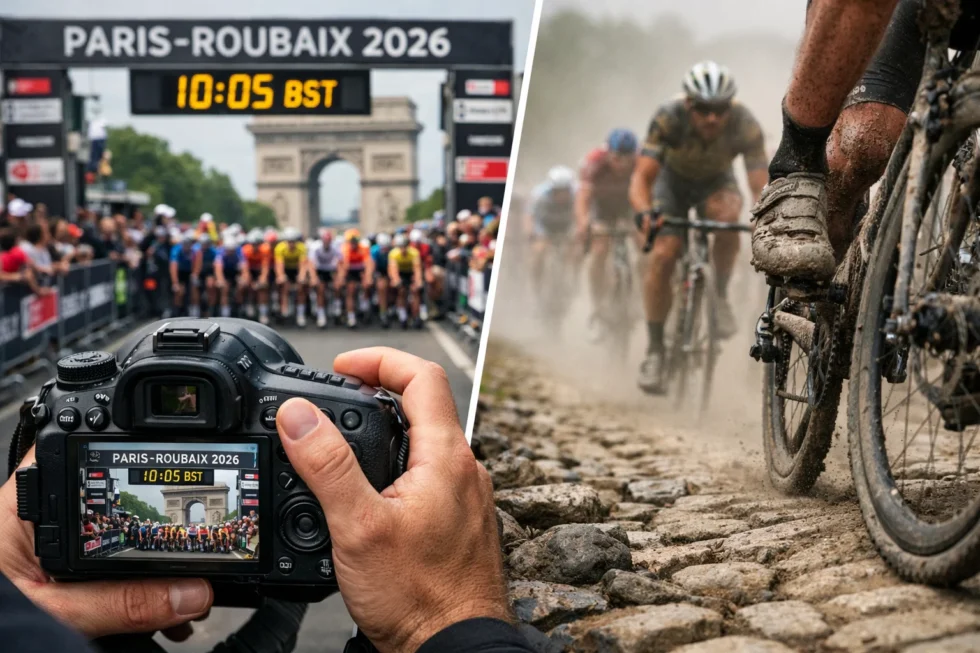
Paris-Roubaix 2026 start time is set for Sunday, April 12, with the men’s race officially beginning at 10:05 BST in Compiègne and expected to finish around 15:50 BST in Roubaix, as the 123rd edition of cycling’s most brutal one-day Monument unfolds across 258.3km and 30 cobbled sectors in northern France, including Arenberg, Mons-en-Pévèle and Carrefour de l’Arbre — the decisive stretches that define the race outcome, reported by The WP Times.
The women’s race follows later in the day, starting at 13:45 BST and finishing approximately 17:20 BST, creating a full-day broadcast schedule for UK audiences, with coverage beginning earlier at 09:30 BST on television platforms as global interest centres on a potential historic clash between Tadej Pogačar and Mathieu van der Poel, alongside a landmark opportunity in the women’s race for a repeat winner in Roubaix.
Paris-Roubaix 2026 start time and full race schedule (UK)
The structure of race day reflects both tradition and broadcast strategy, with staggered starts ensuring continuous coverage from morning through late afternoon. The men’s race remains the headline event, but the women’s race has rapidly gained parity in attention and competitive significance.
Key timings (BST)
| Event | Start Time | Expected Finish | Location |
|---|---|---|---|
| Men’s race | 10:05 BST | ~15:50 BST | Compiègne → Roubaix |
| Women’s race | 13:45 BST | ~17:20 BST | Denain → Roubaix |
| UK TV coverage begins | 09:30 BST | — | TNT Sports / HBO Max |
The early broadcast window reflects the neutral start phase, where riders roll out before racing officially begins. By the time the peloton hits the first cobbled sectors, race dynamics are already forming, with positioning critical ahead of the narrow pavé roads.
The schedule also ensures overlap between the men’s finale and the women’s build-up, maximising audience retention across both races — a key shift in how cycling is packaged for global television.
Route, distance and why timing matters in Paris-Roubaix
Paris-Roubaix is not simply defined by distance, but by terrain and race timing. The 258.3km route includes 30 cobbled sectors, many of which arrive deep into the race when fatigue peaks and mechanical risks increase. The opening phase after the 10:05 BST start is typically controlled, but within the first 100km, the peloton begins to fracture as speed increases and positioning battles intensify. Timing becomes critical because:
- Early sectors (within first 2 hours) create initial splits
- Mid-race sectors determine breakaway survival
- Final sectors (last 50km) decide the winner
Unlike stage races, there is no recovery. Riders must manage effort precisely across nearly six hours of racing.
Core race features
- Total distance: 258.3 km
- Cobbled sectors: 30
- Key sectors: Arenberg Forest, Mons-en-Pévèle, Carrefour de l’Arbre
- Finish: Roubaix Velodrome
The expected finish window around 15:50 BST is based on average race speeds of 43–46 km/h, but weather conditions — especially wind or rain — can significantly shift timing.
How to watch Paris-Roubaix 2026 live in the UK and globally
Broadcast timing aligns closely with the race schedule, with UK viewers able to follow the full race from pre-start build-up through to the velodrome finish.
UK and international broadcast options
- UK: TNT Sports, HBO Max
- USA: NBC Sports, Peacock
- Canada: Flobikes
- Free streams (geo-restricted):
- France TV (France)
- NOS (Netherlands)
- VRT / RTBF (Belgium)
- SBS On Demand (Australia)
The UK broadcast begins at 09:30 BST, providing analysis, rider interviews and tactical previews before the 10:05 BST start. Streaming access has become increasingly central, with VPN usage allowing viewers to bypass regional restrictions — particularly relevant for free European broadcasts.
“Hell of the North”: what riders and analysts say about race timing
(“Paris-Roubaix is not won in the final kilometre — it’s decided hours earlier when positioning, timing and survival come together on the cobbles,” — race analyst commentary, European cycling broadcast) The importance of start time extends beyond logistics. Riders must align nutrition, pacing and equipment strategy precisely to the race clock. A poorly timed effort — even early — can eliminate contenders long before the decisive sectors. For favourites like Pogačar and Van der Poel, timing also relates to attack strategy:
- Early attack risks exhaustion
- Late attack risks being blocked or outnumbered
- Mechanical timing (punctures) often decisive
The race’s unpredictability is why consecutive wins — such as Van der Poel’s current streak — are historically rare.
Why Paris-Roubaix 2026 could be historic
The 2026 edition is shaped by two parallel narratives tied directly to race timing and execution:
- Mathieu van der Poel aiming for a fourth consecutive win — a historic milestone
- Tadej Pogačar attempting to complete his Monument collection
In the women’s race, Lotte Kopecky and Pauline Ferrand-Prévot are positioned to potentially become the first repeat winners, adding further historical weight to the schedule. Timing, again, is central: both races are structured to maximise peak performance windows, with finishes timed for optimal broadcast and sporting drama.
What happens next on race day
As the race progresses beyond the 10:05 BST start, the timeline typically unfolds as follows:
- 10:05–12:00 — Controlled racing, breakaway formation
- 12:00–14:30 — Key cobbled sectors, major splits
- 14:30–15:50 — Final attacks and decisive moves
- ~15:50 — Velodrome finish in Roubaix
The final lap inside the Roubaix velodrome remains one of cycling’s most iconic finishes, often decided between a small group or solo rider after hours of attrition.
Read about the life of Westminster and Pimlico district, London and the world. 24/7 news with fresh and useful updates on culture, business, technology and city life: Horoscope today 13 April 2026 London: women’s money, health and control under Scorpio last quarter Moon