
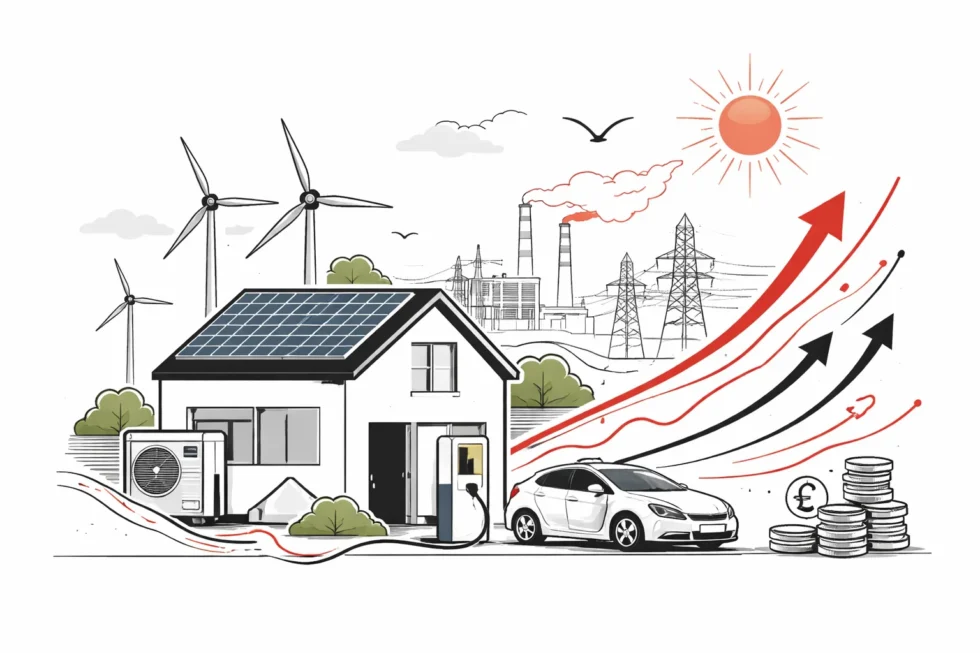
Energy demand for green upgrades across Great Britain has accelerated sharply since late February 2026, as households respond to rising global fuel costs triggered by the Iran war and resulting disruption to oil and gas flows. Data from energy suppliers and analysts indicates a rapid increase in installations of solar panels, heat pumps and electric vehicles, with households attempting to offset an expected 18% rise in energy bills from July 2026 under the next price cap adjustment. The shift is being driven not by policy alone but by immediate cost pressure, as wholesale gas prices surged and filtered into electricity markets. The WP Times reports.
The price shock follows the escalation of conflict on 28 February 2026, when strikes involving the United States, Israel and Iran disrupted energy supply chains, including flows through the Strait of Hormuz — a route responsible for roughly a fifth of global LNG and oil transit. Although a temporary ceasefire announced on 7 April 2026 eased markets, analysts warn that volatility remains embedded in pricing structures, leaving UK households exposed despite limited direct dependence on Middle Eastern supply. As a result, domestic energy behaviour is shifting structurally toward self-generation and electrification.
Energy demand surge UK: how many homes are switching and why costs are driving behaviour
The increase in demand for green energy technologies reflects a direct consumer response to pricing risk rather than long-term environmental planning. Suppliers report a notable spike in enquiries and installations of rooftop solar systems, alongside increased orders for heat pumps and electric vehicles since early March.
At the same time, wholesale dynamics show why this shift is accelerating. The cost of gas-fired electricity generation in Britain rose by 42% within four weeks, increasing from £77.75/MWh to £110.42/MWh, with peak wholesale electricity prices reaching £137.21/MWh on 20 March 2026. These increases translate into higher retail tariffs with a lag, creating a predictable incentive for households to reduce grid dependence. Key drivers behind the shift:
- Expected 18% increase in household energy bills from July 2026
- Volatility in global oil and LNG markets following Middle East conflict
- Increased awareness of energy independence at household level
- Availability of domestic technologies (solar, EVs, heat pumps)
- Policy continuity from previous energy crises (2021–2023)
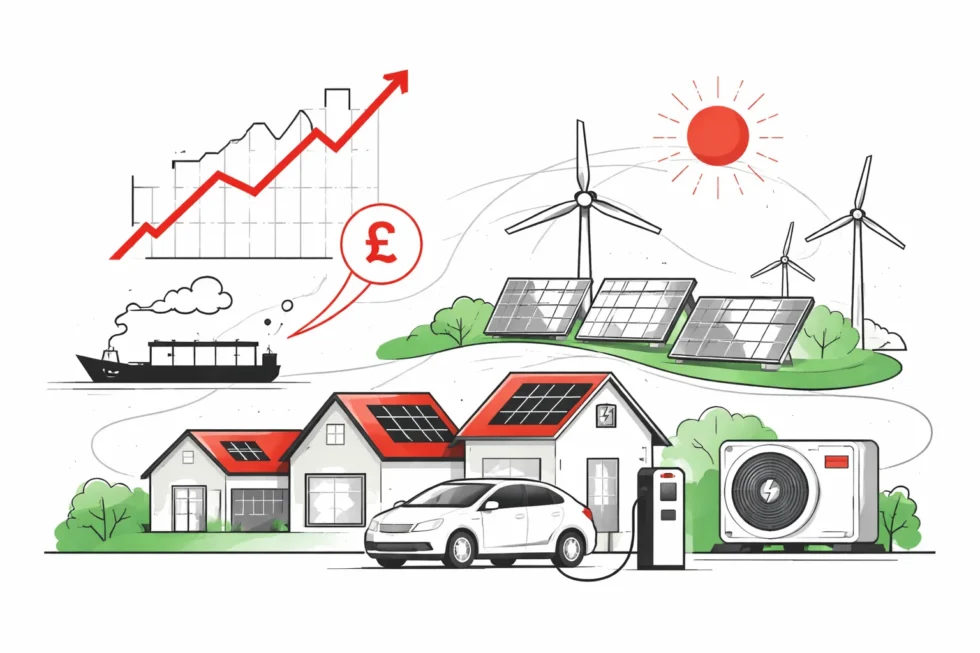
For households, the calculation is increasingly financial: upfront installation costs are weighed against long-term bill stability in an environment of repeated price shocks.
Wind and solar impact: how renewables are shielding Britain from gas price shocks
The expansion of renewable energy capacity since the previous energy crisis has materially reduced Britain’s exposure to gas price volatility. According to analysis by Ember, wind and solar generation significantly offset the impact of rising fossil fuel costs during the first month of the crisis.
Between 28 February and 28 March 2026, renewables played a dominant role in electricity supply:
| Metric | 2021 comparison | 2026 level |
|---|---|---|
| Wind + solar share | Lower baseline | ~40% of electricity demand |
| Gas share | 38% | 23% |
| Gas generation change | — | -39% |
| Renewable generation | — | +52% |
This structural shift translated directly into cost savings. Measured system impact:
- Approximate savings of £7 million per day in gas purchases
- Reduced need for imported fossil fuels
- Lower exposure to wholesale price spikes
- Greater stability in electricity supply mix
Without the additional renewable capacity installed since 2021, analysts estimate gas-related costs during the crisis period would have been 52% higher.
Quotes and analysis: what energy experts say about the UK’s exposure
(“The latest fossil fuel crisis proves that wind and solar have already lowered our dependence on gas and delivered genuine savings. We now need to deploy more renewables and reduce reliance on volatile gas for good,” Josie Murdoch, Energy Analyst, Ember, UK, April 2026)
(“Britain is not directly dependent on Middle Eastern gas, but it remains exposed to global price-setting mechanisms, which ultimately drive domestic costs,” UK energy market briefing, April 2026) The expert consensus points to a structural vulnerability: even with diversified supply, Britain remains tied to international pricing systems. This means that geopolitical shocks translate rapidly into domestic costs, regardless of physical supply security.
The long-term trajectory of Britain’s energy system suggests further reduction in gas dependency, but delivery timelines remain critical. Since October 2021, more than 750 wind and solar projects have either begun construction or secured planning permission, representing a pipeline of approximately 60 GW.
Forward-looking capacity targets:
- ~55 GW current wind and solar capacity
- Additional projects targeting 45 GW under CfD schemes by 2031
- Acceleration of government auctions (AR8) to bring capacity online faster
However, the effectiveness of this transition depends on execution speed. Delays in project delivery would prolong exposure to volatile gas markets, while rapid deployment could further stabilise electricity prices over time. For households, the implication remains immediate: energy costs are likely to stay elevated in the short term, reinforcing the economic case for private investment in green technologies.
Read about the life of Westminster and Pimlico district, London and the world. 24/7 news with fresh and useful updates on culture, business, technology and city life: Housing market slump UK: house prices fall and mortgage shock hits spring market in April 2026