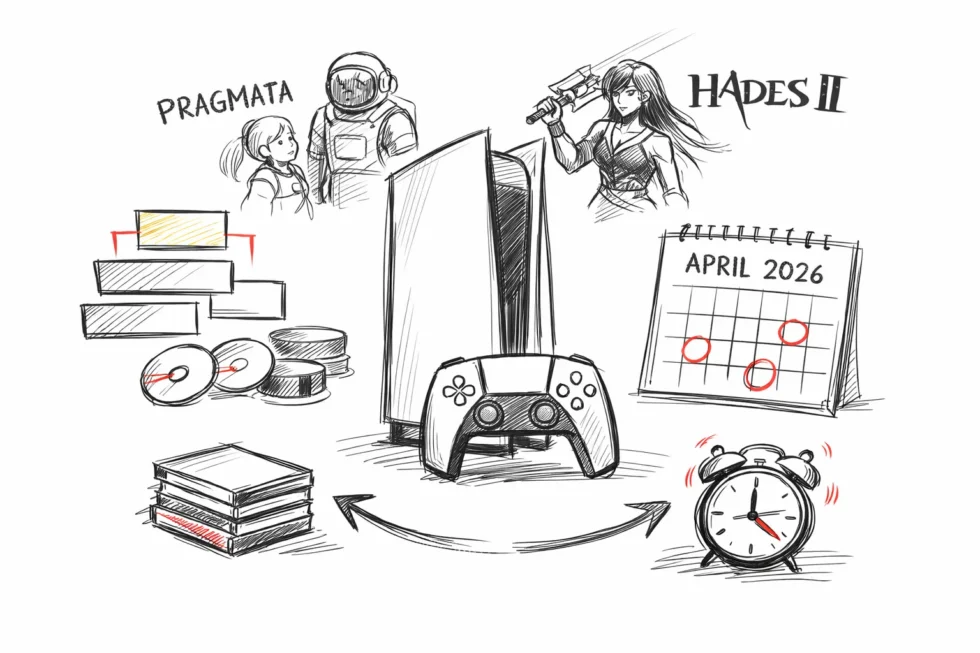
PlayStation Plus games April 2026 are being assessed against one of the busiest mid-month release windows of the year, as Sony’s subscription model operates in parallel with a surge of new PS5 launches led by titles such as Pragmata and Hades II. As of 14 April, the service remains structured around rolling access rather than a single fixed drop, with monthly Essential titles already live and the broader catalogue under Extra and Premium continuing to rotate, The WP Times reports.
The April cycle reflects a wider industry shift in how value is delivered to players. Subscription libraries are no longer positioned as secondary to purchases but operate as a core layer of engagement, particularly during weeks when new releases compete directly for attention. In practice, this means users are navigating between included titles and newly launched games such as Mouse: P.I. For Hire and Ereban: Shadow Legacy, shaping both playtime and spending decisions across April.
PlayStation Plus games April 2026: what is available and how access works
Sony’s PlayStation Plus structure in April 2026 is built around three distinct tiers, each designed to serve a different segment of the player base. The Essential tier continues to provide a small number of monthly games, typically refreshed at the start of each month and retained for as long as the subscription remains active. This remains the entry-level offering and is still widely used by players primarily interested in online multiplayer access.
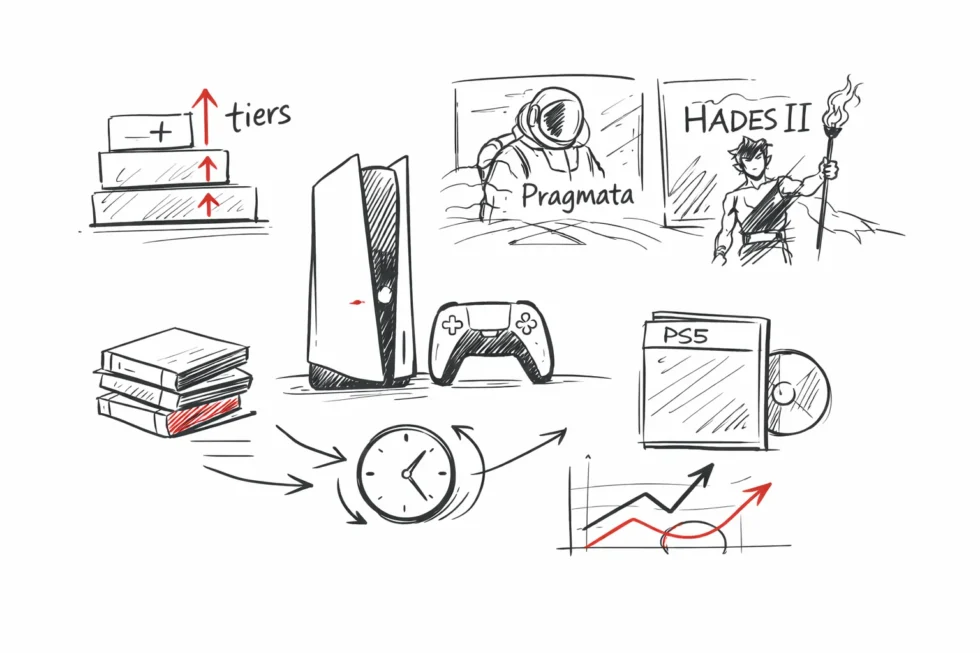
The Extra tier functions as the core value layer, offering a large and rotating catalogue of PS4 and PS5 titles. This catalogue behaves more like a streaming library than a fixed collection, with games entering and leaving on a scheduled basis. The Premium tier builds on this with additional access to legacy titles, timed trials and cloud streaming, targeting users who want broader archival access and early testing options. The key shift in April is not structural but behavioural. Players are no longer simply redeeming monthly games; they are navigating a dynamic library that requires timing, awareness of rotations and selective engagement depending on availability windows.
Key features in April
- Monthly Essential titles already active from early April
- Extra catalogue continuing to rotate mid-month
- Premium offering trials and legacy content
- No single “April drop” — instead continuous updates
- Subscription access tied to active membership
New PS5 releases in April: why they matter for PS Plus users
The week of 13–19 April 2026 introduces a dense lineup of releases that directly influence how PlayStation Plus is used, even when those titles are not included in the subscription itself. This overlap between new releases and subscription content is now a defining feature of the gaming market.
Titles such as Pragmata bring high production value and narrative-driven gameplay that typically sits outside subscription services at launch. Meanwhile, Hades II represents a different category—high-demand sequels with strong replayability that can drive direct purchases even among subscribers.
Alongside these, games like Mouse: P.I. For Hire and Gecko Gods illustrate the continued strength of stylised and mid-tier titles, which often become candidates for future inclusion in subscription catalogues. The practical effect is a redistribution of player attention. Even when PlayStation Plus offers a deep catalogue, new releases can temporarily draw users away, particularly during high-density launch weeks such as mid-April.
Notable releases this week
- Pragmata – major sci-fi release (17 April)
- Hades II – high-demand sequel (14 April)
- Mouse: P.I. For Hire – stylised FPS (16 April)
- Cthulhu: Cosmic Abyss – narrative horror (16 April)
- Gecko Gods – exploration puzzle (16 April)
The April cycle highlights a structural change in how players consume games. Subscription access and direct purchases are no longer competing models but complementary ones, with each serving a distinct role in the player journey. PlayStation Plus provides a consistent base of available content, reducing the need for frequent purchases. However, new releases—particularly those with strong marketing or established franchises—continue to drive immediate sales. This creates a hybrid model where users rely on subscription access for general play while selectively purchasing high-priority titles.
Timing plays a critical role in this balance. Many players are aware that certain games will eventually enter the PlayStation Plus catalogue, leading to delayed purchasing decisions. At the same time, the risk of missing out on launch-period engagement often leads to immediate purchases for major titles. This dual behaviour reflects a mature market in which value is measured not only by cost but by access timing and content relevance.
Typical timing for PS Plus inclusion
| Game type | Entry into PS Plus |
|---|---|
| Indie titles | 2–4 months |
| Mid-tier games | 3–6 months |
| AAA titles | 6–12 months |
Catalogue strategy: why PlayStation Plus is no longer “just free games”
Sony’s strategic positioning of PlayStation Plus has evolved significantly. What began as a service centred on monthly “free” games has transformed into a layered content platform designed to retain users over longer periods. The Essential tier still reflects the original model, offering predictable monthly additions. However, the Extra and Premium tiers represent a shift towards continuous engagement, with large catalogues that require active exploration rather than passive redemption.
This transition aligns with broader trends in digital media, where subscription models prioritise retention and long-term usage over one-time transactions. In this context, PlayStation Plus functions not only as a value proposition but as a distribution channel that competes directly with traditional sales. The emphasis is now on volume, accessibility and variety. Rather than focusing on individual headline titles, the service encourages users to remain within the ecosystem by providing ongoing access to a wide range of content.
Strategic shifts
- From monthly drops to rolling catalogues
- From ownership to access-based engagement
- From promotions to retention strategy
- From static libraries to dynamic rotation
- From secondary feature to core platform
April 2026 is not marked by a single major overhaul but by incremental changes that reflect the ongoing evolution of the PlayStation Plus model. The most important factor for users is timing—understanding when content is added, removed or highlighted within the service.
The mid-month period typically introduces updates to the Extra and Premium catalogues, even if these changes are less visible than the start-of-month Essential refresh. At the same time, new releases increase competition for user attention, making it more important for players to prioritise which titles to engage with. Another factor is the increasing use of trials and limited-time access under the Premium tier. This allows users to test new titles before committing to a purchase, further blurring the line between subscription and retail models. Overall, April represents a continuation of trends rather than a disruption, but it reinforces the importance of active management of subscription content.
What to monitor
- Mid-April catalogue updates
- Titles scheduled to leave the service
- New trial availability under Premium
- Overlap with major releases
- Timing of future additions
Practical guidance: how to maximise PlayStation Plus in April
April is not about finding games — it is about using timing to extract value. With a crowded release schedule and a rotating catalogue, efficiency matters more than volume. The key is to treat PlayStation Plus as a managed library, not a passive subscription.
If you play regularly, your advantage is access. Focus on the Extra and Premium catalogues and work through titles that are likely to leave soon — this is where the real value sits. New releases such as Hades II should only be purchased immediately if they are a priority; otherwise, delay and monitor potential inclusion later.
If you play selectively, avoid spreading time across too many games. Choose one major release or one catalogue title at a time. Mixing both leads to unfinished games and wasted subscription value. For most users, one purchased title plus one catalogue game is the optimal balance.
If your focus is saving money, then rotation awareness is critical. Games enter and leave the catalogue quietly, and missing a title window means paying full price later. Checking updates once per week is enough to stay ahead.
What to do now
- Check which games are leaving within 2–4 weeks and play those first
- Do not buy at launch unless you plan to play immediately
- Use Premium trials to test before spending
- Keep one main game + one backup game to avoid overload
- Reassess your tier — downgrade if you are not using Extra/Premium fully
The broader context: PlayStation Plus within the 2026 market
PlayStation Plus in 2026 has moved beyond its original role as a value-added feature and now operates as a central access layer within the gaming economy. The shift is structural: players no longer build libraries primarily through ownership, but through ongoing access, with subscription catalogues forming the baseline of engagement. This transition changes not only how games are consumed, but how time, spending and attention are allocated across the platform.
At the same time, the release cycle continues to assert its influence. High-profile titles such as Pragmata still define moments of peak demand, drawing players away from subscription catalogues and into immediate purchase decisions. Subscription models cannot replicate the urgency or cultural weight of these launches, which remain critical for revenue concentration and visibility across the market.
The result is not a replacement of one system by another, but a coexistence that requires constant adjustment. Players move fluidly between catalogue access and premium releases, depending on timing, relevance and perceived value. In this environment, the concept of ownership becomes secondary to availability, while the timing of engagement becomes the primary driver of efficiency.
What defines value in April is therefore not the volume of content, but the precision of its use. A large catalogue has limited impact if it is not navigated with awareness of rotation cycles, trial availability and release timing. Players who adapt to this model—by delaying purchases where appropriate, prioritising expiring titles and using access strategically—extract significantly more value without increasing spend.
This dynamic reflects broader market conditions. Subscription access is increasingly positioned as the default entry point, while premium releases continue to anchor the industry’s economic structure. Consumption patterns are now hybrid by design, combining continuous access with selective ownership. Within this system, timing has become the central variable, shaping both user behaviour and the perceived worth of the PlayStation Plus ecosystem.
Read about the life of Westminster and Pimlico district, London and the world. 24/7 news with fresh and useful updates on culture, business, technology and city life: PlayStation Plus Essential Game Gets Even Better With Free Update as Sony confirms April 2026 lineup