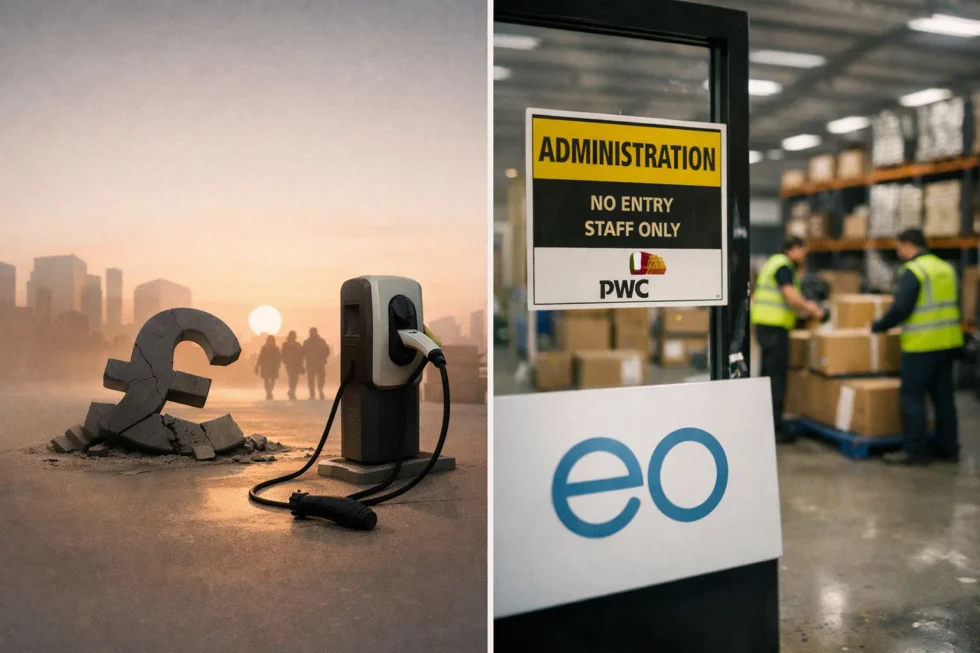
UK EV charger company collapse has materialised with EO Charging entering administration on 14 April 2026, triggering immediate redundancies and the controlled wind-down of operations after a failed sale process and prolonged liquidity pressure across its UK and international business, The WP Times reports, citing electrive as confirming the timeline and scale of the collapse. The company, which supplied EV charging infrastructure, software platforms and fleet services to major clients including logistics operators, supermarkets and commercial fleets, appointed administrators from PwC after funding rounds, restructuring efforts and an accelerated M&A process failed to resolve persistent cashflow constraints.
EO Charging’s collapse follows a sequence of strategic retrenchments through 2025 and early 2026, including scaling back international expansion, divesting parts of its domestic charger business and launching a buyer search in January that did not result in a transaction, leaving administration as the only remaining option. Founded more than a decade ago and previously ranked among Europe’s fastest-growing companies, the firm had built a multi-market EV infrastructure model, but continued losses, contract pressure in the UK fleet segment and tightening capital conditions ultimately undermined its ability to sustain operations at scale.
UK EV charger company collapse: what happened to EO Charging
EO Charging built its business around supplying end-to-end EV charging solutions, combining hardware, software platforms and maintenance services for commercial fleets and large-scale clients. Its customer base included major logistics and retail operators, reflecting strong early demand for electrification infrastructure across the UK. However, growth came with structural challenges. The company expanded aggressively into international markets including the US, Australia, New Zealand and parts of Europe, supported by significant investment rounds, including funding secured in 2023 to drive overseas expansion. This strategy increased operational complexity and capital requirements at a time when profitability remained out of reach.
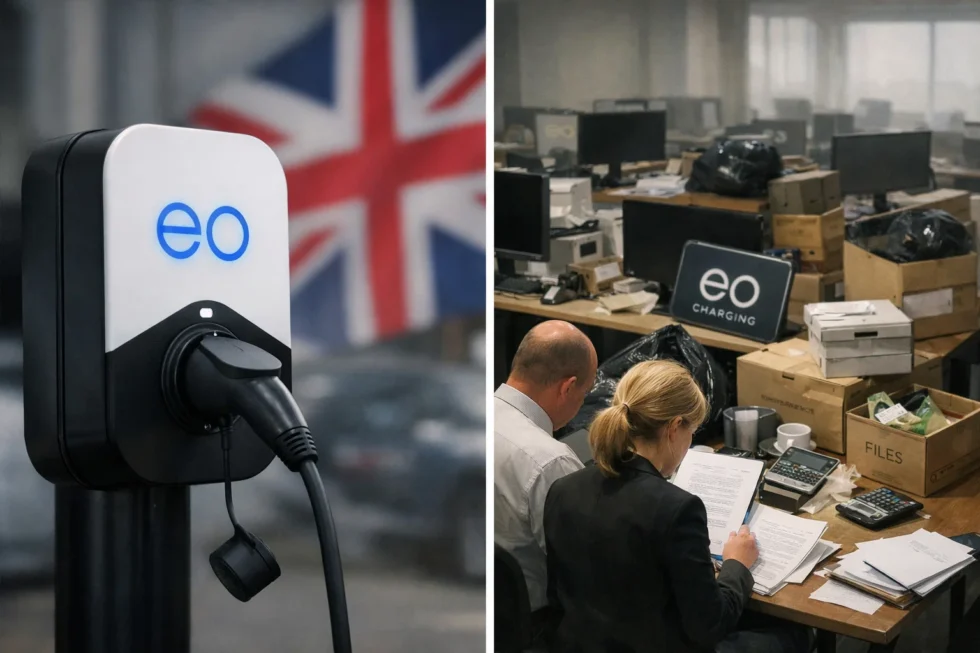
By 2025, the company had begun to reverse course. International expansion was scaled back, and the focus shifted to core UK operations and its cloud-based charge point management platform. Despite these adjustments, financial pressures intensified, particularly as large commercial contracts became harder to sustain under tightening margins and competitive pricing in the EV infrastructure sector. In January 2026, EO Charging initiated an accelerated merger and acquisition process in an attempt to secure a buyer or investor. That process did not result in a transaction, leaving the company without sufficient liquidity to continue trading.
Administration, redundancies and operational shutdown
The appointment of administrators from PwC marked the formal transition into insolvency proceedings. Immediately following the appointment, 69 of the company’s 93 employees were made redundant, with the remaining staff retained temporarily to support an orderly wind-down.
The administration process is focused on three priorities: maintaining continuity for existing customers, transferring services where possible, and maximising the value of remaining assets. This includes supporting clients in migrating to alternative EV charging providers to minimise disruption to fleet operations and infrastructure networks. Edward Williams, joint administrator at PwC, described the situation as “regrettable”, confirming that efforts will be made to ensure a structured transition for customers and an orderly closure of the business.
Key facts from the EO Charging collapse
| Category | Detail |
|---|---|
| Company | EO Charging |
| Date of administration | 14 April 2026 |
| Administrator | PwC |
| Employees | 93 total |
| Redundancies | 69 confirmed |
| Remaining staff | Retained short-term for wind-down |
| Key issue | Liquidity crisis after failed sale |
| Markets | UK, US, Australia, NZ, Europe |
The redundancy process will be supported through the UK’s statutory framework, with affected employees able to claim through the Redundancy Payments Service.
UK EV charger company collapse: market pressure across EV infrastructure sector
The UK EV charger company collapse involving EO Charging exposes a structural imbalance at the core of the EV infrastructure market, where demand growth is accelerating but revenue realisation remains delayed and uneven. While EV adoption continues to expand across the UK and Europe, charging providers operate within capital-heavy models that depend on long-term utilisation, stable contracts and continuous access to funding—conditions that have tightened sharply since 2024 amid higher borrowing costs and investor caution.
In practice, the sector is being reshaped by a convergence of pressures. High installation costs—particularly for fleet and depot charging—are often front-loaded, while returns depend on multi-year usage patterns that are still maturing. At the same time, operators face contract concentration risk, where a limited number of large fleet clients can define revenue stability. This is compounded by rapid technological change, including smart charging standards and interoperability requirements, which increase both development costs and upgrade cycles. Pricing competition has intensified as new entrants and utilities expand their footprint, compressing margins across both hardware and service layers. EO Charging’s model—integrating hardware, software platforms and 24/7 support—aligned with the industry’s long-term direction, particularly around smart charging and ISO-compliant systems. However, scaling that model across multiple international markets required sustained capital backing at a time when funding conditions weakened. The result is a widening gap between projected EV growth curves and the immediate commercial viability of infrastructure providers, especially those pursuing aggressive expansion without stable profitability.
Industry reaction and customer transition: operational continuity under pressure
The immediate industry response has focused on continuity risk, particularly for commercial fleet operators reliant on EO Charging’s infrastructure and software ecosystem. Administrators from PwC are prioritising system stability during the transition phase, ensuring that charging networks, monitoring platforms and maintenance services remain operational while alternative providers are identified.
For fleet operators, the exposure is not limited to physical charge points but extends to integrated systems—load management, remote diagnostics and uptime guarantees—that underpin daily logistics operations. Any disruption to these systems introduces operational friction, requiring coordinated migration to new suppliers to avoid downtime. Industry participants indicate that transitions of this type are technically feasible but time-sensitive, particularly where proprietary software platforms are involved.
The broader reaction across the sector has been measured but clear: financial resilience is now as critical as technological capability. Companies with diversified funding, strong balance sheets and scalable service models are expected to consolidate their position, while smaller or highly leveraged operators face increased scrutiny from both clients and investors.
The administration process will now move into asset realisation, with potential buyers assessing EO Charging’s technology stack, customer contracts and infrastructure footprint. This may include the sale of software platforms, intellectual property or segments of its charging network to established operators seeking to expand capacity or client reach. Customer migration is expected to take place in structured phases, depending on contractual obligations and system compatibility. Remaining employees will support this transition, maintaining service continuity while contracts are reassigned or terminated. For clients, the priority is maintaining operational uptime rather than renegotiating terms, meaning speed and technical integration will define the transition process.
From a market perspective, the collapse is likely to accelerate consolidation across the UK EV charging sector. Larger energy groups, infrastructure funds and integrated mobility providers are positioned to absorb distressed assets, strengthening their market share while reducing fragmentation. This aligns with a broader shift towards fewer, more capitalised players capable of sustaining long-term infrastructure investment.
Administrator statement and confirmed position
“It’s regrettable that the Company has been left with no option but to enter administration and that 69 employees have sadly been made redundant. The administrators are looking to assist customers in smoothly transitioning to alternative suppliers with the support of the remaining employees, before winding down the company in an orderly manner and seeking to optimise the value of its assets,” (Edward Williams, joint administrator at PwC, UK, April 2026).
The EO Charging collapse defines a turning point for the UK EV infrastructure sector, where growth alone is no longer sufficient to sustain operations. The market is entering a phase where capital discipline, contract structure and scalable profitability determine survival, even as electrification demand continues to expand.
Read about the life of Westminster and Pimlico district, London and the world. 24/7 news with fresh and useful updates on culture, business, technology and city life: EuroMillions unclaimed prize: £125k Isle of Man winner may not know before deadline