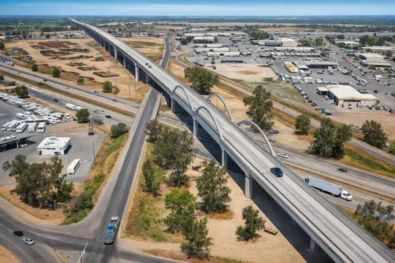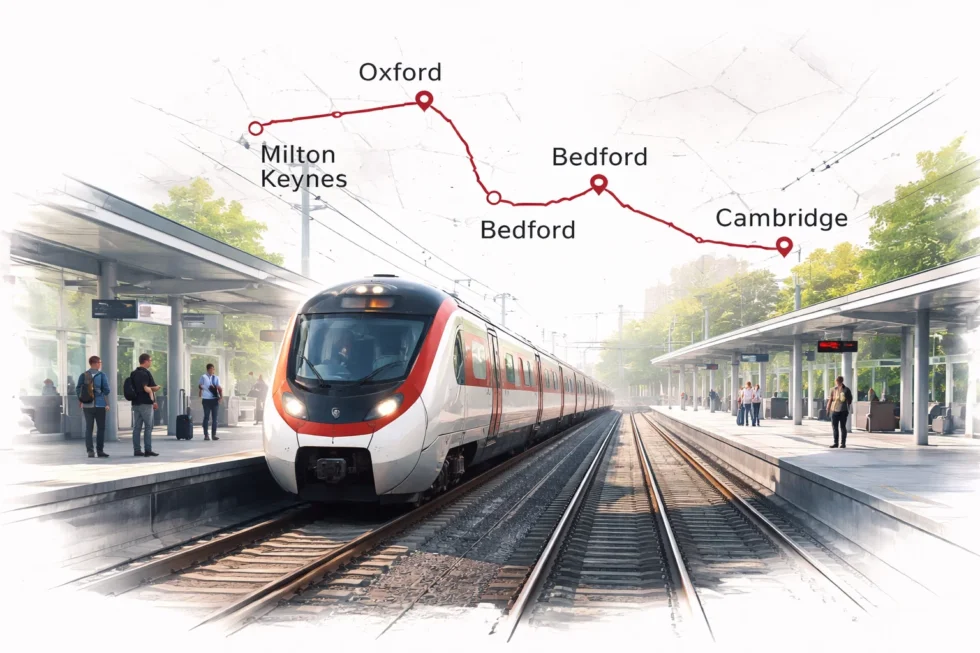
East West Rail proposals connecting Oxford, Milton Keynes, Bedford and Cambridge have moved into an advanced planning phase as of April 2026, with updated documentation confirming a target service of up to five trains per hour, a new station at Stewartby linked to a major leisure development, and infrastructure upgrades designed to support long-term passenger growth across the Ox-Cam corridor. The revised scheme from East West Railway Company} integrates projected demand from housing expansion and a planned Universal resort near Bedford, while setting out a phased delivery strategy intended to bring operational sections online earlier rather than waiting for full completion, The WP Times reports.
The scheme addresses a structural gap in the UK rail network: the absence of a continuous, high-frequency east–west route between key economic centres. Currently, many journeys between these cities require indirect travel via London or multiple interchanges, increasing journey times and reducing reliability. East West Rail is designed to replace this with a direct corridor, shifting the system towards frequency-based travel where passengers rely less on exact timetables and more on consistent service availability throughout the day.
East West Rail timeline: when construction, phases and opening are expected
As of April 2026, East West Rail is not a single construction event but a staged programme with different sections progressing at different speeds. This phased approach is central to understanding when passengers will actually see benefits. Current timeline expectations:
- 2025–2026: Route refinement, consultation updates and planning adjustments, including integration of the Bedford resort demand
- Late 2026 – 2027: Expected start of major construction on central sections (subject to approvals)
- 2027–2029: Progressive opening of initial operational segments where infrastructure is completed first
- Early 2030s: Full corridor connectivity between Oxford and Cambridge targeted
This timeline reflects standard UK rail delivery cycles, where planning, land acquisition and engineering design often take several years before visible construction begins. The phased model allows parts of the network to begin operating earlier, particularly in areas with fewer engineering constraints. For passengers, the key point is that benefits will not arrive all at once. Instead, improvements will appear gradually—first as isolated sections, then as a connected network.
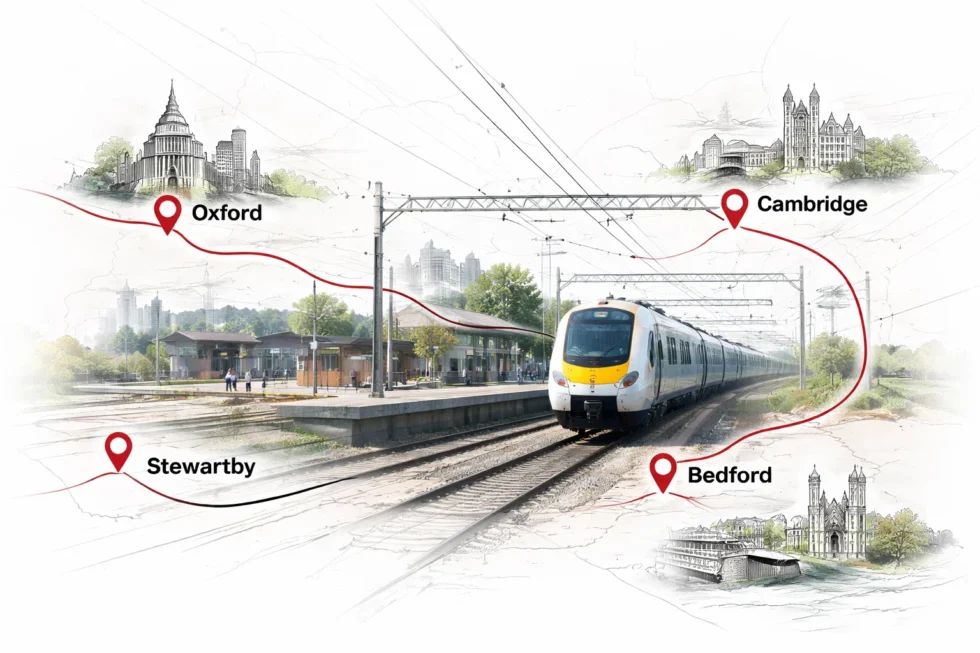
Route, stations and five trains per hour service explained
The East West Rail service is designed as a high-frequency regional connector rather than a long-distance express line. The emphasis is on reliability, capacity and usability across multiple cities rather than maximum speed between endpoints. Operational structure:
- 4 trains per hour running consistently across the full route
- +1 additional train deployed during peak periods or expanded to full-day operation
- Five-carriage trains, balancing capacity with flexibility
- Ability to extend services beyond the core route into the wider UK network
The “five trains per hour” model is critical. In practical terms, it reduces waiting times to roughly 10–15 minutes, bringing the service closer to metro-style frequency rather than traditional regional rail.
A major addition is the Stewartby station near Bedford, designed to serve a planned Universal theme park. This reflects a forward-looking planning model where infrastructure anticipates demand from major developments rather than reacting to existing population patterns. At the eastern end, Cambridge will see significant upgrades:
- New station entrance to reduce congestion
- Step-free access across all platforms
- Expanded cycling infrastructure
- Improved public space and access routes
These changes are aimed at handling sustained increases in passenger flow rather than short-term peaks.
What the project changes for passengers in real terms
The most important shift for passengers is not speed, but structure. East West Rail changes how journeys are organised across central England.
| Factor | Before East West Rail | After East West Rail |
|---|---|---|
| Route logic | Via London or multiple changes | Direct east–west connection |
| Frequency | Irregular, timetable-dependent | Up to 5 trains per hour |
| Waiting time | Often 20–40 minutes | Around 10–15 minutes |
| Journey time | Indirect and longer | Shorter, more direct |
| Accessibility | Partial step-free access | Full accessibility upgrades |
| Travel flexibility | Fixed planning required | Flexible, turn-up-and-go |
This transformation has direct daily impact. Commuters gain more predictable travel, missed trains become less critical, and journey planning becomes simpler. For occasional travellers, particularly leisure trips, the system becomes easier to use without detailed scheduling.
Why Bedford and the Universal resort matter in the plan
The inclusion of a major leisure development near Bedford is a key factor in the updated plans. Unlike traditional commuter-focused rail projects, East West Rail is being designed to handle mixed demand: daily commuting, business travel and large-scale leisure flows. A representative from Universal Destinations and Experiences stated that the site was chosen partly for its central location and connectivity, with the railway expected to enhance access significantly. The Stewartby station would provide direct rail links to the resort, reducing reliance on road travel and supporting higher visitor numbers (Gidon Freeman, UK statement, 2026). This integration ensures more consistent passenger volumes throughout the week, not just during peak commuting hours, improving long-term viability.
Economic and regional impact across the Ox-Cam corridor
The Oxford–Cambridge corridor is already one of the UK’s most productive regions, driven by universities, technology firms and research institutions. However, limited east–west connectivity has restricted its full potential. East West Rail is expected to change that by:
- Expanding the effective labour market across cities
- Making new housing developments more viable
- Reducing transport bottlenecks
- Attracting further private investment
By connecting cities directly, the project allows them to function as a single economic cluster rather than isolated centres.
What matters now is execution, not announcement. The project is moving into a stage where approvals, engineering detail and final route decisions will determine whether timelines hold and where the first real benefits appear. The critical signals are clear: confirmation of construction start dates from late 2026, finalised station locations, and how seamlessly the new line is integrated into existing services without creating bottlenecks elsewhere. Just as important are the first opening segments—these will show whether frequency, reliability and passenger demand align with projections or require adjustment.
For passengers, the early operational sections will be the real test, not the full line. If those initial stretches deliver consistent service, manageable journey times and visible uptake, the rollout is likely to accelerate, with additional capacity and timetable expansion following. If not, delays or redesigns could slow the wider programme. In practical terms, East West Rail will not arrive as a single moment but as a sequence of usable upgrades. As sections come online through the late 2020s into the early 2030s, the shift will be gradual but structural: fewer indirect journeys via London, more direct regional movement, and a rail system that begins to function on frequency and accessibility rather than rigid scheduling.
What matters now is execution, not announcement. The project is moving into a stage where approvals, engineering detail and final route decisions will determine whether timelines hold and where the first real benefits appear. The critical signals are clear: confirmation of construction start dates from late 2026, finalised station locations, and how seamlessly the new line is integrated into existing services without creating bottlenecks elsewhere. Just as important are the first opening segments—these will show whether frequency, reliability and passenger demand align with projections or require adjustment.
For passengers, the early operational sections will be the real test, not the full line. If those initial stretches deliver consistent service, manageable journey times and visible uptake, the rollout is likely to accelerate, with additional capacity and timetable expansion following. If not, delays or redesigns could slow the wider programme. In practical terms, East West Rail will not arrive as a single moment but as a sequence of usable upgrades. As sections come online through the late 2020s into the early 2030s, the shift will be gradual but structural: fewer indirect journeys via London, more direct regional movement, and a rail system that begins to function on frequency and accessibility rather than rigid scheduling.
Read about the life of Westminster and Pimlico district, London and the world. 24/7 news with fresh and useful updates on culture, business, technology and city life: Horoscope today London 16 April 2026: Sagittarius Moon tests discipline, money and health