
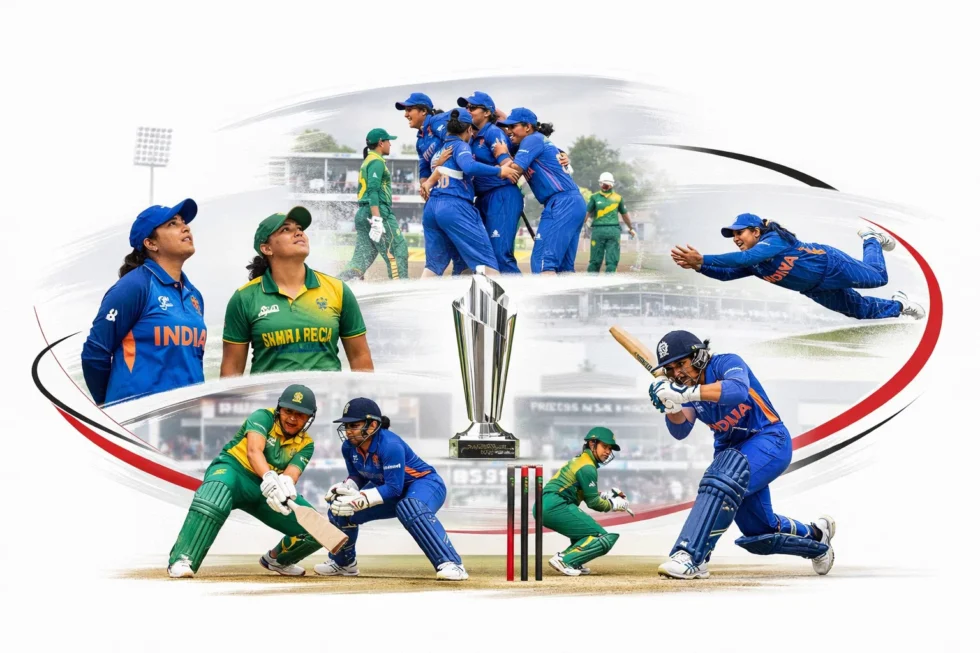
India Women vs South Africa Women opens a five-match T20I series in Durban with INDW vs SA-W framed not as a routine bilateral, but as a direct pre–T20 World Cup examination between two sides drawn in the same group and likely competing for a semi-final place. Played less than two months before the global tournament, SA-W vs INDW arrives at a point where both teams are shifting from experimentation to execution, with squad balance, role clarity and pressure management now under immediate scrutiny, The WP Times reports.
The timing sharpens the stakes. India Women enter with a settled core and upward momentum, while South Africa Women face the need to correct structural weaknesses exposed in recent defeats. Across venues in Durban, Johannesburg and Benoni, conditions will vary enough to force tactical adjustments, meaning INDW vs SA-W becomes a layered test of adaptability rather than a simple measure of form.
form and momentum define India Women vs South Africa Women gap
India Women approach INDW vs SA-W with measurable advantages in recent results, depth and stability. Series wins across formats, including high-pressure contests against top-ranked opposition, have reinforced a core built around Harmanpreet Kaur and Smriti Mandhana, with contributions extending beyond the top order. South Africa Women, by contrast, enter SA-W vs INDW after a 4–1 T20I defeat to New Zealand that exposed recurring issues:
- limited conversion of starts into match-defining totals
- inconsistent middle-overs scoring rates
- breakdowns in bowling execution against set batters
The statistical gap is not overwhelming, but it is directional. India’s ability to post and defend totals above 160 has been more consistent, while South Africa Women have struggled to sustain pressure across full innings. That imbalance is why India Women vs South Africa Women is being treated as a readiness test rather than a neutral series.
selection pressure and squad reshaping in INDW vs SA-W
India Women vs South Africa Women is not merely a preparatory bilateral. INDW vs SA-W is functioning as a live selection audit less than two months before the Women’s T20 World Cup, with both camps forced to weigh immediate results against unresolved squad questions. For South Africa Women, the issue is not only form but availability: Marizanne Kapp remains unavailable as she continues her recovery from illness, while Dane van Niekerk is also out of the series after suffering an injury during the New Zealand leg. That removes two senior all-round options, strips experience from key phases of the innings and leaves SA-W vs INDW as an important test of whether the Proteas can build a viable tournament balance without two of their most recognisable names.
The pressure therefore shifts sharply onto the players who are available. Laura Wolvaardt is no longer simply the senior batter; she becomes the structural anchor around whom South Africa’s batting tempo, stability and decision-making are built. Annerie Dercksen carries increased value because she offers the multi-phase flexibility South Africa are missing without Kapp, while Ayabonga Khaka remains central to the seam unit after leading the attack against New Zealand. Behind the stumps, selectors are also widening their options: uncapped Tebogo Macheke has been brought in as cover and competition, while Anneke Bosch keeps her place after stepping in during the New Zealand series, underlining that South Africa are still refining both personnel and role clarity rather than arriving with a locked World Cup XI.
India Women are operating from a stronger position, but their selection story is still active. The core is more settled, yet INDW vs SA-W gives India a high-quality window to test whether newer options can be trusted under pressure before final World Cup decisions are made. Kashvee Gautam has been added specifically to strengthen the fast-bowling resources and remains uncapped in T20Is, making this series her clearest route into the tournament conversation. Anushka Sharma has also been included as a hard-hitting all-round option after domestic T20 output that marked her out as a player capable of changing tempo, while Uma Chetry is in the squad as back-up to Richa Ghosh. India’s selection approach is therefore less about patching holes and more about identifying which fringe players can expand tactical flexibility without weakening the side’s existing balance.
That makes SA-W vs INDW significant in two directions at once. For South Africa Women, it is a test of whether the side can absorb major absences and still produce a credible World Cup structure. For India Women, it is a test of how much bench strength can be trusted when the margins tighten. In practical terms, performances in Durban, Johannesburg and Benoni are likely to shape final discussions around seam depth, wicketkeeping cover, finishing options and all-round balance — which is why India Women vs South Africa Women should be read not just as a series, but as a selection trial played at international intensity.
conditions across venues add tactical variability
The India Women vs South Africa Women schedule introduces a critical variable: changing conditions across three venues within a condensed window.
| Venue | City | Conditions | Tactical impact |
|---|---|---|---|
| Kingsmead | Durban | Slower, humid surface | Favours control, cutters, spin |
| Wanderers | Johannesburg | Pace, bounce, altitude | Rewards aggressive seam bowling |
| Benoni | Gauteng | Balanced pitch | Requires all-round adaptability |
Matches are played within roughly ten days, reducing recovery and adjustment time. Seasonal cooling in South Africa also affects pitch behaviour and evening conditions, particularly in later matches. For INDW vs SA-W, this means teams must switch strategies quickly — a key requirement for tournament play where fixtures often demand rapid tactical recalibration.
execution over strategy: what captains are signalling
Pre-series messaging around India Women vs South Africa Women points to a shift away from experimentation towards precision, with INDW vs SA-W framed internally as a test of whether established plans can withstand match pressure rather than whether new systems are required. At this stage of the cycle, both teams are no longer searching for identity — they are testing reliability. South Africa captain Laura Wolvaardt addressed the issue directly, identifying execution rather than structure as the central problem:
“We’ve been trying to fix things. With the ball it was in our execution… we didn’t bowl to our field placings,” (Wolvaardt, Durban pre-series briefing).
The emphasis is significant. It suggests that South Africa’s recent struggles have not come from flawed planning but from breakdowns in discipline — particularly in maintaining lines under pressure and aligning bowling strategy with field settings. In T20 cricket, where margins are narrow, those lapses translate quickly into boundary sequences and loss of control. Wolvaardt also pointed to a recalibration in batting intent:
“We’ve worked on being more proactive, rotating strike better and refining shot selection.”
That reflects a clear tactical correction after a series in which South Africa’s innings often stalled between overs seven and fifteen — a phase that increasingly defines T20 outcomes.
India captain Harmanpreet Kaur, by contrast, projected continuity rather than adjustment:
“We are in good shape. There is still some experimentation, but the team is confident.”
Her framing places India Women in a different phase of preparation. Rather than fixing systemic issues, INDW vs SA-W is about reinforcing consistency and ensuring that squad depth does not dilute performance standards.
On emerging players, she added:
“Kashvee Gautam is very talented and can contribute in all departments.”
The tone is measured — indicative of a side integrating new options without altering its core structure. For India Women, execution means maintaining established patterns across varying conditions. Taken together, the messaging from both camps converges on a single point: India Women vs South Africa Women will not be decided by innovation, but by which side applies its existing blueprint more consistently under pressure.
key tactical battles in SA-W vs INDW
The India Women vs South Africa Women series is expected to hinge on repeatable, high-impact phases rather than isolated moments, with SA-W vs INDW likely to be shaped by how each team manages the middle overs and closing stages. For South Africa Women, the pressure points are structural:
- Death overs discipline: recent matches exposed inconsistency in yorker execution and slower-ball variation, leading to late-innings acceleration by opponents
- Middle-overs scoring rate: too often dependent on low-risk accumulation without boundary options, allowing pressure to build
- Top-order dependency: heavy reliance on Wolvaardt increases vulnerability if early wickets fall
- Game management under pressure: decision-making in tight chases and defence phases remains inconsistent
For India Women, the tactical focus is more about optimisation than correction:
- Top-order continuity: maintaining the scoring platform built around Smriti Mandhana and the established opening structure
- Seam depth evaluation: identifying which pace options can deliver across different surfaces and match situations
- Middle-overs control: sustaining pressure through disciplined bowling and fielding rather than chasing wickets
- Integration without disruption: ensuring new players fit into defined roles without affecting balance
What distinguishes INDW vs SA-W is that both teams already understand their tactical requirements. The variable is not awareness, but execution — particularly in phases where matches are often decided within two or three overs.
why India Women vs South Africa Women matters for the World Cup
The strategic weight of INDW vs SA-W is amplified by tournament structure. India Women vs South Africa Women are grouped alongside Australia, Pakistan, Bangladesh and the Netherlands, creating a scenario where direct results between India and South Africa may determine progression. The implications are immediate and practical:
- Direct pathway pressure: both teams are likely competing for the same semi-final slot behind Australia
- Live tactical intelligence: each match provides actionable data on opposition strengths, match-ups and weaknesses
- Psychological edge: momentum and belief gained here can carry directly into the World Cup
- Selection clarity: performances will influence final squad balance, particularly fringe roles
In that context, SA-W vs INDW is not isolated. It is effectively a preview of a decisive group-stage contest, with consequences extending beyond the series result.
outlook: INDW vs SA-W as final high-level examination
India Women vs South Africa Women is expected to deliver closely contested matches despite India’s stronger recent trajectory, with South Africa Women entering under greater corrective pressure but with the advantage of home conditions. Across INDW vs SA-W, several indicators will define the series:
- whether South Africa can stabilise batting output across full innings
- how effectively India rotate and trust their bench without losing control
- the impact of emerging players when exposed to sustained pressure
- adaptability to contrasting conditions across Durban, Johannesburg and Benoni
With the T20 World Cup approaching, the margin for adjustment is narrowing. SA-W vs INDW therefore stands as one of the final high-intensity examinations where execution, rather than experimentation, will determine readiness — and potentially shape the trajectory of both campaigns.
Read about the life of Westminster and Pimlico district, London and the world. 24/7 news with fresh and useful updates on culture, business, technology and city life: What is behind Scottie Scheffler Masters complaint after Augusta loss to McIlroy