
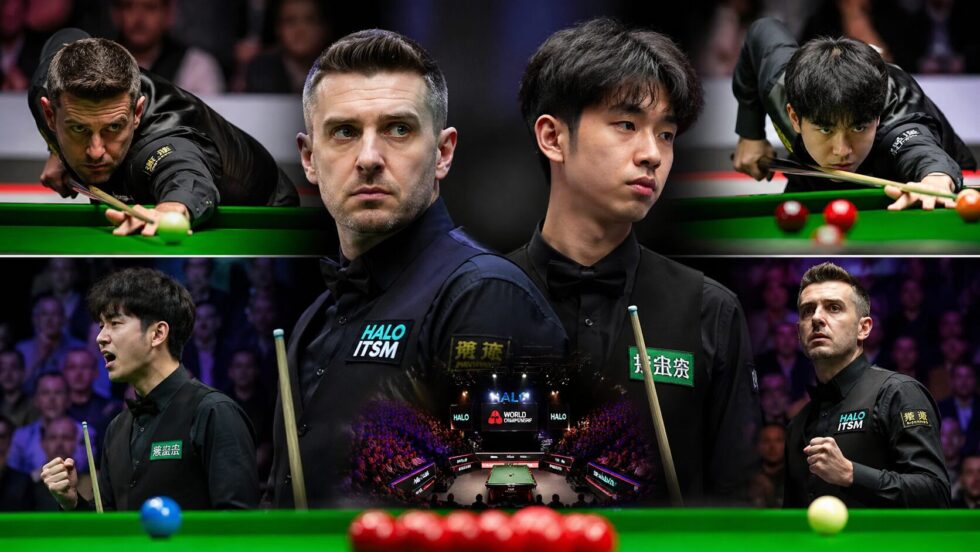
Mark Selby Wu Yize was played over two days — 26 and 27 April 2026 — at the Crucible Theatre, where a second-round match defined by sustained tactical control and limited scoring margins was completed late on Monday evening with Wu Yize securing a 13–11 victory over Mark Selby. The result closed one of the most structurally balanced ties of the last-16 stage and reset the tournament bracket ahead of quarter-final play on 28 April, with Wu progressing and Selby eliminated from the competition, The WP Times reports, with details confirmed by BBC Sport.
The match was shaped by format as much as execution. Played as a best-of-25 across three sessions, it followed the established Crucible rhythm in which incremental control, error management and frame-level decision-making determine outcomes over extended play. By the end of the second session on 27 April, Wu had established a 9–7 lead. In isolation, the margin was minimal, but within the match structure it imposed a constraint on Selby: the requirement to chase frames in a format that rewards containment.
The opening session on 26 April provided no early separation. Frames were shared, scoring was controlled, and both players prioritised safety exchanges over aggressive shot selection. Selby operated within his established pattern — reducing pace, closing angles and extending frames — while Wu mirrored that approach, avoiding forced shots and maintaining positional discipline. The absence of sustained break-building from either player reinforced the tactical nature of the contest.
The second session on 27 April introduced the first measurable shift. Wu began to convert marginal advantages into frames, not through high scoring but through sequence control — winning exchanges, forcing difficult returns and maintaining table position. The scoreboard moved to 9–7, but more significant was the pattern: Wu was dictating the terms of engagement without extending risk. Selby remained within reach but without clear momentum. The final session on the evening of 27 April defined the match. Wu extended his lead early, moving to 12–9 after a prolonged frame exceeding 50 minutes, characterised by safety exchanges and incremental positional gains. That frame altered the pressure distribution. Selby, required to take on lower-percentage shots, missed a red along the cushion, allowing Wu to return and complete the frame. The margin at that stage reduced the available recovery path.
Selby responded with two consecutive frames, narrowing the score to 12–11. The response confirmed that scoring opportunities remained, but it also reduced the match to a single-frame margin for error. In the next frame, Selby failed to secure a safe outcome from a snooker escape, leaving a red available. Wu capitalised, clearing the table to complete the match 13–11 without a decider. The match also contained visible indicators of pressure. Selby, typically controlled in long-format play, showed frustration during the closing phase, striking the table with his cue after a missed shot. The moment did not directly change the frame outcome, but it reflected the cumulative effect of a match in which control had gradually shifted.
(“The match was tough and exhausting… especially against Mark Selby. I’m happy I could stay focused and play well in the safety exchanges,” Wu Yize said after the match, Sheffield, 27 April 2026)
From a technical standpoint, the result did not depend on peak scoring metrics. There was no decisive gap in highest breaks or total points. The separation emerged through execution in key frames — particularly mid-table situations where positional accuracy determined control. Wu maintained a lower error frequency in those phases, while Selby’s missed opportunities occurred at structurally significant points. The 13–11 scoreline reflects a match that remained competitive throughout. In best-of-25 format, a two-frame margin indicates that both players retained access to the match deep into the final session. The difference lies in frame allocation: Wu secured a higher proportion of frames where control was contested rather than open.
The outcome carries immediate structural consequences. Wu progresses to the quarter-finals at the Crucible for the first time, entering the next round scheduled from 28 April. His opponent is Hossein Vafaei, whose progression completes that section of the draw. The match therefore transitions from a completed tie into a defining input for the next phase of the tournament.
For Selby, the elimination reinforces a pattern specific to the Crucible context. Despite success in other events during the season, results at the World Championship have been constrained by the demands of extended multi-session play. The format reduces variance and increases the cost of isolated errors, particularly when trailing entering the final session.
On 28 April, the match is not part of the live snooker schedule today, but its outcome determines that schedule. The transition from last-16 to quarter-finals is dependent on completed results, and the Selby–Wu match forms one of the confirmed entries into that structure. Wu remains active in the tournament; Selby does not. The broader significance lies in tournament progression rather than isolated performance. Each completed match defines the next stage, and the shift from multi-table early rounds to the later phases increases both visibility and constraint. From the quarter-finals onward, the structure tightens, and the margin for recovery narrows further. Within that framework, Mark Selby Wu Yize is a completed match with ongoing structural impact. It marks the closure of one phase of the championship and the formation of the next. The confirmed result — Wu Yize 13, Mark Selby 11 — stands as part of the official progression of the World Snooker Championship and remains integral to the configuration of play on 28 April and beyond.
Read about the life of Westminster and Pimlico district, London and the world. 24/7 news with fresh and useful updates on culture, business, technology and city life: Why is Giant from Gladiators leaving BBC after three seasons and what triggered his departure