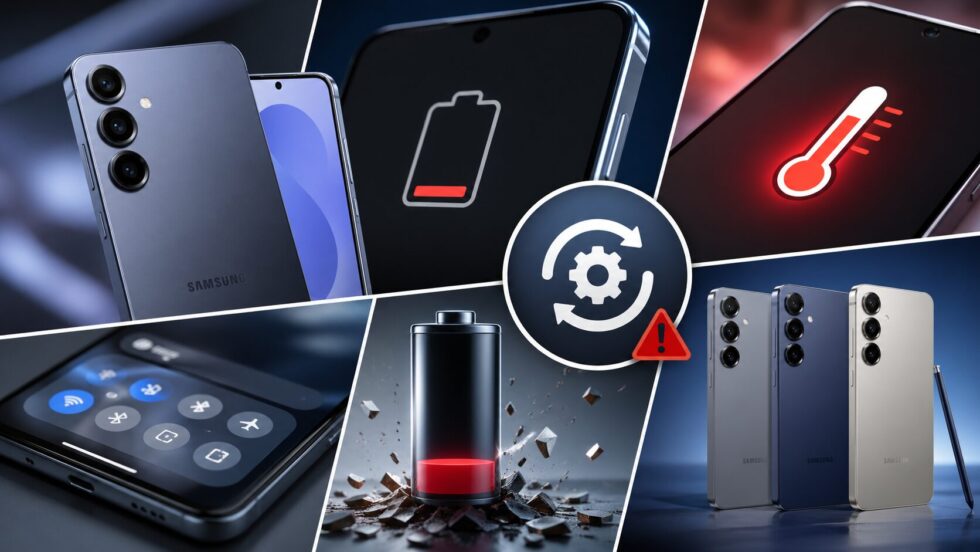
Samsung Galaxy S25 and Galaxy S24 users are facing a growing technical issue after the April 2026 security update, with widespread reports of severe battery drain and overheating affecting daily device performance across multiple regions, raising concerns about software stability and update quality. The problem emerged shortly after the update rollout, with users describing rapid drops in battery levels and devices heating under normal usage conditions, disrupting routine operations and reliability, The WP Times reports.
Samsung has not yet confirmed the root cause or issued an official fix, leaving millions of users without clear guidance as complaints continue to spread across forums, surveys and tech platforms, while early evidence suggests a potential software-related regression rather than hardware failure, possibly linked to system processes, background activity or newly updated security frameworks.
Samsung Galaxy S25 battery drain: what users are reporting after update
The issue has been described with a consistent pattern across both flagship generations, indicating a possible systemic fault introduced with the April patch rather than isolated incidents or ageing batteries. Users report sudden battery drops from high charge levels within hours, even under moderate usage conditions such as messaging, browsing or streaming. The timing of complaints aligns closely with the update rollout, strengthening the correlation between the patch and the malfunction. Reports highlight that the issue affects both active use and standby behaviour, suggesting deeper system-level disruption rather than a single app malfunction.
Many users also report overheating, which typically correlates with increased processor or background activity, further indicating that the device may be operating inefficiently after the update. Key symptoms reported by users:
- Battery dropping from 70–90% to near zero within hours
- Overheating during normal use
- Increased background activity without clear cause
- Faster drain during standby mode
- Inconsistent battery percentage readings
This combination of symptoms points to a potential software mismanagement of power resources rather than physical battery degradation.
Performance before update vs after: why the gap matters
Before the April 2026 update, the Samsung Galaxy S25 demonstrated stable and competitive battery performance across independent testing benchmarks, making the current reports particularly significant. The device consistently delivered over 14 hours of video playback in controlled tests, positioning it as a reliable flagship in terms of endurance. The hardware specifications have not changed, which reinforces the likelihood that the issue originates from software rather than physical components. The same battery capacity and charging systems remain in place across both S24 and S25 models.
Battery performance comparison
| Metric | Before update (S25) | After update (reported) |
|---|---|---|
| Video playback | ~14+ hours | Not sustainable |
| Standby drain | Minimal | Increased significantly |
| Overheating | Rare | Frequently reported |
| Battery consistency | Stable | Erratic drops |
The contrast between pre-update benchmarks and current user reports suggests a regression rather than gradual decline. In technical terms, this points to a disruption in power optimisation systems rather than expected wear.
Possible causes behind Samsung Galaxy S25 update issue
At this stage, no confirmed cause has been identified, but several technically plausible explanations are being discussed based on common post-update issues in Android systems. These scenarios reflect known patterns seen in previous update-related disruptions.
The most likely explanation involves background processes triggered by the update, which may continue running longer than expected and consume excessive power. Another potential factor is system-level optimisation failure, where the device fails to correctly manage CPU, network or app activity. There is also discussion around specific ecosystem components being involved, including security frameworks or third-party app interactions that may conflict with updated system permissions. Potential causes being investigated:
- Post-update indexing or cache rebuilding processes
- Changes in modem or network behaviour increasing standby drain
- Miscalibration of battery percentage reporting
- Thermal management inefficiencies increasing power usage
- Interaction with apps or services after update
Each of these scenarios could independently or collectively contribute to the observed issues, making diagnosis more complex without official confirmation.
Industry reaction and expert commentary
The lack of official communication has become a key concern, as users remain uncertain whether the issue is recognised internally or being actively addressed. Industry observers note that silence following widespread reports can increase user frustration and erode trust in update cycles. One technology publication noted the impact of such failures on user experience, especially when updates are expected to improve security and performance rather than degrade them.
“It's deeply frustrating when a routine update affects core functionality like battery life,” (Android Authority, global tech publication, April 2026).
Experts also point out that modern smartphones rely heavily on software optimisation to achieve battery efficiency, meaning even small errors in system tuning can have disproportionately large effects on performance. The situation is further complicated by similar complaints from users of other Android devices, although early indications suggest this may not be a universal Android issue but rather specific to certain configurations.
What users can do now: practical steps and workarounds
While no official fix is available, several practical steps can help mitigate the impact of the issue or identify whether a specific device is affected more severely. These actions focus on reducing system load and isolating potential causes. The effectiveness of these steps may vary depending on the underlying cause, but they represent the most widely recommended approaches based on current evidence.
Immediate actions to try:
- Enable battery saver mode to limit background activity
- Check battery usage statistics for abnormal processes
- Clear cache partition via recovery mode
- Restart device and monitor changes over 24–48 hours
- Fully discharge and recharge device to recalibrate battery
These steps do not resolve the root issue but may stabilise performance temporarily or reduce the severity of the drain.
What Samsung has not confirmed yet
As of late April 2026, Samsung has not formally acknowledged a battery drain defect tied to the April security update, nor specified affected firmware builds, regions or device variants within the Galaxy S25 and S24 lines. Crucially, there is no published changelog correlation, no incident ID, and no advisory via Samsung Members or official support channels, leaving users without a verified diagnostic baseline.
There is also no clarity on scope segmentation: whether the issue is limited to specific One UI versions, Snapdragon vs Exynos configurations, or carrier-modified firmware. This matters because update rollouts are staggered by region and operator, meaning identical models can run different builds simultaneously. Without build-level transparency, users cannot reliably determine if their device is within an impacted cohort.
Samsung has not confirmed whether the drain reflects real power consumption or a reporting anomaly caused by battery calibration errors. This distinction is critical: a misreporting bug requires recalibration or patch-level correction, while actual consumption spikes indicate deeper failures in power management, radio behaviour or background services. Equally absent is any timeline for remediation. No hotfix ETA, no rollback guidance, and no temporary mitigation recommendations have been issued. In operational terms, this leaves users dependent on community-driven diagnostics rather than manufacturer-supported troubleshooting.
Samsung Galaxy S25 update issue: what happens next
The next phase depends on whether Samsung transitions from passive observation to active incident response. In typical Android lifecycle management, a confirmed regression of this scale would trigger a rapid patch cycle—either a minor OTA hotfix or inclusion in the next scheduled security update. The absence of such signals so far suggests either ongoing internal validation or insufficient reproducible data at scale.
If a corrective update is released, it will likely target system-level optimisation layers—battery management services, thermal control algorithms or background process scheduling—rather than hardware interaction. A patch resolving abnormal drain within one release cycle would reclassify the issue as a contained regression. However, if reports continue without acknowledgement or fix, the risk shifts from technical fault to trust erosion. Flagship devices like the Galaxy S25 depend on predictable update reliability, and unresolved post-update failures raise questions around QA testing, rollout staging and ecosystem integration.
At present, the evidence supports a software-linked regression with consistent timing and symptom patterns, but without official validation, the exact trigger remains unconfirmed. For users, the most effective approach is structured monitoring: track battery usage by process, note firmware version, and document onset timing. This data becomes critical if escalation through support channels is required or if Samsung initiates a broader investigation.
Read about the life of Westminster and Pimlico district, London and the world. 24/7 news with fresh and useful updates on culture, business, technology and city life: Galaxy S27 Ultra to Use Custom Qualcomm Snapdragon 8 Elite Gen 6 Pro – Will It Skip Exynos