
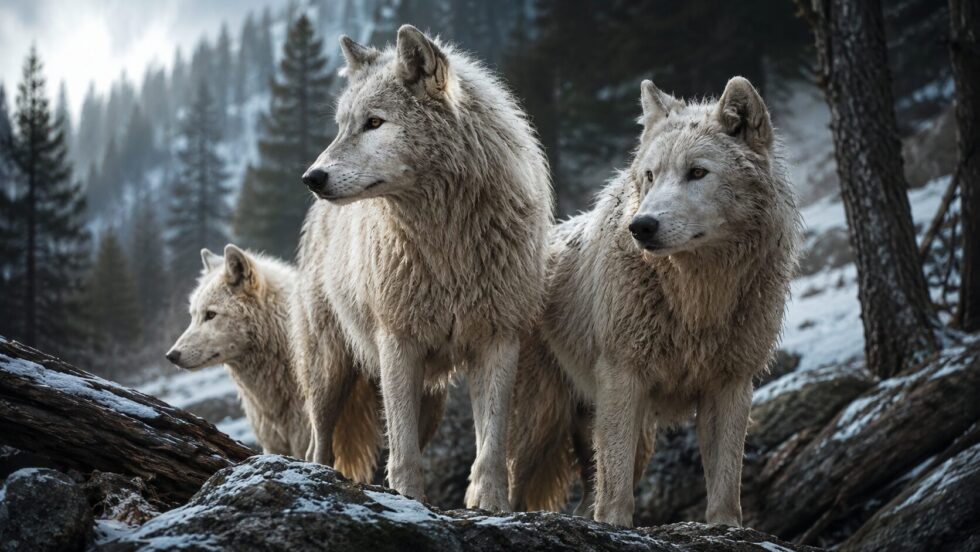
Game of Thrones wolves have re-entered the scientific and public debate after a US biotechnology firm claimed it had recreated the extinct dire wolf and that a new generation has now reached breeding age, raising immediate questions about what has actually been achieved and whether extinction can, in any meaningful sense, be reversed. The claim, amplified by the cultural legacy of Game of Thrones, rests not on recovered species but on advanced genetic engineering — a distinction central to the scientific dispute now unfolding, The WP Times reports.
At issue is not whether genetic modification has progressed — it clearly has — but whether the resulting animals can be described as dire wolves at all. There is no complete, viable genome of the extinct species. What exists instead is a partial reconstruction derived from ancient DNA, combined with the genome of a modern canid, typically the grey wolf. This places the project firmly in the category of engineered approximation rather than biological restoration.
Dire wolf revival in 2026: what the science supports — and what it does not
The term “de-extinction” implies the reconstitution of an extinct organism in its original genetic form. Current methods do not meet that threshold. They operate by editing the DNA of a living species to express selected traits inferred from fossil data. In practical terms, the process involves:
- fragmented ancient DNA used as reference material
- a living host genome as the biological base
- CRISPR-based insertion or modification of traits
- selection for physical resemblance over genetic identity
The result is an organism that may resemble the extinct dire wolf in size or morphology, but is not genetically equivalent to Aenocyon dirus. Recent genomic studies indicate that dire wolves diverged from modern wolves far earlier than previously assumed, making direct recreation biologically implausible with present technology. This is not a semantic distinction. It defines whether the project constitutes conservation science or synthetic biology.
The Game of Thrones effect: cultural framing versus biological reality
Public understanding of dire wolves has been heavily shaped by Game of Thrones and its literary source, A Song of Ice and Fire by George R. R. Martin. In that context, the animals are depicted as enlarged, highly intelligent wolves with strong social bonds to humans. The scientific record is more restrained. Dire wolves were:
- a distinct evolutionary lineage, not direct ancestors of modern wolves
- adapted to Ice Age ecosystems that no longer exist
- dependent on prey species that are now extinct
- behaviourally undocumented beyond inference
The gap between representation and reality is significant. It has, however, contributed to heightened public interest and, arguably, commercial momentum behind such projects.
Structural risks: ecological, ethical and regulatory
The transition from laboratory development to potential breeding introduces a different order of risk. These are not confined to biology but extend into governance and environmental impact. Primary concerns include:
- ecological uncertainty: no defined habitat or role in modern ecosystems
- genetic instability: long-term effects of engineered genomes remain unknown
- animal welfare: creation of organisms outside natural evolutionary context
- regulatory absence: limited international frameworks governing such work
- conceptual ambiguity: public confusion between restoration and modification
There is also a strategic concern within the conservation community that high-profile de-extinction projects may redirect funding and attention from endangered species that can still be preserved.
Company claims and scientific scrutiny
The company behind the project states that the animals are “healthy, socially stable and approaching natural reproduction”, presenting this as a milestone in moving from experimental phase to population viability.
(“The animals are stable and approaching natural reproductive cycles,” — company statement, 2026)
Such claims, however, remain unverified in the absence of peer-reviewed publication, independent genomic analysis, and longitudinal behavioural data. For the scientific community, these are not procedural formalities but the minimum threshold for credibility.
What this means in 2026: restoration or redefinition
The emergence of so-called “Game of Thrones wolves” marks a structural shift in biotechnology from conservation towards controlled genomic design. The central issue is no longer technical feasibility — partial trait reconstruction is demonstrably achievable — but classification, legitimacy and biological integrity. In strict scientific terms, the threshold for restoration remains unmet.
Current evidence supports a constrained and more precise interpretation:
- the dire wolf has not been restored at the genomic level and cannot be reproduced as an original species with present methods
- engineered organisms may express selected phenotypic traits, but remain genetically anchored to extant canids
- no peer-reviewed, independently verified dataset confirms species-level equivalence
- ecological function, including trophic role and habitat integration, is undefined and likely non-replicable
This positions de-extinction not as a completed scientific breakthrough, but as a transitional domain within synthetic biology. It operates at the boundary between reconstruction and invention, where the output is neither a recovered species nor a conventional organism, but a designed biological analogue.
In 2026, the term “de-extinction” therefore functions more as a conceptual and communicative framework than a precise scientific outcome. The field has advanced materially in genetic engineering, but remains fundamentally constrained by evolutionary discontinuity, incomplete genomic data and the absence of viable ecological contexts.
Read about the life of Westminster and Pimlico district, London and the world. 24/7 news with fresh and useful updates on culture, business, technology and city life: Where to watch Eurovision 2026 in the UK: live broadcast, streaming, date and participants list