
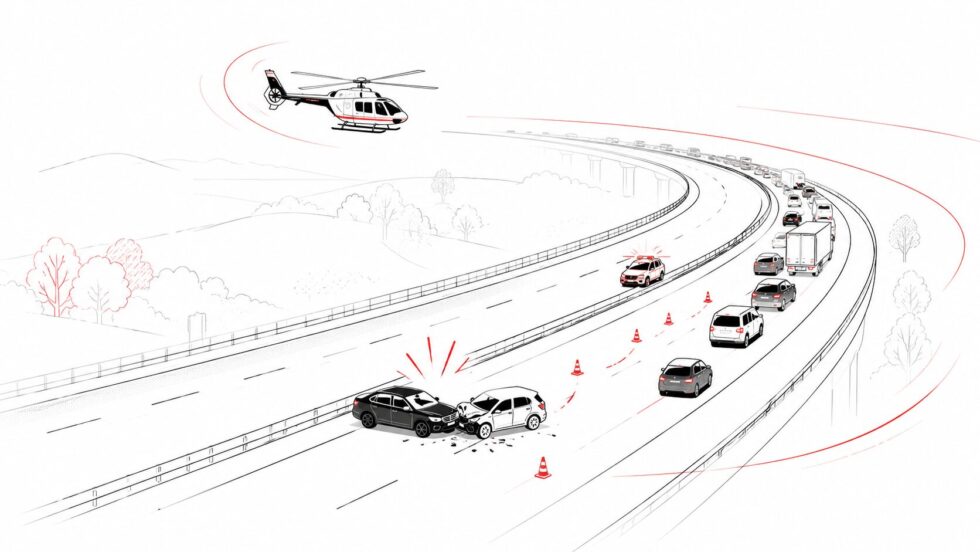
M25 accident today caused major disruption on Wednesday, 24 June 2026, after emergency services were called at about 10:00 BST to a serious two-vehicle crash on the clockwise carriageway between junctions 6 and 7 near Godstone in Surrey. A man was airlifted to hospital after suffering a leg injury, part of the motorway was closed, and drivers were warned to expect lengthy delays during the summer hot spell, The WP Times reports.
The incident affected one of the busiest orbital motorway sections around London during the late morning and afternoon. Surrey Police, South East Coast Ambulance Service, fire crews and National Highways dealt with the scene, while access at junction 5 was closed to prevent additional traffic joining the affected stretch. National Highways later indicated that around 300 to 400 metres of fuel had been left on the road, meaning resurfacing work was expected across all four lanes before the carriageway could safely reopen.
M25 accident today near Godstone: where the crash happened and what police confirmed
The crash happened on the M25 clockwise between junction 6 for Godstone and junction 7, a section used by drivers heading around the south-eastern side of the London orbital route. Surrey Police said two vehicles were involved in the serious collision, and emergency services were called to the scene during the morning. South East Coast Ambulance Service said it was called at about 10:00 BST and that one male patient had suffered a leg injury. He was airlifted to hospital for further treatment.
The motorway closure created queuing traffic and a wider knock-on effect because the M25 connects drivers moving between Surrey, Kent, Gatwick routes and the wider London motorway network. Police also closed access at junction 5 to prevent additional vehicles joining the affected stretch. That step usually indicates that trapped traffic and emergency access have become part of the operational problem, not just the collision itself. For motorists, the most important confirmed point is that this was not a minor lane closure. It was a serious motorway incident involving emergency services, an air ambulance response and road-surface work after the collision. Drivers already caught between junctions 5 and 6 were told not to leave their vehicles, with police saying traffic was expected to start moving when safe.
Key facts known today
| Detail | What is known |
|---|---|
| Road | M25 clockwise |
| Location | Between junctions 6 and 7, near Godstone, Surrey |
| Date | Wednesday, 24 June 2026 |
| Vehicles | Two vehicles involved |
| Casualty | One man airlifted to hospital |
| Injury reported | Leg injury |
| Emergency call | Around 10:00 BST |
| Traffic impact | Long delays and closures |
| Extra issue | Fuel on the carriageway requiring resurfacing |
Why the M25 closure became more serious: fuel on the road and heat damage risk
The traffic impact appears to have been extended by a fuel spillage on the carriageway. National Highways South-East said there was around 300 to 400 metres of fuel on the road, and because of the length of time it remained there during hot weather, resurfacing work was expected to be needed across all four lanes. That detail matters because it changes the incident from a crash response into a road-safety and repair operation.
Fuel on a motorway surface can create several hazards. It can reduce tyre grip, increase braking distance and make lane reopening unsafe until the surface has been treated properly. In high temperatures, the problem becomes more complicated because road materials can be affected by heat, contamination and surface degradation. That is why traffic may remain stopped even after vehicles have been recovered and emergency medical work has finished.
National Highways indicated that a full carriageway closure was anticipated for resurfacing. For drivers, this means the delay is not only connected to police investigation or casualty care. It is also linked to the physical condition of the road and whether all lanes can safely reopen. This is especially important on the M25 because even a short closure can quickly spread congestion across several junctions. When an incident affects all lanes, traffic officers must manage trapped traffic, diversion pressure and emergency access at the same time. In this case, the location near Godstone also affects drivers using routes toward Sevenoaks, Gatwick, Reigate, Redhill and the wider Surrey-Kent border area.
What drivers should do after the M25 accident near junctions 6 and 7
Drivers heading toward this part of the M25 should avoid assuming that delays will clear quickly. Even when emergency vehicles leave the scene, resurfacing, debris removal, fuel treatment and safety inspections can keep a carriageway closed for longer than expected. Anyone travelling clockwise through Surrey should check live traffic information before setting off and allow substantial extra time. The most practical advice is to avoid the affected area where possible and use alternative routes only if they are suitable for motorway-level traffic. Local roads around Godstone can quickly become congested when M25 traffic diverts, and smaller villages are not designed to absorb heavy flows of HGVs and commuter traffic. Drivers should not follow unofficial shortcuts blindly, especially if navigation apps send many vehicles through the same rural roads.
For anyone already trapped in stationary traffic, the police instruction is clear: do not leave the vehicle unless directed by emergency services. Walking on a motorway is dangerous, even when traffic appears stopped. Emergency lanes, hard shoulders and gaps between vehicles may still be used by police, fire, ambulance, recovery crews and traffic officers.
Motorists should remember:
- Check National Highways or live traffic updates before travelling.
- Avoid the Godstone section of the M25 if the closure remains active.
- Do not leave the vehicle while stationary on the motorway.
- Keep water in the car during hot weather.
- Leave space for emergency and recovery vehicles.
- Do not film the scene while driving past.
- Expect local roads around Godstone and Sevenoaks to be busier than usual.
What officials said about the M25 crash and delays
Surrey Police asked motorists to avoid the area and allow extra time for their journeys. The force said further updates would be provided when available and thanked drivers for their patience. The message reflects the usual police priority in a serious motorway crash: secure the scene, help the injured, protect emergency workers and prevent further collisions. South East Coast Ambulance Service confirmed that it was called to the scene at about 10:00 BST and that the male patient had suffered a leg injury. The fact that he was airlifted to hospital shows the seriousness of the emergency response, although no further medical detail should be assumed beyond what has been officially confirmed.
National Highways South-East also indicated that the road surface had become a major issue because fuel had spread over a long section of carriageway. The agency’s update that resurfacing was expected across all four lanes is significant because it helps explain why disruption may continue beyond the immediate crash response. In a fast-moving traffic incident, the exact reopening time can change. Police may need to complete scene work, recovery teams may need to remove vehicles, and highways crews may need to confirm the road is safe before traffic is released. That is why official updates are more reliable than estimated times circulating on social media.
Why this M25 accident caused wider disruption during the summer hot spell
The crash happened during a hot spell, which made the conditions more difficult for both drivers and emergency workers. Stationary motorway traffic in high temperatures can become uncomfortable and potentially risky, especially for elderly passengers, children, pets and people with medical conditions. Long delays also increase the chance of secondary incidents, including breakdowns, overheating engines and driver frustration.
The M25 is particularly vulnerable to this kind of disruption because it carries local, regional and long-distance traffic at the same time. A closure near Godstone can affect commuters, airport passengers, freight vehicles and drivers moving between Kent, Surrey and the south of London. When junction access is restricted, delays can also move backward onto feeder routes.
The fuel-spillage element adds another layer. If fuel remains on the road surface, traffic cannot simply be released as soon as damaged vehicles are moved. Highways teams must judge whether the carriageway is safe for fast-moving traffic and whether the surface needs repair before reopening. That process can be slow, especially across multiple lanes. This explains why drivers may see emergency vehicles, then recovery vehicles, then resurfacing teams, and still face delays. Each stage has a different purpose. Medical response protects the injured, police management protects the scene, recovery clears vehicles, and road crews make the motorway safe again.
What happens next on the M25 after a serious crash like this
After a serious motorway collision, the first phase is emergency response. Ambulance crews treat casualties, police secure the scene, and fire crews may assist with vehicle safety, fuel, access or rescue. If an air ambulance attends, traffic may need to remain stopped to protect the landing area and medical team.
The second phase is traffic management. National Highways and police decide whether trapped traffic can be released, whether vehicles should be turned around, and whether junctions should be closed to stop more traffic entering the affected section. In this case, the closure at junction 5 was used to prevent additional traffic from joining the motorway.
The third phase is recovery and inspection. Damaged vehicles must be removed, debris cleared and the road surface checked. If fuel has spread across lanes, specialist cleaning or resurfacing may be required. That appears to be one of the central issues in this incident.
The final phase is reopening, which may happen lane by lane or through a full reopening after safety checks. Drivers should not treat any estimated reopening time as guaranteed. In serious crashes, timings can change quickly depending on medical, police and road-surface conditions.
M25 accident today: what is still not known
Several important details have not been officially confirmed. Police have not released the full circumstances of the collision, the identities of those involved or whether any investigation will lead to witness appeals. It is also not yet clear from the available official information exactly how long the full closure and resurfacing work will last.There is also no confirmed public detail about the condition of the injured man beyond the reported leg injury and transfer to hospital. In a serious collision, further updates may come later from police, ambulance services or National Highways. Until then, responsible reporting should avoid speculation about cause, speed, fault or the sequence of the crash.
What is clear today is that the M25 accident near Godstone caused a serious emergency response, a major traffic closure and a road-surface problem linked to fuel on the carriageway. For drivers, the safest course remains simple: avoid the area, check live updates and follow police and National Highways instructions.
Read about the life of Westminster and Pimlico district, London and the world. 24/7 news with fresh and useful updates on culture, business, technology and city life: Will Schools Close If Too Hot? What Parents Need To Know As Britain Faces 38C June Heatwave