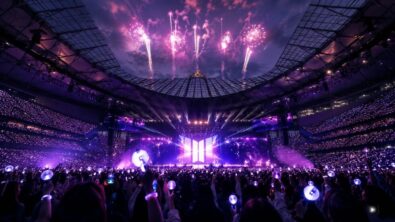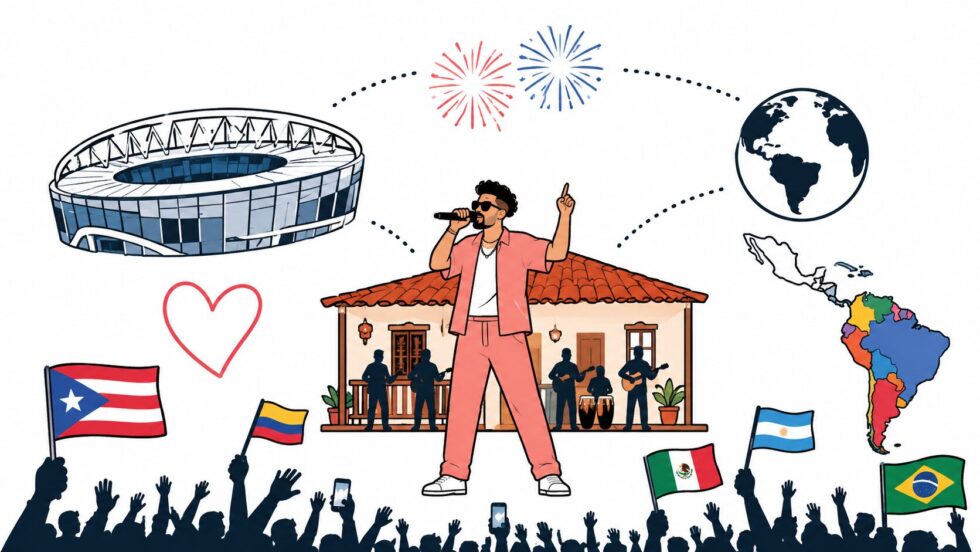
Bad Bunny made British live-music history on Saturday, 27 June 2026, when he became the first Latin American artist to headline a UK stadium, turning Tottenham Hotspur Stadium into a vast Spanish-language celebration of music, memory and identity. The Puerto Rican star, whose real name is Benito Antonio Martínez Ocasio, played the first of two sold-out London nights on his DeBÍ TiRAR MáS FOToS World Tour, drawing around 50,000 fans to north London for a show that mixed reggaeton, trap, salsa, Puerto Rican folk sounds and stadium-scale theatre, The WP Times reports.
The concert was more than a pop spectacle. It was also a cultural moment for Britain’s Latin American communities, with flags from across the region filling the crowd, celebrity guests watching from the stands and Bad Bunny using the night to send solidarity to Venezuela after deadly earthquakes. From the opening songs to the final chorus, the show carried the mood of a street party, a family gathering and a political statement without becoming a speech: London became “Londres”, and a UK stadium briefly felt like the centre of a much wider Spanish-speaking world.
Why was the Bad Bunny London show so important
The key point is simple: this was not just another major concert in London. It marked the first time an artist from Latin America had headlined a stadium in the UK. For a British market long dominated by English-language pop, rock, rap and dance acts, the scale of the event showed how far Spanish-language music has moved from niche listening to mainstream stadium culture.
Bad Bunny did not dilute the show for an English-speaking crowd. He addressed fans almost entirely in Spanish, reportedly asking the audience’s permission at the start before continuing in his own language. That choice mattered. It made the concert feel less like an export carefully adjusted for Britain and more like a direct arrival: Puerto Rico, Latin America and the diaspora occupying one of London’s biggest stages on their own terms. The audience reflected that shift. Thousands arrived with flags from Puerto Rico, Colombia, Venezuela, Honduras, Mexico, Argentina, Chile and beyond. Some were long-time fans who had followed Bad Bunny since his SoundCloud-era rise and early trap records. Others were newer listeners drawn in by his global hits, his Grammy success and the growing British interest in Latin music. The result was a crowd that felt both specific and broad: deeply Latin, but not closed to anyone willing to dance.
What happened at Tottenham Hotspur Stadium
The show was staged at Tottenham Hotspur Stadium in north London, a venue built for Premier League football, NFL games and the modern stadium-concert economy. On Saturday night, however, the atmosphere was closer to a giant block party than a conventional arena performance. Bad Bunny’s current tour is built around DeBÍ TiRAR MáS FOToS, often shortened to DTMF. The title means “I should have taken more photos”, and the album’s emotional centre is memory: family, youth, homeland, missed moments, lost places and the ache of looking back. That idea shaped the concert visually and musically.
A major feature was La Casita, a Puerto Rican-style house used as a second stage. Instead of relying only on futuristic screens, long catwalks and cold digital effects, the production placed a home at the heart of the stadium. It gave the performance a warmer, communal feeling. Bad Bunny moved between the main stage and the house-like set, making the show feel at times like the world’s biggest family party. The production was huge, but not empty. Fireworks, lights, live musicians, crowd cameras and stadium visuals all played their part, yet the show’s strongest image was domestic rather than mechanical: a house, musicians, dancing, flags and people singing in Spanish together in London.
Which songs shaped the night
The set leaned heavily on DeBÍ TiRAR MáS FOToS, the album behind the tour. The night opened with La Mudanza, a track that immediately placed movement, home and identity at the centre of the evening. That was a smart opening choice because it made the show’s emotional language clear before the party fully exploded. Nuevayol was one of the songs that pushed the stadium into a louder, looser mood. Even for people who did not understand every lyric, the rhythm and hooks worked instantly. That is one of Bad Bunny’s biggest strengths as a live artist: the songs carry enough melodic and rhythmic force to reach beyond language, while still rewarding fans who understand the words.
Across the three-hour performance, he moved through different phases of his career: Latin trap, reggaeton, salsa-influenced arrangements, softer emotional moments and big communal choruses. The show reminded newer British fans that Bad Bunny’s rise did not happen with one viral hit. It came from years of building a sound that could move between club music, street music, melancholy pop and cultural storytelling.
There were quieter stretches for casual listeners, especially during deeper cuts from his discography. But for long-time fans, those moments mattered. They gave the concert weight and history, showing how an artist who once seemed like a disruptive outsider has become one of the world’s defining live performers.
Who was in the crowd
The night also had a celebrity edge. Adele was spotted in the stands, Maya Jama was seen around La Casita, and Novak Djokovic appeared days before Wimbledon, introducing a song. Their presence added a layer of British pop-culture attention, but they were not the centre of the story. The real focus was the crowd. Fans came dressed for heat, humidity and celebration. Many carried flags. Many filmed almost every chorus. Many treated the night as a personal milestone, not just a concert ticket. For younger Latin fans in Britain, the show was a moment of visibility: proof that their language, music and identity could fill one of the country’s major stadiums. That visibility is important because Latin American communities in the UK are often culturally present but institutionally under-recognised. London has long had Latin neighbourhoods, businesses, restaurants, clubs and community networks, especially around areas such as Seven Sisters and Elephant and Castle. But a stadium show of this size turned that presence into something impossible to miss.
What was the Venezuela moment
One of the most emotional parts of the concert came when Bad Bunny paid tribute to Venezuela after deadly earthquakes. His message was brief but powerful, telling Venezuelans that Latinos around the world stood with them.
That moment changed the mood of the night without stopping the concert’s energy. It showed how Bad Bunny’s role has grown beyond entertainment. He is now treated by many fans as a cultural voice: someone who can bring attention to Latin American pain, pride and politics in spaces that do not normally centre those stories. The speech also fitted the wider tone of the tour. Bad Bunny did not turn the London concert into a formal political rally. He did not need to. The politics were already there in the language, the flags, the set design, the decision to centre Puerto Rican identity and the repeated message that places and people should not be erased.
Why does La Casita matter
La Casita is one of the most discussed parts of the tour because it carries several meanings at once. On the surface, it is a stage prop: a Puerto Rican-style home placed inside a stadium. But visually it says much more. It suggests memory, neighbourhood, family, migration and the fragile idea of home. For Puerto Rican fans, it points towards local architecture and cultural memory. For diaspora fans, it speaks to the feeling of carrying home with you into another country. For British audiences, it offers a different kind of stadium spectacle: not just a superstar on a giant platform, but a superstar bringing a house, a street and a community into the venue.
That is why the show did not feel like a standard global pop tour. Many stadium concerts try to look bigger than life. Bad Bunny’s tried to make the stadium feel smaller, warmer and more human.
What does this say about Spanish-language music in Britain
Bad Bunny’s London show is part of a wider shift. Spanish-language music is no longer only a holiday soundtrack or a club-night category in the UK. It is now a serious commercial force. Rosalía has sold out major venues, Karol G is set to play Tottenham Hotspur Stadium next summer, and younger British listeners are increasingly comfortable with music that does not need English to feel immediate. The old assumption was that language would limit Latin artists in Britain. Bad Bunny challenges that. His London audience did not need every word translated. Some understood everything. Some understood enough. Some understood almost nothing but still responded to the rhythm, production and emotion. That does not mean the language barrier has disappeared. Radio play, press coverage and casual audience growth can still be harder for non-English artists in the UK. But the ceiling is clearly higher than many in the British industry once assumed.
The bigger message is that Bad Bunny’s success is not just about crossing over. It is about refusing to leave his identity behind while doing it. He did not become a UK stadium headliner by becoming less Puerto Rican or less Spanish-speaking. He did it by making those things central to the offer. That is why Saturday’s concert felt historic. It was not only a first for an artist. It was a first for a community of listeners who saw themselves represented at a scale usually reserved for English-language superstars.
By the end of the night, the album title had become almost literal. DeBÍ TiRAR MáS FOToS is about wishing you had captured more of the moments that mattered. In Tottenham, thousands tried to avoid that regret, holding phones high as they filmed songs, friends, flags and fireworks. Bad Bunny will leave London after two sold-out nights, but the significance of the weekend is likely to last longer. It showed that Latin music in Britain is not waiting politely outside the mainstream. It is already inside the stadium.
Who is Bad Bunny
Bad Bunny, born Benito Antonio Martínez Ocasio on 10 March 1994 in Vega Baja, Puerto Rico, is one of the world's biggest recording artists and the leading global figure in Spanish-language music. He first gained attention in 2016 by uploading songs to SoundCloud while working as a supermarket bagger, before signing with the independent label Hear This Music.
Blending reggaeton, Latin trap, hip-hop, salsa, merengue and traditional Puerto Rican rhythms, Bad Bunny has transformed Latin music from a regional genre into a global mainstream force without switching to English. His albums have topped charts across the Americas and Europe, while his stadium tours regularly sell out within hours.
He has won multiple Grammy and Latin Grammy Awards, became the first artist with an all-Spanish-language album to win the Grammy for Album of the Year with Debí Tirar Más Fotos in 2026, and is consistently among the world's most-streamed artists on major music platforms.
Beyond music, Bad Bunny is known for promoting Puerto Rican culture, Latin American identity and social issuesthrough his concerts, videos and public appearances. His performances often combine large-scale stadium production with symbols of home, family and Caribbean heritage, making cultural identity a central part of his global appeal rather than a backdrop to it.
Read about the life of Westminster and Pimlico district, London and the world. 24/7 news with fresh and useful updates on culture, business, technology and city life: What are tonight’s Lotto results and National Lottery numbers for Saturday 27 June 2026