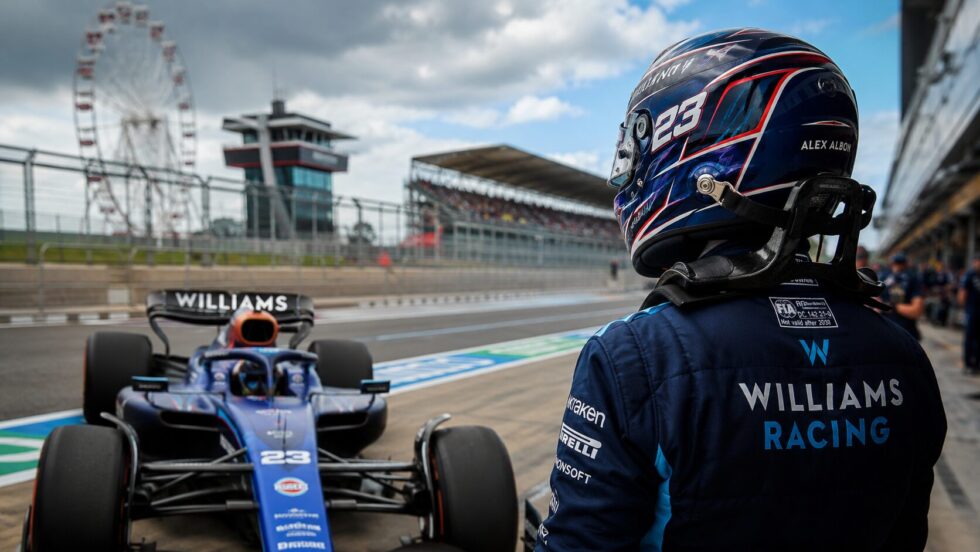
Alex Albon will start the British Grand Prix Sprint from the pit lane after Williams changed the suspension set-up on his car under parc fermé conditions at Silverstone, turning a difficult but manageable 16th-place Sprint start into a full strategic reset for the Grove-based team. The FIA decision was issued on Saturday, 4 July 2026, before the Sprint, after officials found that Car 23 had been altered without the required approval, The WP Times reports.
The ruling means Albon loses his place on the Sprint grid and must begin from the pit lane, while team-mate Carlos Sainz keeps his normal starting position because the same suspension change was not made on his car. For Williams, this is not only a penalty story. It is also a sign that the team preferred to sacrifice track position in the short Sprint to gather data, improve balance and protect its wider British Grand Prix weekend.
Why was Alex Albon demoted by the FIA at Silverstone
Alex Albon was demoted because Williams changed the suspension set-up of his car after parc fermé rules were already in force. Under Formula 1’s parc fermé system, teams are heavily restricted from making performance-related set-up changes once cars have entered the controlled period.
The FIA document said the suspension set-up of Albon’s Williams had been changed without approval from the Technical Delegate, which triggered a mandatory pit-lane start for the Sprint. Reports cite Articles B3.5.3 and B3.5.4 of the FIA F1 Regulations as the basis for the action. Williams confirmed the move in a short statement, saying the pit-lane start would allow the team to make set-up changes and “gather learnings” for the rest of the weekend and the season.
What does the Alex Albon pit-lane start mean for Williams
For Albon, the penalty removes any realistic chance of converting a midfield Sprint position into points unless the race becomes chaotic. Sprint races are short, pit stops are usually limited, and track position matters more than long-run tyre strategy. For Williams, the calculation appears different. Starting 16th was already a difficult route to points. By accepting the pit-lane start, the team could change the car in a way that may help Albon understand balance, tyre behaviour and race pace before the main Grand Prix.
| Detail | Confirmed position |
|---|---|
| Driver | Alex Albon |
| Team | Atlassian Williams F1 Team |
| Car | No 23 |
| Event | 2026 British Grand Prix Sprint |
| Original Sprint start | 16th |
| New start | Pit lane |
| Reason | Suspension set-up changed under parc fermé |
| Team-mate affected? | No, Carlos Sainz remained on the grid |
Parc fermé rules exist to stop teams from qualifying with one type of car and racing with another. Once the car enters parc fermé, set-up changes are restricted so that the machine used in qualifying remains broadly the same for the race or Sprint.
Suspension settings are particularly important because they affect ride height, tyre contact, stability, kerb use, braking confidence and high-speed cornering balance. At Silverstone, that matters hugely. The circuit is fast, flowing and loaded with corners where a nervous rear end or poor front response can destroy lap time. That is why the Albon penalty is not a paperwork issue. Williams changed something that can directly influence performance.
Why is Alex Albon starting the British Grand Prix Sprint from the pit lane
Alex Albon will start the British Grand Prix Sprint from the pit lane after Williams changed the suspension set-up on his car under parc fermé conditions at Silverstone, turning a difficult but manageable 16th-place Sprint start into a full strategic reset for the Grove-based team. The FIA decision was issued on Saturday, 4 July 2026, before the Sprint, after officials found that Car 23 had been altered without the required approval, The WP Times reports.
The ruling means Albon loses his place on the Sprint grid and must begin from the pit lane, while team-mate Carlos Sainz keeps his normal starting position because the same suspension change was not made on his car. For Williams, this is not only a penalty story. It is also a sign that the team preferred to sacrifice track position in the short Sprint to gather data, improve balance and protect its wider British Grand Prix weekend.
Why was Alex Albon demoted by the FIA at Silverstone
Alex Albon was demoted because Williams changed the suspension set-up of his car after parc fermé rules were already in force. Under Formula 1’s parc fermé system, teams are heavily restricted from making performance-related set-up changes once cars have entered the controlled period. The FIA document said the suspension set-up of Albon’s Williams had been changed without approval from the Technical Delegate, which triggered a mandatory pit-lane start for the Sprint. Reports cite Articles B3.5.3 and B3.5.4 of the FIA F1 Regulations as the basis for the action.
Williams confirmed the move in a short statement, saying the pit-lane start would allow the team to make set-up changes and “gather learnings” for the rest of the weekend and the season.
What does the Alex Albon pit-lane start mean for Williams
For Albon, the penalty removes any realistic chance of converting a midfield Sprint position into points unless the race becomes chaotic. Sprint races are short, pit stops are usually limited, and track position matters more than long-run tyre strategy. For Williams, the calculation appears different. Starting 16th was already a difficult route to points. By accepting the pit-lane start, the team could change the car in a way that may help Albon understand balance, tyre behaviour and race pace before the main Grand Prix.
| Detail | Confirmed position |
|---|---|
| Driver | Alex Albon |
| Team | Atlassian Williams F1 Team |
| Car | No 23 |
| Event | 2026 British Grand Prix Sprint |
| Original Sprint start | 16th |
| New start | Pit lane |
| Reason | Suspension set-up changed under parc fermé |
| Team-mate affected? | No, Carlos Sainz remained on the grid |
What are parc fermé rules and why do they matter
Parc fermé rules exist to stop teams from qualifying with one type of car and racing with another. Once the car enters parc fermé, set-up changes are restricted so that the machine used in qualifying remains broadly the same for the race or Sprint.
Suspension settings are particularly important because they affect ride height, tyre contact, stability, kerb use, braking confidence and high-speed cornering balance. At Silverstone, that matters hugely. The circuit is fast, flowing and loaded with corners where a nervous rear end or poor front response can destroy lap time. That is why the Albon penalty is not a paperwork issue. Williams changed something that can directly influence performance.
Why would Williams accept a pit-lane start for Alex Albon
The likely reason is that Williams judged the original set-up was not good enough for the rest of the weekend. Albon had qualified for the Sprint, but 16th was not a strong points platform. A pit-lane start is painful, but it may be less costly than leaving the car in a compromised window. Albon later said Williams were “not going to score points if we don’t try something”, reflecting the team’s need to find a better direction at Silverstone.
That matters because Williams are racing at their home Grand Prix and need clean data from both cars. If Albon’s car was struggling with balance, tyre warm-up or high-speed stability, a suspension change could help the engineers understand whether the issue was set-up related rather than a deeper limitation of the package.
What did the FIA say about Alex Albon’s Williams
The FIA position was simple: Williams changed the suspension set-up of Car 23 under parc fermé without approval, and that breach required a pit-lane start. The decision was not framed as a discretionary sporting punishment but as the regulatory consequence of the change. In practical terms, the FIA did not need to prove intent or advantage. Once the car was changed in a restricted area of set-up, the rule applied.
How does this affect the British Grand Prix Sprint grid
Albon’s move to the pit lane meant the Sprint started with one fewer car in its original grid slot. The rest of the field moved through the normal start procedure, while Albon had to wait for the pit exit release. That creates two immediate problems. First, he loses the launch phase, where drivers can gain places into Turn 1. Second, he starts behind the field and must deal with dirty air, tyre temperature and limited laps to recover.
At Silverstone, overtaking is possible, especially with DRS, but the Sprint distance gives little time to rebuild a race from the back.
The bigger question is whether the set-up change helps Williams for Sunday’s Grand Prix. If Albon’s car becomes more stable and predictable, the team may view the Sprint sacrifice as useful. If the change fails to produce better pace, then Williams will have lost track position without gaining much in return. The Saturday Williams report described a busy Sprint and qualifying day at Silverstone, with both cars reaching the second phase of qualifying for the second successive day. That gives the team some encouragement, even if Albon’s Sprint was damaged before it began. Alex Albon’s pit-lane start matters because it shows how tight Formula 1’s Sprint weekends have become. Teams get less practice, less time to correct mistakes and fewer opportunities to experiment once parc fermé begins.
Williams made a deliberate trade-off: lose Sprint track position now, try to improve the car for later. For Albon, that means a difficult afternoon at Silverstone. For Williams, it may still be valuable if the data helps the team unlock a better race car for the main British Grand Prix.
Read about the life of Westminster and Pimlico district, London and the world. 24/7 news with fresh and useful updates on culture, business, technology and city life: When will Oasis 2027 tour dates be announced and could 12 Etihad nights define Manchester next summer