The Claire's UK collapse reached its decisive point on 27 April 2026, when the accessories retailer closed the last of its 154 standalone shops across the UK and Ireland and made about 1,300 employees redundant. The shutdown followed the company's second administration in less than a year and appeared to end three decades of Claire's as a familiar destination in British shopping centres and high streets, The WP Times reports, citing appointment documents from administrators Interpath Advisory and Kroll, filings connected to the US Chapter 11 process, and UK retail trade coverage.
Yet within days of the final closures, French jewellery entrepreneur Julien Jarjoura disclosed plans to rebuild a much smaller Claire's business in Britain. Backed by the brand's American owner, Ames Watson, he said he intended to secure new leases for about 50 shops, reopen between four and 10 locations a week and operate the revived business without the debts, old stock and central-office costs carried by its predecessor. "The brand was basically dead and we're bringing it back to life," Jarjoura told The Guardian (Julien Jarjoura, interview with The Guardian, London, May 2026).
The proposed return does not reverse the administration or restore the company that employed 1,300 people. It represents a separate, privately funded attempt to use the Claire's name, selected locations and the chain's strongest commercial assets — particularly ear piercing, brand recognition and its position among younger shoppers — without taking on the failed UK company's full estate and liabilities. As of 12 July 2026, the closure of the former estate is confirmed, as is Jarjoura's plan to re-establish roughly 50 shops. However, no authoritative public list confirming that all 50 stores have opened has been released. The accurate description is therefore that Claire's is attempting a phased UK comeback, not that the planned revival has already been completed.
What happened to Claire's in the UK and Ireland
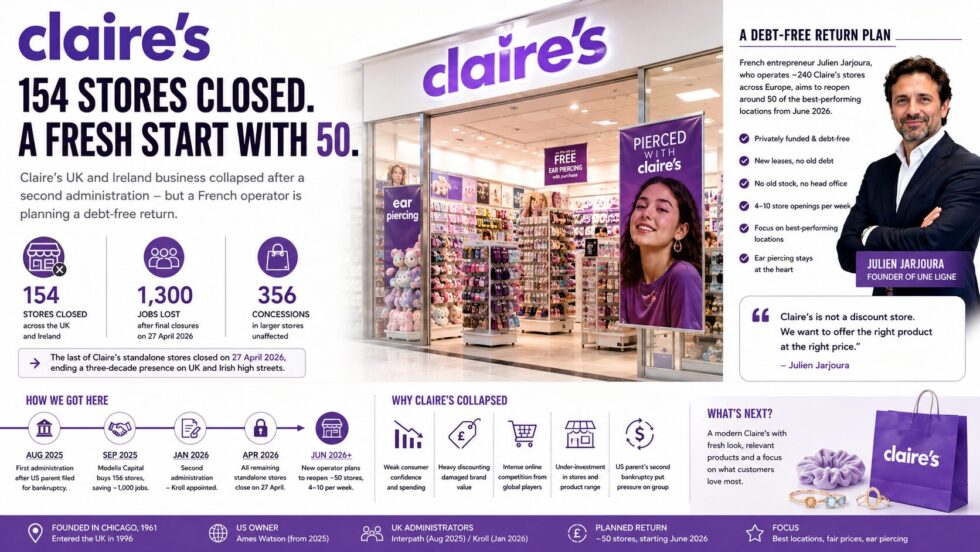
Claire's Accessories UK entered administration for the first time in August 2025 after its US parent filed for Chapter 11 bankruptcy protection. Will Wright and Chris Pole of Interpath Advisory were appointed joint administrators to Claire's Accessories UK Ltd, Claire's European Services Limited and Claire's European Distribution Limited on 13 August 2025 (Interpath Advisory statement, Birmingham, 13 August 2025). At that stage, the British and Irish business operated 306 shops — 278 in the UK and 28 in Ireland — employed more than 2,150 people, and had recorded a pre-tax loss of about £4m on sales of £137m in its latest published accounts.
The appointment followed a formal notice by the US group. "This decision, while difficult, is part of our broader effort to protect the long-term value of Claire's across all markets," said Claire's chief executive Chris Cramer at the time (Chris Cramer, Claire's statement, August 2025). Interpath said it would keep trading the stores while searching for a buyer. "Claire's has long been a popular brand across the UK, known not only for its trend-led accessories but also as the go-to destination for ear piercing," said Will Wright, UK chief executive at Interpath (Will Wright, Interpath Advisory, Birmingham, August 2025). "Over the coming weeks, we will endeavour to continue to operate all stores as a going concern for as long as we can, while we assess options for the company." A partial rescue was announced on 29 September 2025. Modella Capital agreed to acquire 156 stores from the administrators, protecting approximately 1,000 jobs. A further group of locations remained under Interpath's control while their future was assessed. The deal preserved a substantial section of Claire's estate, but it did not resolve the commercial weaknesses that had pushed the business into insolvency. The rescued operation entered the important Christmas period with a reduced store network but continued to face weak demand, high operating expenses and the legacy of years of under-investment.
In January 2026, only months after the acquisition, Modella placed Claire's back into administration. Kroll was appointed to handle the second insolvency process. The business traded through successive store closures during the following months. By late April, attempts to sell or rescue the remaining operation had failed. The last standalone stores stopped trading on 27 April 2026, completing the closure of all 154 Claire's locations then operated by the insolvent UK and Irish company. Around 1,300 employees were informed that they were being made redundant, across England, Scotland, Wales, Northern Ireland and the Republic of Ireland.
It is important to distinguish those 154 stores from Claire's concession business. Approximately 356 concessions — smaller Claire's-branded sections situated inside larger retailers — were not included in the immediate closure of the standalone estate. Some continued trading while discussions over their longer-term future took place.
Claire's UK collapse: the confirmed figures
| Fact | Confirmed detail |
|---|---|
| First UK administration | 13 August 2025 |
| First administrator | Interpath Advisory (Will Wright, Chris Pole) |
| Estate before the first administration | 306 UK and Irish stores (278 UK, 28 Ireland) |
| Employees initially at risk | More than 2,150 |
| Latest published accounts | ≈£4m pre-tax loss on £137m sales |
| Stores acquired by Modella Capital | 156 |
| Jobs protected in the September 2025 deal | Approximately 1,000 |
| Second administration | January 2026 |
| Second administrator | Kroll |
| Final standalone closures | 27 April 2026 |
| Standalone stores closed | 154 across the UK and Ireland |
| Redundancies | Approximately 1,300 |
| Concessions outside the immediate closure | Approximately 356 |
| US owner | Ames Watson ($140m: $104m cash + $36m seller note, Sept 2025) |
| Proposed new UK operator | Julien Jarjoura (Une Ligne) |
| Proposed revived estate | About 50 shops, 4–10 a week from June 2026 |
The figures show that the April shutdown was not Claire's first contraction. It was the final stage of a restructuring that had already removed almost half of the original 306-store estate in 2025.
Why did Claire's collapse
There was no single cause. Claire's failure resulted from the combination of excessive financial pressure, weak trading, structural changes in retail and a store proposition that had not been modernised quickly enough.
The US parent entered bankruptcy again
Claire's global difficulties were central to the UK crisis. Claire's Holdings LLC commenced voluntary Chapter 11 proceedings in the United States on 6 August 2025, its second US bankruptcy in seven years. The group had previously entered bankruptcy in 2018 under the weight of billions of dollars in debt. Although it later emerged from that process, the underlying challenge remained: Claire's operated a large international store network at a time when younger consumers were moving towards online marketplaces, social-commerce platforms and faster-changing fashion competitors.
The 2025 bankruptcy once again placed the group's international divisions under pressure, and the UK and Irish subsidiary entered administration only days after the American filing. Ames Watson subsequently bought the North American business and Claire's intellectual property for $140m — structured as $104m in cash plus a $36m seller note — in a deal completed in September 2025 (Ames Watson announcement, Columbia, Maryland, 19 September 2025). That transaction allowed the brand to survive in the US, preserving at least 795 of roughly 1,500 North American stores, but it did not automatically rescue the European subsidiaries or cover the liabilities of the British company. "Claire's is one of those rare brands that defines a stage of life," said Lawrence Berger, partner and co-founder at Ames Watson (Lawrence Berger, Ames Watson, September 2025).
The UK business was already losing money
Claire's UK operation had recorded a pre-tax loss of about £4m on sales of £137m for the year ending 3 February 2024. A loss of that scale was serious but not necessarily fatal for a retailer with more than 300 stores. The larger problem was that Claire's had limited room to absorb further pressure. It faced rent, staffing, energy and supply-chain costs across a wide estate. At the same time, its core customers were highly price-sensitive and had access to thousands of inexpensive accessories through Amazon, Shein, Temu, TikTok Shop and supermarket clothing ranges. That left the retailer caught between rising operating expenses and limited power to raise prices.
Consumer behaviour had changed
Claire's built its reputation before smartphones and social commerce transformed how children and teenagers discovered fashion. For years, a visit to Claire's was part of the shopping-centre experience: customers browsed earrings, hair accessories, friendship jewellery, make-up and licensed products in person, and ear piercing provided an additional reason to visit a physical store. By the mid-2020s, trends moved far more quickly. A product promoted by an influencer could become popular and disappear again within weeks, and digital competitors could identify that demand, manufacture similar products and advertise them directly to consumers without operating hundreds of high-street stores. Claire's retained strong name recognition, but recognition alone did not guarantee that customers would make regular purchases.
Stores suffered from under-investment
Julien Jarjoura, who operates Claire's stores elsewhere in Europe, argued that the British estate had not received enough investment. He believes the chain's problems were largely down to a lack of investment in stores, products not right for the UK market and prices that were too high, meaning many items ended up being discounted (Julien Jarjoura, interview with The Guardian, May 2026). That criticism went beyond cosmetic store design: under-investment can affect lighting, displays, stock presentation, piercing areas, staff levels, technology and the speed at which stores receive relevant products. A retailer aimed at children, teenagers and parents has to feel current. Shops that appear cluttered, tired or disconnected from social-media trends quickly lose relevance, even when the brand remains widely known.
The product range and heavy discounting damaged the offer
Jarjoura also argued that Claire's product selection had not been sufficiently adapted to UK customers. International retail brands often fail when central buying teams assume the same products, prices and campaigns will work in every country, but preferences vary by market, school culture, age group and season. Claire's also became associated with large multi-buy promotions. Discounts can clear stock, but permanent promotion trains customers not to pay full price, and the stated price loses credibility because shoppers expect a bigger offer later. "We are not a discount store but we like to sell stuff at a fair price," Jarjoura said, criticising deals in which shoppers were encouraged to buy three products and receive four (Julien Jarjoura, interview with The Guardian, May 2026). The revived range is expected to begin at about £1.90 and extend beyond £100, creating room for both inexpensive accessories and more valuable jewellery.
What was Modella Capital's role
Modella Capital did not own Claire's global brand. It bought the majority of the UK and Irish store operation from the first administration in September 2025. The acquisition of 156 stores saved about 1,000 jobs and gave the business a chance to continue trading. However, the turnaround window was extremely short. Only a few months later, Claire's and another Modella-owned retailer, The Original Factory Shop, were placed into administration. At the time, Modella pointed to rising taxes and difficult high-street trading conditions and concluded that the businesses no longer had a realistic prospect of returning to profitable trading.
The second administration demonstrates the limitations of buying a distressed retail estate without first resolving its deeper trading problems. Removing some stores and liabilities can stabilise a company temporarily, but it does not automatically repair weak merchandise, falling footfall, poor customer perception or an expensive store network.
Who is Julien Jarjoura
Julien Jarjoura is the French entrepreneur behind jewellery company Une Ligne and an established operator of Claire's shops in continental Europe. He runs approximately 240 Claire's stores across France, Austria, Portugal and Spain, giving him direct experience of the brand, its supply system and its customer base. Jarjoura had explored buying the UK business before the final closure, first attempting an acquisition in January 2026. After the old company stopped trading, he secured approval from Ames Watson to bring Claire's back to Britain under a new structure.
His plan is not to acquire the failed British company intact. Instead, he is creating a new operation through fresh agreements with landlords and the American brand owner. "A lot of people think Claire's is a British brand. It is extremely famous in the UK and there is no way it is going away," Jarjoura said (Julien Jarjoura, interview with The Guardian, May 2026). That distinction is central to the economics of the proposed relaunch.
How will the new Claire's business work
The proposed UK company is intended to be privately funded and debt-free. Jarjoura said he was using his own capital and did not expect the business to produce an immediate profit. He began negotiating new leases with landlords and aimed to open between four and 10 shops a week, building towards an initial estate of about 50 locations. Rather than reopening every available branch, he is targeting sites believed to have the strongest potential. The model removes several of the largest burdens carried by the previous operation.
No legacy debt
The revived operator is not assuming the old company's debts. This allows the new business to direct cash towards rent, wages, products, shopfitting and marketing rather than servicing liabilities created before the relaunch.
New leases instead of the full estate
Jarjoura is negotiating directly with landlords rather than taking responsibility for all 154 former shops. That gives him the ability to select locations according to current footfall, rent and expected sales. Landlords with empty Claire's units may also be prepared to offer more favourable terms than those agreed before the administration.
No old stock
He did not acquire the remaining inventory from Kroll. Old stock can appear to be an asset, but it often creates a substantial cost. Products may be outdated, duplicated, damaged or already associated with clearance sales. Starting with a newly selected range allows the operator to change the brand's presentation immediately.
No Birmingham head office
Jarjoura also declined to take over Claire's former Birmingham headquarters. A central office carries rent, management salaries, technology costs and administrative functions. Operating the UK estate within a wider European structure may allow the new company to share buying, logistics and management resources. However, it remains to be seen whether a leaner central operation can support 50 British stores effectively.
Selected former managers
Some former Claire's UK executives have been recruited for the new operation. That gives the revived company access to local knowledge without restoring the full previous organisation. Former managers can help identify profitable sites, experienced employees, suitable landlords and products that performed well in Britain.
Will Claire's continue ear piercing?
Yes. Ear piercing is expected to remain a central service in the reopened shops. This is commercially important because ear piercing gives Claire's something that online competitors cannot deliver through a website or app. Customers must visit a store, often accompanied by a parent or guardian, and the appointment can then generate additional sales of starter earrings, aftercare products and accessories. The service also creates a personal connection to the brand: for many customers, Claire's is remembered not simply as a shop but as the place where they had their ears pierced for the first time. However, the service requires trained employees, strict hygiene standards and customer trust, so any revived business will have to invest in training and consistency rather than treating piercing merely as an add-on sale.
Have 50 Claire's stores already reopened?
Not on the basis of publicly verified information available by 12 July 2026. Reports published at the beginning of May said Jarjoura expected to start opening shops in June and intended to reach approximately 50 locations. Those reports described a plan, not a completed 50-store rollout. No comprehensive official list identifying all reopened UK locations had been published by 12 July, so it would be inaccurate to claim that Claire's had already reopened all 50 stores.
The safest formulation is that the new operator is working towards a network of roughly 50 British shops, with openings intended to take place in phases. This distinction matters because reopening a store requires more than obtaining brand permission. The operator must complete lease agreements, recruit staff, install stock and systems, arrange insurance, prepare piercing facilities and satisfy local compliance requirements.
Why the Claire's story matters for the UK high street
Claire's is an unusually clear example of how a retail brand can survive while the company operating it fails. The old UK and Irish business closed because its costs, liabilities and trading model were no longer sustainable. The brand itself still had value because customers recognised the name, landlords knew the retailer and the ear-piercing service continued to attract physical visits. Jarjoura's plan is effectively a test of whether that value can be separated from the failed corporate structure.
The strategy has become increasingly common in distressed British retail. Buyers acquire intellectual property, selected stores, websites or operating rights while leaving debts, expensive leases and surplus stock inside an insolvent company. That can preserve a brand, but it does not recreate the previous employer. The new business is usually smaller, more selective and less burdened by central costs, and many former employees and communities still lose their stores even when the name returns elsewhere. Claire's closure eliminated around 1,300 jobs; a 50-store successor would represent less than one-third of the former 154-store estate and would not replace all of those positions. The commercial logic is nevertheless clear: a smaller business can concentrate sales in the best locations, negotiate new rental terms and avoid supporting marginal stores.
Claire's collapse in the wider retail economy
The failure came during a difficult period for consumer-facing businesses. The Insolvency Service recorded 1,868 registered company insolvencies in England and Wales in May 2026. That was 10% lower than April and 16% lower than May 2025, but the number still demonstrated the persistent pressure facing companies after several years of inflation, expensive borrowing and weak consumer confidence. Of the May total, 1,423 cases were creditors' voluntary liquidations, 285 were compulsory liquidations, 135 were administrations and 25 were company voluntary arrangements. For the wider picture, see our guide to who has gone bust in the UK in 2026 and why.
Retailers have been particularly exposed because they face pressures on both sides of the profit equation. Labour, rent, business rates, energy and imports increase costs, while consumers resist higher prices and can switch to online competitors. Claire's was also vulnerable because much of its merchandise was discretionary — earrings, hair accessories and novelty products can be postponed when households become cautious. At the same time, the retailer could not simply eliminate its physical shops, because ear piercing and browsing were among the main reasons for choosing Claire's over a digital marketplace.
Can the Claire's relaunch succeed?
The new model has several advantages. It begins without the old company's financial liabilities, it can select only the strongest sites, negotiate new leases, install a new product range and use Jarjoura's existing European infrastructure. Claire's also retains valuable recognition among parents and younger shoppers, so the brand is not being launched from zero, which can reduce the cost of attracting customers. Ear piercing remains a significant point of difference, and a successful store can combine service revenue, jewellery sales and impulse purchases in a relatively small unit.
There are, however, substantial risks. The former business trained customers to expect heavy discounts, and changing that behaviour may take time; shoppers may reject higher-quality or more expensive jewellery if they continue to see Claire's primarily as a source of cheap accessories. The target customer is also difficult to retain, as children grow out of styles quickly while teenagers may regard a brand associated with younger girls as insufficiently sophisticated. Competition remains intense, with online marketplaces undercutting Claire's prices and beauty retailers, fashion chains and supermarkets increasingly selling accessories aimed at the same audience. The revived business must therefore offer more than a familiar logo: it needs relevant products, disciplined prices, clean stores, reliable piercing services and a credible connection to the way Generation Alpha discovers fashion.
What remains unknown on 12 July 2026?
Several important details have not been fully disclosed. There is no authoritative public list of all stores included in the planned 50-location estate, so the exact number already trading is unclear. The financial arrangements between Jarjoura and Ames Watson have not been published in detail; it is known that he has the American owner's approval to operate the brand, but the terms of the licensing or franchise agreement remain private. The number of former Claire's employees rehired by the new company has not been confirmed, nor is it clear how many of the approximately 356 concessions will remain open under the new structure and whether they will carry the same refreshed product range as the standalone shops. Finally, no revenue or profitability target has been disclosed. Jarjoura has said that he is not expecting immediate profit, which suggests the first stage will focus on rebuilding customer confidence and establishing a stable store network.
The central lesson from the Claire's collapse
The Claire's case should not be described simply as a closure followed by a rescue. The company that operated 154 standalone stores collapsed: its shops closed, its employees were made redundant and its liabilities remained in administration. What followed was an attempt to create a new, smaller and financially cleaner company around the surviving value of the Claire's brand. The speed of that process was striking — the final stores closed on 27 April, and the proposed 50-store relaunch was reported only days later. But speed does not guarantee success. The new operator still has to prove that Claire's can sell relevant products at credible prices without returning to the constant promotions that weakened the previous business.
The strongest factual conclusion on 12 July 2026 is therefore this: Claire's disappeared as a nationwide standalone UK and Irish retailer after its second administration, closing 154 shops and cutting around 1,300 jobs. Julien Jarjoura is now attempting to rebuild a smaller, debt-free UK operation of about 50 stores with new leases, new stock and a revised pricing strategy — but the full rollout and its commercial outcome remain unconfirmed.
Frequently asked questions
Did every Claire's store in the UK close?
All 154 standalone shops operated by the insolvent UK and Irish company closed by 27 April 2026, covering the UK and Ireland together. Approximately 356 concessions inside larger retailers were not included in the immediate standalone-store shutdown.
How many jobs were lost?
About 1,300 employees were made redundant when the remaining standalone estate closed.
When did Claire's enter administration?
The UK and Irish business first entered administration on 13 August 2025. A large part of the estate was bought by Modella Capital in September, but the rescued company entered administration again in January 2026.
Who owns the Claire's brand?
Ames Watson owns the North American business and Claire's intellectual property after acquiring them from the US bankruptcy process for $140m in September 2025.
Who is bringing Claire's back to Britain?
French entrepreneur Julien Jarjoura, founder of jewellery company Une Ligne and operator of about 240 Claire's shops in continental Europe, is leading the proposed UK relaunch with Ames Watson's approval.
How many Claire's stores are reopening?
Jarjoura announced a target of approximately 50 UK shops, opening between four and 10 stores a week from June 2026. As of 12 July, no complete authoritative list confirming all 50 openings had been published.
Is the new Claire's company taking over the old debts?
No. The proposed operation is privately funded and intended to be debt-free. It is not taking on the failed company's legacy debts, Birmingham head office or remaining old stock.
Will Claire's still pierce ears?
Yes. Ear piercing is expected to remain one of the main services offered by the revived shops.
Why did Claire's fail?
The collapse followed losses, rising operating expenses, weak consumer spending, under-investment in stores, strong online competition, an unsuitable product mix and excessive reliance on discount promotions. The bankruptcy of the US parent also destabilised the European operations.
Is Claire's recovery guaranteed?
No. The new structure has lower debt and fewer stores, but the operator must still rebuild customer trust, improve the range and compete with inexpensive online retailers.
Read about the life of Westminster and Pimlico district, London and the world. 24/7 news with fresh and useful updates on culture, business, technology and city life: The Hidden Labour Market Keeping London's Grandest
Homes Running