The Donald Trump NATO summit in Ankara ended with the American president praising “a lot of unity” among the alliance’s 32 countries, only hours after he had called Spain a “terrible partner”, demanded the suspension of US trade with Madrid, renewed his claim that Greenland should be controlled by Washington and attacked European governments for failing to support America’s war with Iran. The two-day gathering on 7 and 8 July nevertheless reaffirmed NATO’s Article 5 collective-defence guarantee, maintained American membership of the alliance and secured commitments on higher military investment, defence production and at least €70bn in equipment, assistance and training for Ukraine during 2026.
The result was not a conventional diplomatic reconciliation. NATO avoided an immediate political rupture and presented an agreed declaration, but European governments left Ankara with the same strategic concern with which they had arrived: the alliance remains dependent on American troops, intelligence, nuclear deterrence and logistical power, while its most important member is led by a president whose public position can change within hours. Trump’s transition from threats to praise therefore became the central story of the summit, exposing the difference between NATO’s formal military strength and the growing uncertainty surrounding the reliability of US political leadership, The WP Times reports, citing the Ankara declaration, official NATO figures, White House statements and Reuters reporting from the Turkish capital.
Donald Trump NATO summit began with attacks on Spain, Iran and Greenland
Trump arrived at the Ankara summit in a confrontational mood after the temporary ceasefire involving Iran failed to hold. Sitting beside NATO secretary general Mark Rutte, the US president said the ceasefire was “over”, described Iran’s leadership in highly personal terms and indicated that he was no longer certain he wanted to negotiate another agreement.
The confrontation with Tehran had not been formally launched as a NATO operation. Article 5 of the North Atlantic Treaty applies when a member suffers an armed attack under the geographical and legal conditions set out in the treaty; it does not automatically require every ally to participate in any separate military campaign initiated by Washington.
Trump nevertheless accused European governments of failing to support the United States sufficiently during the Iran conflict. His complaints reflected a broader interpretation of alliance loyalty, under which political support for American military decisions is treated as evidence of whether a country is a dependable partner.
“I am very disappointed in NATO. They were not there for us on Iran,” Trump said before the leaders’ meeting, according to Reuters coverage from Ankara. He later argued that the United States had been treated unfairly by countries benefiting from American protection. ([Reuters, 8 July 2026]) His most direct attack was aimed at Spain. Trump called Madrid a “terrible partner”, objected to its resistance to NATO’s 5% defence-investment commitment and instructed US Treasury secretary Scott Bessent to prepare an end to trade with the country.
“We are going to stop doing trade with Spain. They are a terrible partner,” Trump said during the summit. ([Reuters, 8 July 2026])
The declaration was politically dramatic but legally and economically difficult to execute. Spain is part of the European Union’s single market and common commercial policy, meaning Washington cannot always isolate trade with one EU state without affecting wider US-EU economic relations. No detailed embargo mechanism or timetable was announced during the summit.
Spanish Prime Minister Pedro Sánchez later said Trump’s tone softened after the president received more information about Spain’s military contribution. Madrid’s annual defence expenditure has nearly doubled to approximately €33bn, while its share of GDP has risen from about 0.98% in 2017 to close to NATO’s former 2% benchmark. Spain argues that the effectiveness of an ally should not be measured solely by a single percentage. Madrid points to its troops deployed on NATO missions, naval and air capabilities, participation in eastern-flank deterrence and the strategic importance of the American military presence at Spanish bases. The Sánchez government has resisted the full 5% target, warning that such expenditure could require reductions in public services or taxation increases. Spain’s position has made it the clearest internal opponent of the defence-spending settlement promoted by Trump.
Trump’s principal complaints before the Ankara meeting
- European allies had not supported Washington sufficiently during the Iran conflict.
- Spain was resisting the 5% NATO defence-investment commitment.
- European countries had relied excessively on US military protection.
- Denmark had not agreed to American control of Greenland.
- Some NATO members had failed to demonstrate what Trump considered political loyalty.
- The United States continued to carry capabilities that Europe could not rapidly replace.
Trump did not abandon these complaints when he later praised the alliance. Instead, NATO leaders succeeded in moving the summit towards issues on which he could claim that his pressure had already produced results.
Trump renewed his demand for US control of Greenland
The argument over Greenland added an extraordinary territorial dispute to a summit intended to demonstrate unity between treaty allies. During his meeting with Turkish President Recep Tayyip Erdoğan, Trump again said Greenland should be controlled by the United States rather than Denmark. He argued that Copenhagen was not investing enough in the Arctic territory and claimed that growing Russian and Chinese activity created a direct danger to American security. Greenland is a self-governing territory within the Kingdom of Denmark. Denmark and the United States are both founding NATO members, while Greenland is already covered by the alliance’s collective-defence framework. American forces also have long-standing access to the territory through defence arrangements with Copenhagen.
Danish Prime Minister Mette Frederiksen responded by saying Denmark was prepared to defend “every inch of NATO”, including all parts of the Danish kingdom.
“Greenland is not for sale,” Greenlandic Prime Minister Jens-Frederik Nielsen said as Danish and Greenlandic officials rejected the idea that the territory’s political future could be decided by Washington. ([Reuters, 8 July 2026])
The disagreement is not limited to symbolism. Greenland sits between North America and Europe, hosts the US Pituffik Space Base and is strategically important for missile warning, space surveillance, Arctic shipping and monitoring Russian military activity.
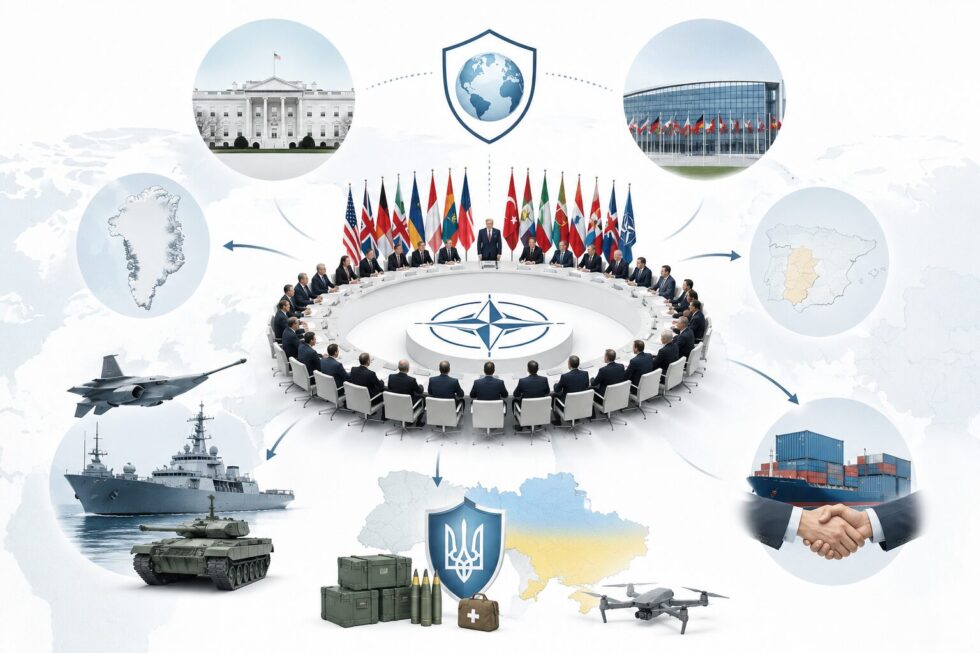
Denmark has indicated that it is open to expanding cooperation with Washington under the 1951 defence agreement, including a larger US security presence. It has not accepted that greater military access requires a transfer of sovereignty. The distinction is central to the dispute: Washington already possesses mechanisms for strengthening Arctic defence without acquiring Greenland. European officials therefore see Trump’s territorial language as an unnecessary challenge to the sovereignty of a fellow ally.
NATO Ankara summit reaffirmed Article 5 and kept America inside the alliance
Despite the hostile opening, the Ankara declaration reaffirmed what NATO called an “ironclad commitment” to Article 5 of the Washington Treaty. Article 5 states that an armed attack against one ally is considered an attack against all. Each member must assist the country attacked, although the treaty allows governments to determine the action they consider necessary, including the use of armed force.
“Here in Ankara, allies reaffirmed their ironclad commitment to collective defence under Article 5, that an attack on one is an attack on all,” Rutte said after the leaders’ meeting. ([NATO secretary general Mark Rutte, Ankara press conference, 8 July 2026])
The statement was significant because Trump has repeatedly suggested that American protection could depend on whether an ally spends enough on defence. NATO governments had entered the summit seeking an explicit US endorsement rather than another conditional formulation. During the closed session, Trump told the other leaders: “We want to remain with you,” according to a person familiar with the discussion quoted by Reuters. The same source said Trump indicated that the United States was prepared to continue selling weapons to allied countries. The remarks provided immediate reassurance that Washington was not preparing a formal NATO withdrawal, although they did not remove longer-term doubts about US force levels or political conditions attached to military support. After the meeting, Trump’s public language changed sharply.
“There was a lot of love in that room,” he said, presenting the summit as unusually positive and emphasising the alliance’s unity.
Rutte dismissed the earlier disputes as evidence that democratic governments could argue openly and still reach agreement.
“Yes, we have quarrels. We have fights. But we always come together,” the NATO secretary general said. ([Mark Rutte, post-summit press conference, 8 July 2026]) The institutional outcome was therefore considerably more stable than Trump’s opening statements had suggested.
What NATO’s 32 members agreed in Ankara
| Issue | Confirmed Ankara outcome |
|---|---|
| Collective defence | “Ironclad” commitment to Article 5 reaffirmed |
| US membership | Trump told leaders Washington wanted to remain in NATO |
| Defence target | Implementation of the 5% of GDP commitment by 2035 |
| Core military spending | At least 3.5% of GDP for armed forces and NATO capability targets |
| Wider security spending | Up to 1.5% for infrastructure, resilience and related investment |
| Ukraine | €70bn pledged for equipment, assistance and training in 2026 |
| 2027 support | Allies committed to sustaining at least an equivalent level |
| Defence industry | Faster production, joint procurement and new weapons programmes |
| Russia | Identified as a continuing threat to Euro-Atlantic security |
| Iran | Warned against developing a nuclear weapon and obstructing navigation |
The summit declaration did not settle every disagreement, but it protected the alliance’s central legal and political commitments.
NATO’s 5% defence commitment means 3.5% for forces and 1.5% for security
The largest structural change facing the alliance was not agreed in Ankara but at the NATO summit in The Hague on 25 June 2025. All allies committed to investing 5% of gross domestic product annually in defence and security-related requirements by 2035. That total is divided into two categories:
- At least 3.5% of GDP for core defence, armed forces and agreed NATO capability requirements.
- Up to 1.5% of GDP for critical infrastructure, military mobility, civil preparedness, cyber defence, innovation and defence-industrial capacity.
The distinction matters because not all of the 5% represents conventional military expenditure. Investment in railways capable of carrying heavy armour, resilient ports, protected telecommunications, energy networks and cyber infrastructure may fall within the broader 1.5% category.
NATO’s previous target required members to spend at least 2% of GDP on defence. The new commitment therefore represents a major increase and will place sustained pressure on European public finances.
Rutte said before the Ankara meeting that allies had spent an additional $258bn during 2025 when measured against earlier investment trajectories.
“This summit is about implementation, getting it done,” he said. “When you look at the numbers, $258bn extra was spent in 2025.” ([Mark Rutte, NATO doorstep statement, 8 July 2026])
The White House used a different comparison, saying allied investment had risen by more than 20% and that allies had spent $120bn more than in 2025. The difference appears to reflect varying baselines, definitions and comparison periods rather than a simple contradiction; the two figures should not be treated as directly interchangeable. ([White House fact sheet, July 2026]) The central challenge is now practical. Governments must convert budget commitments into ammunition, air defence, drones, ships, aircraft, trained personnel, secure communications and deployable formations. Money allocated in a national budget does not automatically produce usable military power. European defence manufacturers face long production cycles, shortages of specialist labour, fragmented procurement and dependence on non-European components.
Ankara arms deals exceeded $50bn as NATO pushed industrial expansion
The summit was accompanied by weapons and procurement announcements worth more than $50bn. Britain and 11 other European countries backed programmes for long-range precision weapons, while NATO governments announced purchases involving aircraft, drones and other systems. The aim is to increase the alliance’s ability to strike distant military targets and reduce dependence on a limited number of American capabilities. Rutte said NATO had to expand production urgently because Russia, China, Iran and North Korea were increasing their military cooperation and industrial capacity.
“The threat will not disappear even when the war in Ukraine ends,” he said before the summit, stressing that Russia would remain a long-term danger to European security. ([NATO secretary general, Ankara summit briefing])
The investment drive is also intended to improve NATO’s ability to sustain a lengthy conflict. The war in Ukraine has demonstrated that modern armed forces consume artillery shells, interceptors, drones and precision missiles at rates far above peacetime procurement levels. European countries have increased orders, but many production lines still require several years to deliver complete systems. Air-defence missiles are particularly scarce because Ukraine needs them immediately while NATO members are also trying to rebuild their own stocks. The summit’s industrial message was therefore as important as its declaration. The alliance needs guaranteed orders, multi-year contracts and common standards if higher budgets are to create greater military capacity.
NATO pledged €70bn in military support for Ukraine in 2026
Ukraine remained a central part of the Ankara agenda despite Trump’s confrontation with allies over Iran and Greenland.
The summit declaration committed NATO members to providing €70bn in military equipment, assistance and training for Ukraine during 2026. Allies also stated that they intended to maintain at least an equivalent level of support in 2027. The figure does not represent direct expenditure by NATO as a single institution. It combines sovereign commitments by individual governments, including weapons purchases, bilateral deliveries, training and other assistance.
Zelenskyy attended the summit seeking additional air-defence systems after renewed Russian attacks. Ukraine’s immediate requirements include Patriot interceptors, medium-range air defence, artillery ammunition, drones and long-range weapons. Trump met Zelenskyy in Ankara and used substantially warmer language than during some previous encounters.
He praised the Ukrainian president for keeping the country together during a war that began with Russia’s full-scale invasion in February 2022. The change was notable after earlier occasions on which Trump had publicly criticised Zelenskyy and argued that Ukraine lacked negotiating leverage. Analysts linked the shift partly to Trump’s growing frustration with Russian President Vladimir Putin. Washington’s attempts to secure negotiations had not produced a durable settlement, while Russia continued military operations and rejected terms acceptable to Kyiv.
The change should not be interpreted as an unconditional American commitment to every Ukrainian objective. Trump continues to seek a negotiated end to the war and wants European governments to finance a larger share of Ukraine’s defence. It nevertheless indicated that his relationship with Putin had not delivered the swift settlement the White House had expected.
Erdoğan and Rutte helped turn confrontation into a claim of success
Trump’s relationship with Turkish President Recep Tayyip Erdoğan appears to have helped stabilise the summit. The US president said he might not have attended had the meeting not been held in Turkey and described his relationship with Erdoğan as exceptional.
“Turkey has been, in many ways, much more loyal than other countries that we thought would be loyal,” Trump said. “Sometimes you get along with the toughest people.” ([Donald Trump, meeting with Recep Tayyip Erdoğan, Ankara, 7 July 2026])
Turkey had strong reasons to prevent the gathering from collapsing. Erdoğa wanted to demonstrate Ankara’s importance inside NATO, promote Turkey’s expanding defence industry and improve relations with Washington. The summit coincided with movement on US-Turkish military relations, including Trump’s willingness to discuss future sales of F-35 fighter aircraft and the easing of American sanctions. Ian Lesser of the German Marshall Fund described the summit as having a “bipolar quality”, but argued that Trump’s personal connection with Erdoğan helped keep the confrontation from overwhelming the formal meeting.
“The fact that President Trump has this apparently very close relationship with President Erdoğan probably played a role in stabilising things,” Lesser said. ([Ian Lesser, German Marshall Fund, quoted after the Ankara summit])
Rutte supplied the second part of the political formula. He repeatedly credited Trump with forcing European allies to increase military expenditure.
“I think we should praise Donald Trump for the fact that NATO is so much stronger,” Rutte told reporters. ([Mark Rutte, Ankara, July 2026])
The argument allowed Trump to present the alliance’s spending increases not as evidence that NATO had previously failed, but as proof that his pressure had succeeded. His rhetoric could therefore move from accusation to victory without requiring him to withdraw his complaints.
Europe must prepare for a stronger NATO with less predictable US leadership
The Ankara summit showed that NATO’s institutions remain resilient. The alliance produced a common declaration, reaffirmed Article 5, increased support for Ukraine and moved forward with major defence programmes.
Around 80,000 American military personnel remain stationed in Europe, according to widely used Pentagon estimates, although troop numbers can fluctuate according to deployments and exercises. The United States also supplies capabilities European forces cannot yet reproduce at the same scale, including strategic intelligence, aerial refuelling, missile warning, nuclear deterrence, military transport and command systems. Charles Kupchan, a Georgetown University professor and former White House adviser, argued that Trump’s hostile rhetoric had not destroyed NATO’s military structure.
“NATO is still NATO. There are still 80,000 US troops in Europe,” he said. ([Charles Kupchan, Georgetown University])
His larger warning concerned the collapse of continuity in American foreign policy.
“Every time there is a presidential election, we swing from one grand strategy to a completely different grand strategy,” Kupchan said. “If you are the chancellor of Germany or the prime minister of Japan, you have to plan for the worst.” ([Charles Kupchan, quoted after the Ankara summit]) That uncertainty is likely to accelerate the Europeanisation of NATO rather than produce a formal break with Washington.
Britain, Germany, France, Poland and the Nordic states will be expected to provide larger formations, more ammunition, stronger air defence and greater logistical capacity. European governments will also need contingency plans for operations in which American assistance arrives later, at a lower level or with additional political conditions.
Europe cannot rapidly replace the United States, but it can reduce the number of military functions for which American support is indispensable.
The immediate lesson from Ankara is therefore not that NATO is collapsing. It is that the alliance is being reorganised around two realities: Europe must contribute substantially more military power, and American political support can no longer be assumed to remain consistent from one presidential statement to the next. The Donald Trump NATO summit ended with unity because the formal alliance survived the president’s attacks. Yet the standard by which success was judged was revealing. A meeting that began with threats against Spain, territorial claims against Denmark and criticism of multiple allies was regarded as successful once Trump confirmed that the United States still wanted to remain. That is reassurance, but it is also evidence of how low expectations surrounding transatlantic stability have fallen.
Materials used: Reuters, NATO, The White House, The Guardian.
Read about the life of Westminster and Pimlico district, London and the world. 24/7 news with fresh and useful updates on culture, business, technology and city life: K2 Airways Cargo 737 missing near Karachi after Sharjah flight