
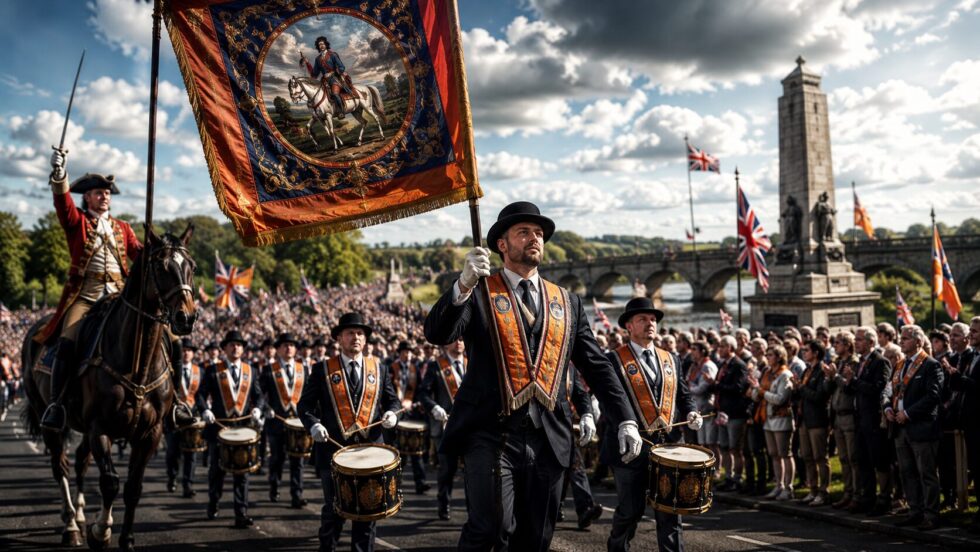
Battle of the Boyne 2026 parades will take place across Northern Ireland on Monday, 13 July, as the region observes the substitute bank holiday for the Twelfth, The WP Times editorial team reports. The holiday moves to Monday because 12 July falls on a Sunday this year, bringing closures of banks, government offices and some businesses, reduced public transport services and major road restrictions in towns hosting the annual processions.
The commemorations mark King William III’s victory over King James II at the Battle of the Boyne in 1690 and remain the largest event in the Orange Institution’s annual calendar. Major demonstrations are expected in 18 locations across Northern Ireland, including Belfast, Ballymena, Ballymoney, Cookstown, Larne, Limavady, Royal Hillsborough and Portglenone. Orange lodges, marching bands, women’s and junior organisations and supporters will gather for morning processions before continuing to demonstration fields, where religious services, speeches and formal proceedings are traditionally held. Large crowds are expected along the main routes, particularly in Belfast and other major host towns. Motorists should prepare for rolling road closures, temporary parking restrictions, diversions and longer journey times throughout the day. Bus and rail services may also operate to special bank-holiday timetables, making advance planning essential for spectators, residents and workers.
Monday, 13 July 2026, is an official bank holiday in Northern Ireland. However, employees are not automatically entitled to paid leave unless the date is included in their employment contract or annual holiday allowance. Supermarkets, pharmacies, pubs, restaurants and visitor attractions may operate reduced or location-specific opening hours. This guide brings together the confirmed Battle of the Boyne 2026 venues, expected parade arrangements, transport information, bank-holiday rules and practical advice for families, visitors, photographers, employees and businesses planning around the Twelfth.
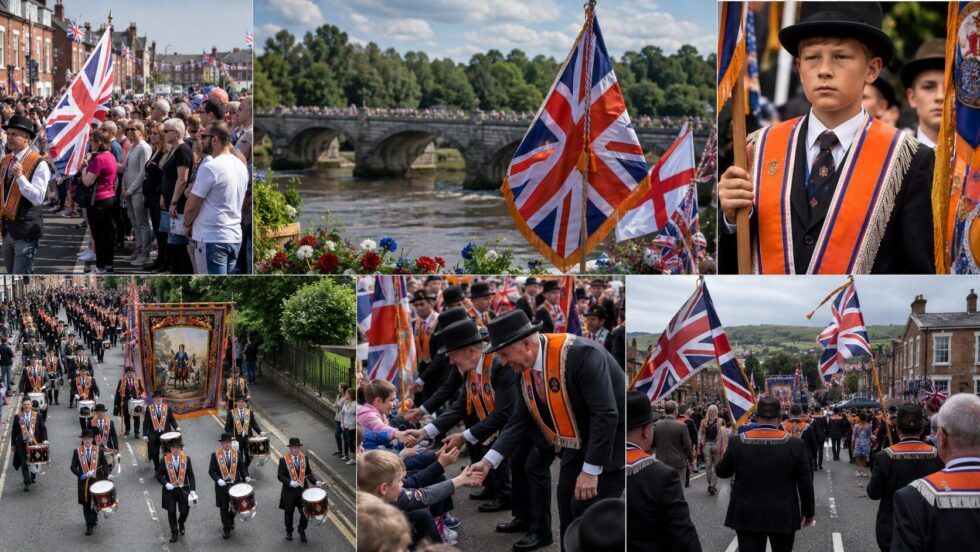
Quick Answer: The Twelfth 2026 at a Glance
- Date observed: Monday 13 July 2026 (substitute bank holiday).
- Original anniversary: Sunday 12 July 2026 — the fixed date of the Battle of the Boyne commemoration.
- Anniversary marked: the 336th anniversary of the 1690 battle.
- Why it moved: 12 July is a Sunday in 2026, so the statutory bank holiday shifts to the Monday.
- Where it applies: Northern Ireland only. A normal working day in England, Wales and Scotland.
- Scale: over 1,000 lodges and roughly 600 marching bands across 18 host venues (plus Rossnowlagh in the Republic of Ireland the preceding weekend).
- Biggest gatherings: Newtownhamilton (billed as the world's largest single Orange gathering) and Belfast (the longest route, over six miles).
- Also known as: Orangemen's Day, the Glorious Twelfth, the Twelfth, Orange Day.
- TV coverage: BBC One Northern Ireland and BBC iPlayer, 9pm, Monday 13 July.
Why the Bank Holiday Falls on Monday 13 July 2026
The Battle of the Boyne bank holiday is one of only two public holidays unique to Northern Ireland — the other is St Patrick's Day on 17 March. It is fixed to 12 July, the anniversary of the 1690 battle. When that date lands on a weekend, a substitute weekday is granted so the public still receives its day off.
In 2026, 12 July is a Sunday. Under the standard substitution rule, the statutory bank holiday therefore moves to the next weekday: Monday 13 July. Crucially, the substitute date carries exactly the same legal status, employment rights and pay entitlements as the original — it is not a "lesser" holiday in any respect.
This is the same mechanism that shifts Christmas Day and Boxing Day when they fall at weekends. The dates are set under the Banking and Financial Dealings Act 1971, with Northern Ireland-specific proclamations issued by the Secretary of State for Northern Ireland.
Northern Ireland Has the Most Bank Holidays in the UK
Northern Ireland observes 10 bank holidays in 2026 — more than any other UK nation. England and Wales have 8; Scotland has 9. Northern Ireland matches England and Wales on every shared date, then adds St Patrick's Day and the Battle of the Boyne on top.
| Date | Bank holiday | Notes |
|---|---|---|
| Thu 1 Jan | New Year's Day | UK-wide |
| Tue 17 Mar | St Patrick's Day | Northern Ireland only |
| Fri 3 Apr | Good Friday | UK-wide |
| Mon 6 Apr | Easter Monday | Not observed in Scotland |
| Mon 4 May | Early May bank holiday | UK-wide |
| Mon 25 May | Spring bank holiday | UK-wide |
| Mon 13 Jul | Battle of the Boyne (substitute) | Northern Ireland only |
| Mon 31 Aug | Summer bank holiday | Same date as England and Wales |
| Fri 25 Dec | Christmas Day | UK-wide |
| Mon 28 Dec | Boxing Day (substitute) | UK-wide |
For anyone planning annual leave, the Twelfth is the one date on this list that is easy to overlook if you are based in Great Britain but working with Northern Ireland colleagues, clients or staff.
What the Battle of the Boyne Actually Commemorates
The Twelfth marks the Battle of the Boyne, fought in 1690 on the banks of the River Boyne near Drogheda, on Ireland's east coast. The clash pitted the Protestant Prince William of Orange against the Catholic King James II. William's victory was later cast as a pivotal moment in the "Glorious Revolution," securing a Protestant succession to the British throne. A quirk of the calendar explains the July date. The battle was fought on 1 July 1690 under the old Julian calendar. When Britain and Ireland adopted the Gregorian calendar in 1752, the date shifted forward, and the commemoration settled on 12 July — where it has remained ever since.
There is a well-worn anecdote from the battle itself: before fighting began, with the two armies drawn up on opposite banks of the Boyne, an early cannon strike from James's artillery struck William on the shoulder. A few inches over and the course of Irish and British history might have read very differently. The wound was slight, William stayed in command, and his forces carried the day. For the Orange Order and the wider unionist community, the Twelfth is the year's foremost cultural occasion — a day of parades, bands, banners and gatherings carrying deep historical, religious and civic significance. The Grand Orange Lodge of Ireland describes it as a public expression of identity, culture and heritage, and increasingly promotes it as a heritage-tourism draw for visitors seeking an authentic Northern Irish cultural experience.
The Twelfth Parades 2026: All 18 Host Venues
The heart of the day is the network of Orange Order demonstrations. In 2026, the main parades are staged across 18 host venues in Northern Ireland, with towns and cities rotating as hosts year to year. Belfast and Ballymena are the only two locations that host a Twelfth demonstration every single year; the others take their turn. A nineteenth parade takes place at Rossnowlagh, in the Republic of Ireland, traditionally on the weekend before the Twelfth.
Here are the confirmed 2026 host venues, grouped by county:
- County Antrim: Ballymena, Larne, Ballymoney, Glenarm
- County Armagh: Newtownhamilton
- County Down: Belfast (hosted within the Belfast area), Rathfriland, Killyleagh, Royal Hillsborough, Ballymartin, Ballywalter
- County Fermanagh: Maguiresbridge
- County Londonderry: Limavady, Kilrea
- County Tyrone: Cookstown, Castlederg, Aughnacloy
- Republic of Ireland: Rossnowlagh (pre-Twelfth weekend)
Across these venues, expect over 1,000 lodges and around 600 bands. The music spans marching flute, pipe, brass and accordion bands, alongside the distinctive thunder of the Lambeg drum — a large, hand-beaten drum that is one of the day's most recognisable sounds.
The Standout Demonstrations in 2026
A few venues carry special weight this year:
- Newtownhamilton (Co Armagh) hosts what the Order describes as the single largest Orange gathering in the world. Around 11 districts, some 150 private lodges and more than 5,000 Orangemen are expected, joined by Orangewomen and junior lodges, with upwards of 20,000 people attending. Roughly 70 bands and dozens of Lambeg drums accompany the procession.
- Belfast stages the longest route of the day, with participants walking more than six miles to the demonstration field. A large contingent of Scottish visitors traditionally travels over to take part.
- Rathfriland (Co Down) expects around 15,000 participants and spectators, with 100 lodges and 90 bands, and hosts the new Grand Master among its guests.
- Ballywalter (Co Down) hosts the North Down demonstration for the first time since 2000, in a seaside setting, accompanied by around 40 bands.
- Royal Hillsborough (Co Down) hosts the South Antrim Combine, with over 60 lodges from across the Lisburn area processing to the historic Hillsborough Fort.
Parade Times and Routes: What to Expect on the Day
Every venue runs its own programme, but the shape of the day is broadly consistent. Below is a representative sample of confirmed 2026 arrangements to show how the timings work in practice. Always confirm the exact route and timing for your specific town from official listings the day before, as details can be adjusted.
Newtownhamilton (Co Armagh) — the world's largest gathering
- Assembly field: Newry Road. Outward parade departs 10.30am.
- Route: Newry Road, Newry Street, Shambles Lane, The Commons, Armagh Street, Castleblayney Street.
- Arrival at demonstration field (Castleblayney Road): approx 11am.
- Platform proceedings: 2pm. Return parade: 3pm.
Rathfriland (Co Down)
- Assembly field: Newry Road. Parade departs 12 noon.
- Route through Lower and Upper Church Square, Main Street, Downpatrick Street, Castlewellan Road to the demonstration field.
- A wreath is laid at the town cenotaph by district officers.
Royal Hillsborough (Co Down) — South Antrim Combine
- Assembly field: Culcavy Road. Parade commences 11.30am.
- Arrival at the demonstration field at Hillsborough Fort: 12.30pm.
- Route: Culcavy Road, Lisburn Street, Main Street, Hillsborough Fort.
Ballywalter (Co Down) — North Down demonstration
- Assembly/demonstration field: Greyabbey Road. Religious service and platform proceedings 11.30am; outward parade departs 12.30pm.
- Led by Ballywalter Heroes LOL 1884 with the award-winning Ballywalter Flute Band, accompanied by around 40 bands.
Glenarm (Co Antrim) — a scenic Coast Road parade
- Assembly field: The Cloney. Parade commences 12 noon.
- Route along the Coast Road, New Road, Mark Street, The Vennel, Altmore Street, Toberwine Street, arriving at the Straidkilly Road demonstration field around 2pm.
- Platform proceedings 3pm; return parade 4pm. Children's activities in the field.
Ballymena (Co Antrim) — "the city of the Seven Towers"
- Assembly field: Brooke Park. Parade commences 12.30pm.
- Arrival at the Cushendall Road demonstration field: 2.30pm.
- 30 local lodges, 17 bands and the traditional Lambeg drum; led by Craigywarren LOL 476 and Craigywarren Flute Band.
The typical rhythm everywhere is: morning assembly, outward parade to the field, a religious service and platform speeches (including political and Orange Order addresses) over lunchtime, then a return parade in the mid-to-late afternoon. Many fields lay on picnics, bouncy castles, face painting and children's entertainment, giving the day a family-fair atmosphere alongside the formal procession.
A Beginner's Glossary: How to Follow What You're Watching
If you have never been to a Twelfth parade, a handful of terms will help you make sense of it:
- The Orange Order (Loyal Orange Institution): the Protestant fraternal organisation that stages the parades. Its members are "Orangemen."
- Lodge (LOL): a local branch of the Order. "LOL" stands for Loyal Orange Lodge, followed by a warrant number (e.g. LOL 1884). Lodges group into districts, which group into counties.
- Orangewomen: members of the Association of Loyal Orangewomen of Ireland, who also take part.
- Junior lodges (JLOL): youth branches, reflecting the Order's emphasis on continuity across generations.
- Banner: the large, painted cloth carried at the head of each lodge, depicting historical, biblical or commemorative scenes. New banners are often "dedicated" in the months before the Twelfth.
- Collarette (sash): the ceremonial band worn over the shoulders, often mistaken by newcomers simply as a "sash."
- The field (demonstration field): the destination where lodges gather for speeches, a religious service and refreshments before the return march.
- Lambeg drum: a very large, loud, hand-beaten drum unique to the tradition, played with cane sticks.
- Marching bands: flute, pipe, brass, accordion and silver bands that accompany the lodges — hundreds appear across the day.
- The Boyne / "Sham Fight": references to the 1690 battle; some areas stage related events in the days around the Twelfth.
Understanding these makes the pageantry far more legible: the banners tell stories, the order of march reflects lodge seniority, and the bands are often the main draw for spectators.
What Closes on Monday 13 July
Treat 13 July like any major UK bank holiday, with Northern Ireland-specific complications around the parades.
Banks and financial services
- High-street bank branches close across Northern Ireland.
- ATMs, online banking and mobile apps operate as normal.
Shops and supermarkets
- Most supermarkets open on reduced bank-holiday hours.
- Many smaller and independent businesses close entirely — often for several days around the Twelfth, not just the Monday.
- Larger retailers and retail parks usually trade, but confirm hours before travelling, especially in and around host towns.
Public offices and services
- Government offices, council services and most public bodies close.
- Schools are on summer break regardless.
Public transport
- Buses and trains run on holiday or special timetables — expect reduced frequency.
- Services along or near parade routes may be diverted or suspended for periods.
Roads and traffic
- Expect rolling road closures, diversions and parking restrictions in and around all 18 host towns.
- Avoid driving directly through demonstration towns during parade periods; follow temporary signage, diversions and police instructions.
- Anyone attending should expect to park some distance from the route and walk in.
Planning Around the Day: Practical Checklists
If you are attending a parade
- Check the official route, assembly field and start time for your host venue the day before.
- Arrive early — central vantage points fill quickly, especially in Belfast, Newtownhamilton and Rathfriland.
- Bring water, sun cover, cash and ear protection for young children (the Lambeg drums and bands are genuinely loud).
- Plan for reduced public transport and heavy foot traffic on the way home.
- Note the return-parade time; many spectators leave after the outward march and miss half the spectacle.
If you want to avoid the crowds
- Identify parade routes and closure points in advance and route around them.
- Do essential shopping and errands before the weekend — many businesses shut early or for several days.
- Allow extra journey time even for short local trips.
If you are travelling to or from Northern Ireland
- Confirm airport, ferry and coach timetables, which may run to holiday schedules.
- Book taxis ahead — demand spikes sharply around parade start and finish times.
- Ferry routes to and from Scotland can be busier than usual with Twelfth travellers.
If you are managing a business or payroll
- Diarise 13 July as a Northern Ireland-only bank holiday.
- Confirm staff rotas and opening hours early, as multi-day closures around the Twelfth are common.
- If you operate across UK regions, remember GB staff work as normal while NI staff are on a bank holiday.
If you are photographing the day
- Banners, drum majors and band uniforms are the strongest subjects; the fields often allow closer, calmer shots than the route.
- Be respectful — this is a live religious and cultural occasion, not a staged event. Ask before close portraits.
- Golden light late in the day suits the return parades.
Bank Holiday Pay: What Northern Ireland Workers Should Know
A persistent myth is that working a bank holiday automatically earns extra pay. It does not — in Northern Ireland as across the rest of the UK.
- No statutory premium. There is no legal right to enhanced pay (time-and-a-half or double-time) simply for working on 13 July. Enhanced rates apply only if your employment contract specifically provides for them.
- Substitute day, identical rights. The 13 July substitute carries the same entitlements as the original 12 July date.
- Check the leave wording carefully. The statutory minimum holiday entitlement is 5.6 weeks — 28 days for a full-time worker. Employers may count bank holidays within that total. Because Northern Ireland has 10 bank holidays, a contract offering "28 days including bank holidays" is markedly less generous than "28 days plus bank holidays." Over a year, that difference is substantial.
This reflects the Working Time Regulations (Northern Ireland) 2016 and the Employment Rights (Northern Ireland) Order 1996. If in doubt, read your contract closely and seek advice where needed — the wording matters far more than the headline day count.
The Banners, Bands and Pageantry Explained
For first-time spectators, the visual language of the Twelfth can be bewildering at first and mesmerising once decoded. Here is what you are actually looking at as a parade passes.
The banners. Each lodge marches behind a large, double-sided painted banner, carried on two poles by banner-bearers with guide ropes to steady it against the wind. The images are not decorative — they are statements of identity. Common scenes include King William crossing the Boyne on a white horse, biblical episodes, portraits of past lodge members, and depictions of local landmarks or historical events tied to that specific lodge. When a lodge marks a milestone — a 100th, 135th or 200th warrant anniversary, as several do in 2026 — a newly commissioned banner is often "dedicated" at a service in the preceding months and paraded for the first time on the Twelfth. Reading the banners is one of the most rewarding parts of watching the day.
The order of march. Lodges do not process at random. The sequence generally reflects seniority and district structure, with senior officers, the county and district banners, and honoured guests holding particular positions. Watching who leads and who follows tells you something about the organisation's internal hierarchy.
The bands. For many spectators, the bands are the main event. Across the day, hundreds appear in four broad families: flute bands (the most numerous and often the loudest), pipe bands (bagpipes and drums, frequently kilted), brass and silver bands (a more traditional, mellow sound), and accordion bands. Competition between bands for reputation and turnout is fierce, and the best are genuinely world-class marching ensembles. Each lodge is typically accompanied by at least one band; large demonstrations field dozens.
The Lambeg drum. No sound is more associated with the Twelfth than the Lambeg — an enormous goatskin drum, sometimes over three feet across, beaten with curved malacca canes. It is extraordinarily loud, felt in the chest as much as heard, and playing one well is a physical feat. A "team" of Lambegs at a large venue produces a rolling thunder that carries for miles. If you are bringing very young children, this is the sound to prepare them for.
The collarettes and regalia. Members wear collarettes (the ceremonial band over the shoulders, often navy and orange) bearing badges and emblems denoting rank, lodge and service. Drum majors leading bands may wear elaborate uniforms, and in 2026 the BBC coverage even features Belfast kiltmakers who produce the kilts worn by some drum majors.
Pre-Twelfth Events: The Build-Up
The Twelfth does not arrive out of nowhere. The days before are filled with community events that are part of the tradition:
- The Eleventh Night (11 July): bonfires are lit in many loyalist areas the night before the Twelfth. These range from modest community gatherings to very large structures, and are a significant tradition in their own right — though they can also be a source of local debate around safety and siting.
- Band parades and district nights: in the run-up, local band parades, sports nights, barbecues and arch dedications take place. In 2026, for example, host districts have programmed five-a-side football, tug of war, community barbecues and Orange arch dedications in the days beforehand.
- Arch dedications: decorative Orange arches spanning streets in many towns are refurbished and re-dedicated ahead of the day.
- Rossnowlagh (Republic of Ireland): the one cross-border demonstration traditionally takes place on the weekend before the Twelfth, in a notably relaxed seaside atmosphere in County Donegal.
Understanding the build-up helps explain why so many businesses in host towns close for several days rather than a single Monday — the whole period around the Twelfth is effectively a local festival week.
When to Go — and When to Stay Away
Not every part of the day suits every visitor. A quick decision guide:
- Best for families: the demonstration fields, which usually offer picnics, bouncy castles, face painting and space to move, away from the crush of the route. Glenarm and other smaller venues tend to feel gentler than the big city parades.
- Best for spectacle and scale: Belfast (longest route, huge turnout) and Newtownhamilton (the largest gathering). Come very early and expect crowds.
- Best for a scenic setting: the seaside and Coast Road venues such as Ballywalter and Glenarm.
- If you want to avoid it entirely: stay clear of host-town centres from mid-morning to late afternoon, do your shopping the previous week, and plan any essential driving around the published routes and closure times.
Accessibility and Safety on the Day
- Noise: bands and Lambeg drums are very loud. Bring ear protection for infants and anyone noise-sensitive.
- Sun and heat: July parades have coincided with hot, sunny weather in recent years. Bring water, sun cream and hats; there is often little shade along routes.
- Mobility: routes involve standing for long periods, and the best viewing spots require walking in from distant parking. Fields can be uneven grass. Plan accordingly if mobility is a concern.
- Crowds: keep children close in dense sections; agree a meeting point in case anyone gets separated, as mobile signal can be patchy when networks are busy.
- Respect: these are live cultural and religious events. Spectators are welcome, but courtesy — not treating participants as a tourist spectacle — goes a long way.
The Marching Season in Context
The Twelfth sits at the peak of a longer "marching season" that runs roughly from April to August, during which many smaller parades take place. But 13 July 2026 is the focal point, drawing the largest crowds, the widest participation and the fullest media coverage.
The tradition is long-established — the Order dates its parades back well over two centuries — and it continues to evolve, with new lodges, new bands and a growing junior movement each year. In 2026, several lodges mark milestone anniversaries, and newly formed bands and ladies' lodges take part for the first time, illustrating how the event renews itself generation by generation.
For visitors new to Northern Ireland, the day is best approached as a significant civic and cultural occasion with strong local variation. The scale, atmosphere and context differ considerably from one town to the next. The most reliable way to understand what to expect in a specific area is to consult official listings and, where you can, ask local colleagues or neighbours — guidance regularly offered to people who have recently moved to the region.
Watching from Home: TV and Radio Coverage
If you would rather follow the day from the sofa, the BBC provides dedicated coverage. The Twelfth 2026 is scheduled to broadcast on BBC One Northern Ireland and BBC iPlayer at 9pm on Monday 13 July, with reports from venues including Rathfriland, Belfast, Rossnowlagh, Ballymoney, Newtownhamilton, Kilrea, Maguiresbridge and Cookstown. The programme typically pairs parade highlights with features on the wider Orange tradition and its role in community life — a useful primer if you plan to attend in a future year.
Frequently Asked Questions
When is the Battle of the Boyne bank holiday in 2026? Monday 13 July 2026. The fixed date is 12 July, but that falls on a Sunday this year, so the substitute bank holiday moves to the Monday.
Is the Twelfth a bank holiday across the whole UK? No. It is a bank holiday in Northern Ireland only. It is a normal working day in England, Wales and Scotland, though it may be marked informally in some communities elsewhere.
Why does the Battle of the Boyne fall on 12 July when the battle was in early July 1690? The battle was fought on 1 July 1690 under the Julian calendar. After Britain and Ireland switched to the Gregorian calendar in 1752, the commemorated date shifted to 12 July.
How many parades are there in 2026, and where? There are 18 main host venues across Northern Ireland — Ballymena, Larne, Ballymoney, Glenarm, Newtownhamilton, Belfast, Rathfriland, Killyleagh, Royal Hillsborough, Ballymartin, Ballywalter, Maguiresbridge, Limavady, Kilrea, Cookstown, Castlederg, Aughnacloy — plus Rossnowlagh in the Republic of Ireland on the preceding weekend.
Which is the biggest parade? Newtownhamilton hosts what the Orange Order describes as the world's largest single Orange gathering in 2026. Belfast has the longest route, over six miles.
How many bands and lodges take part? Over 1,000 lodges and approximately 600 marching bands across the day, watched by hundreds of thousands of people.
Do I get paid extra for working on 13 July? Not automatically. There is no statutory right to premium pay for working a bank holiday in Northern Ireland. Enhanced pay applies only if your contract provides for it.
Will public transport and roads be affected? Yes. Expect holiday timetables on buses and trains, plus road closures, diversions and parking restrictions in and around host towns. Allow extra time and check local updates on the morning.
What's open on 13 July? Most supermarkets trade on reduced hours and larger retailers usually open, but banks and public offices close, and many independent businesses shut — sometimes for several days.
Can visitors attend the parades? Yes. The events are public and the Order actively welcomes spectators and heritage visitors. Check routes and times in advance, arrive early, and be mindful that this is a live cultural and religious occasion.
Is there TV coverage? Yes. BBC One Northern Ireland and BBC iPlayer broadcast The Twelfth 2026 at 9pm on Monday 13 July.
Monday 13 July 2026 is Northern Ireland's Battle of the Boyne bank holiday — the substitute for a Twelfth that lands on a Sunday, marking the 336th anniversary of the 1690 battle. It brings the region's biggest set of parades: over 1,000 lodges and around 600 bands processing through 18 host towns, from the world's largest Orange gathering at Newtownhamilton to Belfast's six-mile route and the seaside setting of Ballywalter. Expect a full bank-holiday shutdown of banks and public offices, reduced retail and transport, and route-by-route road disruption. Plan your shopping, travel and rotas ahead of time, check the official parade route for your town the day before, protect young ears from the drums, and remember that the substitute date carries the same rights and pay rules as the original. Whether you are marching, watching from the route, or catching the highlights on BBC One at 9pm, get the logistics right and the day runs smoothly.
Read about the life of Westminster and Pimlico district, London and the world. 24/7 news with fresh and useful updates on culture, business, technology and city life: July 2026 UK Bank Holidays and Festivals: The Complete Guide to London, Northern Ireland and Britain