
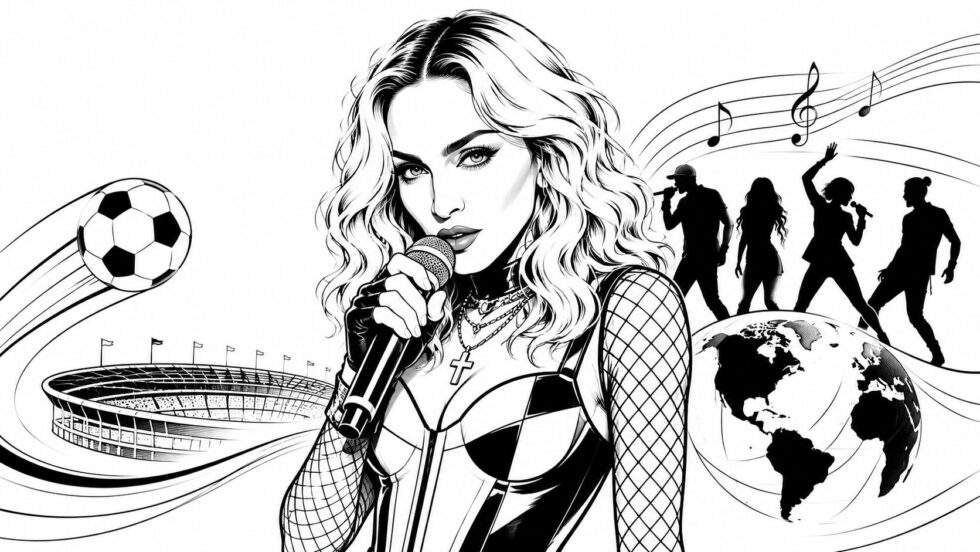
Madonna age is 67: the American singer was born Madonna Louise Ciccone on 16 August 1958 and will celebrate her 68th birthday next month. On Sunday, 19 July 2026, she carried more than four decades of pop history on to one of sport’s largest stages, opening the first FIFA World Cup Final halftime show during Argentina’s meeting with Spain at New York New Jersey Stadium.
The appearance placed Madonna at the centre of a global entertainment production featuring BTS, Shakira, Justin Bieber, Burna Boy, conductor Gustavo Dudamel, the PS22 Chorus and characters from the Muppets. Her son David Banda had encouraged her hours earlier with the Instagram message “BRING THE HEAT MAMA”, while wearing what appeared to be a customised Madonna football shirt, The WP Times reports.
What is Madonna’s age in 2026
Madonna is 67 years old as of 19 July 2026. She was born on 16 August 1958 in Bay City, Michigan, which means she will turn 68 on 16 August 2026. Her precise age has attracted fresh interest because her World Cup appearance arrived during another highly visible period in her career. Rather than appearing solely as a heritage act performing a familiar catalogue, Madonna entered the final as a current recording artist whose new dance album, Confessions II, had reached No. 1 in the United States.
That distinction matters. The performance was not framed simply as a retrospective celebration of a singer whose career began in the late 1970s. It connected her established reputation with a new album campaign, another major chart achievement and an event designed for audiences far beyond conventional pop music coverage.
Madonna’s age and birthday at a glance
| Detail | Confirmed information |
|---|---|
| Full name | Madonna Louise Ciccone |
| Date of birth | 16 August 1958 |
| Age on 19 July 2026 | 67 |
| Next birthday | 16 August 2026 |
| Age after her 2026 birthday | 68 |
| Birthplace | Bay City, Michigan, United States |
| Years active | Since 1979 |
Madonna’s continuing prominence at 67 is unusual not because older performers are absent from major events, but because she remains involved in new releases, large-scale productions and commercial campaigns rather than relying exclusively on anniversary appearances or farewell projects.
Her age also places the World Cup show within a career stretching across six decades. She began performing professionally during the late 1970s, achieved international fame in the 1980s and has since moved repeatedly between pop, dance music, film, fashion, publishing and stadium-scale live entertainment.
Madonna opens the first FIFA World Cup Final halftime show
Madonna opened the inaugural World Cup Final halftime production with “Music”, the title track from her 2000 album, according to the Associated Press. Brazilian football figures Ronaldo and Ronaldinho appeared alongside her during the sequence, creating a deliberate meeting of pop history and World Cup symbolism. FIFA had formally announced Madonna as a co-headliner alongside Shakira, BTS and Justin Bieber. The show was staged on Sunday, 19 July, at New York New Jersey Stadium, commonly known outside FIFA competitions as MetLife Stadium.
The wider production moved rapidly between performers and musical styles. Gustavo Dudamel conducted an orchestral treatment of “Seven Nation Army”, BTS performed “Dynamite”, and Shakira appeared with Burna Boy. Justin Bieber also took part, while the programme incorporated children’s voices and familiar television characters.
It was a concentrated event rather than a conventional concert. Each artist had limited time, and the structure depended on quick entrances, tightly controlled stage changes and songs that could be recognised almost immediately by an international audience. For Madonna, opening the programme provided the most symbolically important position. She introduced a format FIFA had never previously attempted during the final itself and established the tone before the production moved through its larger cast.
Why Madonna’s World Cup performance was historically significant
The 2026 final marked the first time FIFA had placed a full entertainment show between the two halves of a men’s World Cup final. Previous tournaments included opening and closing ceremonies, musical releases and performances around matches, but the interval traditionally remained focused on teams, tactical analysis and the standard break for players. FIFA’s new format borrowed recognisable elements from the Super Bowl, where the halftime show has developed into an event with its own performers, sponsors, audience and cultural significance. The World Cup version carried even greater logistical difficulty because football normally allows a much shorter interval and because temporary equipment had to be introduced and removed without compromising the playing surface.
The production was curated with the involvement of Coldplay frontman Chris Martin and was linked to the FIFA Global Citizen Education Fund, an initiative intended to support educational and football opportunities for children. The concept generated debate before the final. Supporters saw an opportunity to connect football with music and reach viewers who might not usually follow the tournament. Critics argued that extending the interval risked disrupting the match, affecting players’ preparation and importing an American television model into a sport with different traditions.
Those disagreements continued after the performance. Some coverage praised its range and spectacle, while other reactions described it as excessive or questioned whether such entertainment belonged inside the World Cup final. Madonna’s presence ensured the debate extended beyond football. She has spent much of her career turning large public appearances into conversations about celebrity, image, age, sexuality and the boundaries of mainstream culture. At 67, simply occupying the opening position carried a message about who can still be presented as the central attraction at an event of this scale.
David Banda tells Madonna to “bring the heat”
Before the show, Madonna received a public message of support from her son David Banda. The 20-year-old posted a photograph on his Instagram Story wearing what appeared to be a specially made Madonna jersey and wrote: “BRING THE HEAT MAMA.”
The post was accompanied by “I Feel So Free”, a track connected to Madonna’s new Confessions II era. The choice linked the family message directly to the release she was promoting around the World Cup appearance.
David also shared an image of a football shirt signed by Brazilian striker Ronaldo. The inscription reportedly read: “To David, all the best.” His posts brought a personal detail to an event otherwise shaped by global brands, international broadcasters and large-scale stadium production.
David has previously appeared with his mother in public and on stage. He performed during Madonna’s Celebration Tour, which revisited different periods of her recording career, and attended events connected to her wider cultural and fashion work. The relationship has therefore been visible as both a family connection and an artistic one. His World Cup message did not announce a formal role in the halftime show, but it presented him as part of the support surrounding Madonna before another significant performance.
How Confessions II changed the context of Madonna’s appearance
Madonna entered the World Cup final shortly after the release of Confessions II, her first new studio album since 2019 and a sequel in spirit to 2005’s Confessions on a Dance Floor. The record reunited her with producer Stuart Price and returned to the club-oriented electronic sound associated with one of her most commercially successful periods. The album reached No. 1 on the Billboard 200, becoming Madonna’s tenth chart-topping album in the United States. Reports also credited the release with making her the first female artist to secure a US No. 1 album in five consecutive decades.
Its opening total was reported at 134,000 equivalent album units, including strong physical and digital sales. The result made it one of the largest dance-album launches of 2026 and gave Madonna her strongest US album week under the chart’s modern consumption-based measurement system. That performance changed the meaning of her World Cup booking. Without the album, the show might have appeared primarily designed to provide a universally recognisable name and a selection of old hits. With a current No. 1 record, Madonna arrived with new commercial momentum and material that could be connected directly to the event.
Key details from Madonna’s 2026 return
- Confessions II was released on 3 July 2026.
- It continued the dance-pop direction of Confessions on a Dance Floor.
- Stuart Price returned as a principal collaborator.
- The album reached No. 1 on the Billboard 200.
- It became Madonna’s tenth US No. 1 album.
- Its campaign included high-profile appearances before the World Cup final.
- David Banda used the song “I Feel So Free” in his pre-show message.
The timing was carefully aligned. The album arrived just over two weeks before the final, allowing Madonna’s World Cup performance to function as the largest international platform of the promotional campaign.
How Madonna’s age compares with the length of her career
Madonna’s age is often treated as a stand-alone search question, but the more revealing calculation is the length of her working career. At 67, she has been professionally active for approximately 47 years. Her first major commercial breakthrough came with her self-titled debut album in 1983. By the time she appeared at the 2026 World Cup final, more than 43 years had passed since that release. She had already experienced several distinct versions of the music business: vinyl and cassette dominance, the rise of MTV, the CD market, digital downloads, social media promotion and subscription streaming. Few artists have remained commercially visible across all of those periods.
Madonna’s career by decade
| Decade | Major phase |
|---|---|
| 1970s | Move to New York and early professional work |
| 1980s | International breakthrough and global pop stardom |
| 1990s | Reinvention through music, film and major tours |
| 2000s | Electronic and dance resurgence, including Confessions on a Dance Floor |
| 2010s | Stadium touring, new albums and Super Bowl performance |
| 2020s | Celebration Tour, catalogue revival and Confessions II |
The World Cup performance also recalled her 2012 Super Bowl halftime appearance, another event built around a very large television audience and rapid staging. That production featured songs including “Vogue”, “Music” and “Like a Prayer”, with Nicki Minaj, M.I.A. and CeeLo Green among the guests. Fourteen years later, “Music” again provided the opening statement, this time within football’s most important match rather than American football’s championship game.
Why searches for “Madonna age” rise around major performances
Interest in a celebrity’s age usually increases when a public appearance challenges assumptions about career length or visibility. Madonna attracts that attention more strongly because age has been repeatedly discussed in coverage of her clothing, appearance, dancing and relationships. The straightforward answer remains factual: Madonna is 67 and turns 68 in August. However, the frequency of the question also reflects how popular culture treats longevity differently for female artists. Male performers in their sixties and seventies are often described through durability, legacy and veteran status. Female performers are more regularly assessed through comparisons between their present appearance and earlier images. Madonna’s career has repeatedly exposed that imbalance, although the facts of her age require no speculation about her health, cosmetic treatment or private choices.
A responsible account should therefore separate verifiable information from commentary:
| Verifiable fact | Unsupported interpretation to avoid |
|---|---|
| Madonna was born on 16 August 1958 | Claims about medical or cosmetic procedures |
| She is 67 on 19 July 2026 | Assumptions based only on photographs |
| She remains an active recording artist | Claims that her appearance proves a health condition |
| She performed at the World Cup final | Unverified statements about private preparations |
| Her new album reached No. 1 | Predictions about retirement without confirmation |
This distinction is especially important in entertainment reporting, where visual changes can quickly produce unsupported claims presented as fact.
Who performed with Madonna at the World Cup halftime show
FIFA assembled a deliberately international cast rather than building the event around a single performer. The confirmed programme included artists representing American pop, Latin music, K-pop, Afrobeats, orchestral performance and youth choral music.
| Performer | Role in the programme |
|---|---|
| Madonna | Opened with “Music” |
| BTS | Performed “Dynamite” |
| Shakira | Appeared with Burna Boy |
| Justin Bieber | Featured solo performer |
| Burna Boy | Performed alongside Shakira |
| Gustavo Dudamel | Conducted an orchestral section |
| PS22 Chorus | Youth choir contribution |
| The Muppets | Appeared during the entertainment sequence |
The number of acts meant that no one performer received the length of set normally associated with a Super Bowl headliner. Instead, the show operated as a medley structured around quick recognition and visual impact.
Madonna nevertheless held a distinctive position. Opening the first edition of the show effectively made her the performer who introduced FIFA’s new halftime era.
Madonna age: the confirmed answer
Madonna is 67 years old. She was born on 16 August 1958 and will turn 68 on 16 August 2026.
Her age became one of the most searched details surrounding the World Cup final because the performance combined extraordinary career longevity with a current No. 1 album and a new global stage. The reliable story is not that Madonna has somehow escaped ageing. It is that, at 67, she remains capable of securing a leading position inside one of the world’s most heavily watched entertainment and sporting broadcasts. Her opening performance connected several strands of her career: the dance music that established her as a club artist, the stadium productions that later defined her tours, the family presence represented by David Banda’s message and the commercial momentum of Confessions II.
For audiences asking only for the number, the answer is simple. For those asking why it matters, the World Cup show offered a larger explanation: more than four decades after her breakthrough, Madonna was still being selected to open a format designed to represent the future of global mass entertainment.
Read about the life of Westminster and Pimlico district, London and the world. 24/7 news with fresh and useful updates on culture, business, technology and city life: How can UK fans reach Tomorrowland and PAROOKAVILLE 2026 from London