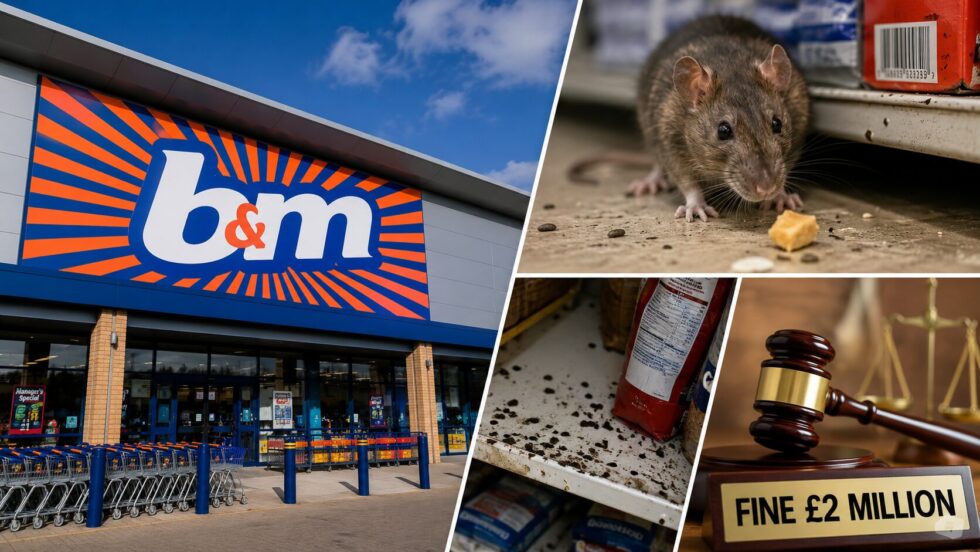
B&M fined £2 million after admitting food hygiene offences connected to serious mouse infestations at three Birmingham stores, where council inspectors found rodent droppings, gnawed food products and contamination affecting retail shelves and packaged goods. The offences concerned branches at St Andrew’s Retail Park, Priory Square Shopping Centre and The Fort Shopping Park, which were inspected between November 2024 and October 2025 after complaints from members of the public, The WP Times reports.
Birmingham City Council’s environmental health officers used emergency powers to close the premises after deciding that the conditions presented a risk to public health. Evidence recorded across the three stores included food products damaged by rodents, mouse urine on packaging and shelving, inadequate cleaning, defects that allowed pests to enter and droppings close to children’s toys. B&M Retail Ltd pleaded guilty at Birmingham Magistrates’ Court. At a sentencing hearing on 13 July 2026, the company was fined £2 million and ordered to pay £18,104 in prosecution costs and a £2,000 victim surcharge, with the sums due within 28 days. Contemporary reporting based on the council’s case records the same penalty and payment terms.
The discount retailer apologised for the failures and said pest-control and food-safety procedures had existed at the affected stores but had not been followed correctly. It said it had accepted responsibility and introduced stronger oversight, expanded pest-control capacity, digital monitoring and more frequent visits from external pest-control contractors.
Why was B&M fined £2 million
B&M was fined after pleading guilty to food hygiene offences arising from conditions discovered at three of its Birmingham branches. The prosecution was brought by Birmingham City Council following separate inspections triggered by public complaints about possible pest activity.
The inspections did not uncover a single isolated mouse sighting. Officers reported evidence of active or widespread infestation, including droppings, damaged food, contaminated surfaces and failures to prevent rodents entering parts of the buildings. At Priory Square, a customer reportedly told the council that they had seen a mouse inside the shop. When environmental health officers inspected the premises, they found evidence including gnawed food, droppings and urine contamination on food packaging and shelving.
They also identified inadequate cleaning and structural defects through which pests could gain access. The store was immediately closed under a Hygiene Emergency Prohibition Notice because officers believed urgent intervention was necessary. At The Fort Shopping Park, droppings were reportedly discovered near children’s toys on display as well as elsewhere on the shop floor and in storage areas. The council concluded that the conditions created a public-health risk and formally closed the premises. The findings recorded at the three stores included:
- Mouse droppings in customer-facing and storage areas.
- Food products apparently gnawed by rodents.
- Damaged products remaining on sale.
- Mouse urine contamination on packaging and shelving.
- Inadequate cleaning and hygiene standards.
- Gaps or structural defects allowing pests to enter.
- Droppings close to children’s toys at The Fort.
- Failures to implement existing pest-control procedures properly.
Reports supplied from the case state that all three stores contained evidence of mouse activity, including droppings and gnawed products.
Which B&M Birmingham stores were affected
The case concerned three B&M stores in Birmingham. The inspections were conducted separately over a period of almost a year.
| B&M store | Inspection date | Main findings reported |
|---|---|---|
| St Andrew’s Retail Park | 11 November 2024 | Mouse droppings, significant mouse activity and gnawed food products offered for sale |
| Priory Square Shopping Centre | 22 January 2025 | Active infestation, droppings, gnawed food, urine contamination, poor cleaning and structural defects |
| The Fort Shopping Park | 27 October 2025 | Widespread mouse activity, gnawed products and droppings near children’s toys |
B&M at St Andrew’s Retail Park
The St Andrew’s Retail Park branch was the first of the three sites inspected. Environmental health officers attended on 11 November 2024 after receiving reports of pests at the premises. Inspectors found substantial evidence of mouse activity. According to the council account reported in the supplied material, the findings included mouse droppings and food products that had been gnawed but were still available for sale. The presence of damaged food in a retail environment was particularly serious because products exposed to rodents may be contaminated even when damage to the packaging appears limited. Officers considered the conditions serious enough to serve a Hygiene Emergency Prohibition Notice.
Such a notice allows an authority to restrict or stop the use of premises where there is an imminent risk of injury to health. It is not simply a request for additional cleaning: it is an emergency legal measure requiring the identified danger to be controlled before normal operation can resume.
The council’s reported findings at St Andrew’s included significant mouse activity, droppings and rodent-damaged products on sale.
B&M at Priory Square Shopping Centre
The Priory Square investigation began after a member of the public reported seeing a mouse inside the store. Officers inspected the branch on 22 January 2025 and found evidence of an active infestation. The recorded problems extended beyond droppings. Inspectors found food products that had been gnawed, as well as urine contamination on packaging and shelving. They also reported inadequate cleaning and faults in the structure of the premises that could allow rodents to enter. These combined failures indicated that the problem involved both pest activity and weaknesses in the systems intended to keep food areas clean and protected.
A Hygiene Emergency Prohibition Notice was served and the shop was closed immediately. The findings and emergency closure are recorded in the source material supplied for the report.
The official B&M store page currently says its Birmingham–Queensway branch at Priory Square Shopping Centre has permanently closed. It directs customers towards alternative nearby locations rather than presenting current opening hours for the branch. The permanent closure should not automatically be described as a direct consequence of the prosecution unless B&M or the council confirms that connection. The verified position is that the branch was involved in the case and that its official store page now lists it as permanently closed.
B&M at The Fort Shopping Park
Environmental health officers visited The Fort Shopping Park branch on 27 October 2025 after another complaint alleging a mouse infestation. They found evidence of mouse activity across the premises, including on the shop floor and in storage areas. Rodent-damaged products and droppings were recorded, while droppings were also found close to children’s toys displayed for sale.
The discovery near toys illustrated the extent to which pest activity had moved beyond food storage areas. Although toys are not food, droppings in a customer-facing area demonstrate failures in cleaning, inspection and early detection. The premises was formally closed under a Hygiene Emergency Prohibition Notice because of the perceived risks to public health. The documented findings included widespread activity and droppings close to toys.
What penalty must B&M pay
B&M Retail Ltd was ordered to pay three separate financial amounts:
| Court order | Amount |
|---|---|
| Fine | £2,000,000 |
| Prosecution costs | £18,104 |
| Victim surcharge | £2,000 |
| Total financial order | £2,020,104 |
The £2 million figure refers to the fine itself rather than the entire amount payable. Once the prosecution costs and surcharge are included, the total court order comes to £2,020,104. The company was instructed to pay the fine, costs and surcharge within 28 days. B&M had pleaded guilty, meaning the court was not required to conduct a contested trial to determine whether the company had committed the offences. The size of the penalty reflects the sentencing framework applied to corporate food hygiene offending, under which courts can consider the seriousness of the risk, the extent of the failure, corporate turnover, culpability and any mitigating action taken after an offence. It should not be assumed that the court calculated the fine solely by counting the number of mice, affected products or closed stores. Corporate penalties are based on the overall offending and the organisation’s responsibility for controlling risks across the relevant premises.
What did Birmingham City Council say about the B&M pest case
Councillor Sam Forsyth, chair of Birmingham City Council’s Licensing and Public Protection Committee, said residents were entitled to expect businesses to provide safe environments and maintain high standards. She described the conditions identified by environmental health officers across the three stores as unacceptable and said immediate intervention had been required to protect the public.
Forsyth said: “This substantial court penalty reflects the seriousness of the offences and sends a clear message that businesses must take their responsibilities seriously.” She also praised environmental health staff for identifying the risks and acting promptly. The council said it would continue to use enforcement powers where necessary to protect residents and ensure that standards were maintained.
The supplied report records the council’s position that the conditions required immediate intervention and that the penalty should serve as a warning to businesses. The case also demonstrates the role of complaints from shoppers. At least two inspections followed information supplied by members of the public, including the reported mouse sighting at Priory Square. Customers who see pests, damaged food, contamination or serious hygiene concerns can report the matter to the retailer and to the relevant local authority’s environmental health service. Birmingham City Council states that its environmental health service investigates food hygiene and public-health concerns reported across the city.
What has B&M said about the mouse infestations
B&M said it was “deeply sorry” for the failures found at the three stores and had taken full responsibility. The retailer explained that food-safety and pest-control procedures had been in place at each site, but those procedures were not followed. That distinction is important: B&M did not claim that no control system existed, but accepted that the controls had failed in practice at store level. The company said: “That should not have happened. We recognise that these failures were unacceptable and that we must learn from them.” B&M said it had subsequently introduced comprehensive measures intended to strengthen controls across the wider business. The changes identified by the company included:
- Enhanced oversight by management.
- A substantial expansion of pest-control capability.
- New digital processes for monitoring potential problems.
- More frequent visits by third-party pest-control specialists.
- Procedures intended to identify and address issues more consistently.
- A renewed commitment to clean, safe and hygienic stores.
These measures go beyond treating the three individual buildings. They indicate that B&M reviewed how pest risks were monitored and escalated across its wider store estate, although the effectiveness of those changes will depend on implementation and continuing compliance.
Are the three affected B&M stores open today
The three stores were closed at the time emergency prohibition action was taken. However, an emergency closure imposed during an inspection does not necessarily mean that a branch remains closed permanently.
A shop may normally reopen after the immediate danger has been removed and the relevant authority is satisfied that it can operate safely. This can require pest treatment, removal of contaminated stock, deep cleaning, proofing work, repairs and new monitoring procedures. The current status must therefore be checked separately for each location.
The official B&M page for the Priory Square Shopping Centre branch says that the Birmingham–Queensway store has permanently closed. No equally clear current closure confirmation was established for the St Andrew’s Retail Park or The Fort Shopping Park branches from the court information alone. Customers should use B&M’s official store locator before travelling, because trading status and opening hours can change. The prosecution affected three specific Birmingham branches. It did not amount to an order closing every B&M store in Birmingham or across the UK.
Can customers return food bought from an affected B&M store
The court case does not establish that every product sold at the three branches was contaminated. The findings concerned particular evidence and broader hygiene conditions identified during the inspections. A shopper who still has food purchased from one of the affected stores should examine the product and packaging carefully. Food should not be eaten when:
- The packaging has been gnawed, punctured or torn.
- There are unexplained stains or signs of contamination.
- The seal is broken.
- Droppings or pest material are visible.
- The food has an unusual smell or appearance.
- A recall or safety warning applies to the product.
Customers should retain the packaging and receipt where possible, photograph any visible damage and contact the store or B&M customer services. Products that appear contaminated should be isolated from other food rather than opened or handled unnecessarily. B&M’s published customer-service information directs return queries to the store where the purchase was made and lists its customer-service contact channel for further assistance. Consumers who believe a product created an immediate health risk may also report the matter to the local authority responsible for the store. Anyone who becomes unwell after eating suspected contaminated food should seek appropriate medical advice and retain information about the product, purchase date and symptoms.
What is a Hygiene Emergency Prohibition Notice
A Hygiene Emergency Prohibition Notice is a formal enforcement measure available to local authorities where conditions at a food business present an imminent risk of injury to health. The notice can prevent the use of an entire premises, a particular process or specific equipment. In this case, the notices were used to close stores because officers considered the evidence of infestation and contamination sufficiently serious. A closure under emergency powers is different from a poor food hygiene rating. A rating communicates an assessment of hygiene standards, while an emergency prohibition measure stops an activity or premises from operating because of an immediate risk. Before a business can resume affected operations, it generally needs to demonstrate that the danger has been removed. Depending on the case, that may include:
- Removing contaminated or damaged stock.
- Completing professional pest treatment.
- Deep-cleaning shelves, storage rooms and customer areas.
- Sealing holes, gaps and other pest entry points.
- Repairing damaged parts of the building.
- Establishing effective inspection and monitoring records.
- Showing that appropriate food-safety controls are operating.
The emergency notices in the B&M case were therefore central to the council’s response. They protected customers at the time of the inspections while the prosecution dealt with the company’s alleged breaches of food hygiene law.
What the B&M fine means for UK shoppers and retailers
For shoppers, the case shows why visible signs of pest activity should be reported rather than dismissed as an isolated problem. One customer complaint can lead to an inspection that reveals wider failures not immediately visible from the main shopping area. For retailers, the judgment underlines that written pest-control procedures are not sufficient when employees and managers fail to apply them consistently. Businesses selling packaged food remain responsible for ensuring that products are protected from contamination throughout storage, display and sale. Regular contractor visits do not remove that responsibility. Store teams must inspect stock, respond to signs of activity, remove damaged goods, keep areas clean, maintain the structure of the building and escalate problems promptly. B&M has acknowledged that procedures were present but were not followed in the three stores. Its response now centres on stronger oversight, expanded pest-control resources and more systematic monitoring.
The £2 million fine is therefore not only a penalty for the conditions found during three inspections. It is also a warning that a national retailer can face substantial consequences when local failures expose customers and food products to preventable contamination.
Read about the life of Westminster and Pimlico district, London and the world. 24/7 news with fresh and useful updates on culture, business, technology and city life: How old is Madonna? Her age as she opens the 2026 World Cup halftime show