How to watch 2026 lunar eclipse is largely a question of location and timing. The deep partial lunar eclipse of 27–28 August 2026 will be visible across most of the Americas, western Europe and western Africa, with the Moon passing so far into Earth's central shadow that only a narrow bright section will remain at maximum eclipse. In Britain the useful viewing window falls before dawn on Friday 28 August, with the partial phase beginning at about 3.33am BST and maximum eclipse at about 5.12am. Across much of the United States, the event happens during the more convenient evening of Thursday 27 August and shortly after midnight on the East Coast. No eclipse glasses are required because observers are looking at the Moon rather than directly at the Sun. The combination of an unusually deep partial eclipse and a rapidly sinking Moon over Britain makes the western horizon as important as the weather, The WP Times reports.
The 2026 lunar eclipse will not technically become total anywhere on Earth. NASA's Scientific Visualization Studio calculates that 96.3 per cent of the lunar disc area will lie inside the umbra, Earth's darkest shadow, at greatest eclipse around 04:13 UTC. The Royal Observatory Greenwich describes an eclipse magnitude of roughly 0.93, meaning the umbral shadow reaches across about 93 per cent of the Moon's diameter. Those figures describe different measurements of the same geometry rather than conflicting forecasts. The result from the ground should resemble an almost fully eclipsed Moon, with most of its surface darkened and potentially coloured copper, rust or muted red while a slim segment remains directly illuminated.
For UK observers, seeing the maximum clearly will depend less on specialist equipment than on finding an open south-western to western horizon before dawn.
When is the 2026 lunar eclipse in the UK and US
The partial lunar eclipse 2026 begins globally when the Moon enters Earth's faint outer penumbral shadow at about 01:24 UTC on 28 August. The visually stronger partial phase starts about 02:34 UTC, when the leading edge of the Moon reaches the umbra and a clearly defined dark section begins moving across the lunar surface. Greatest eclipse follows at approximately 04:13 UTC. The partial phase then lasts until about 05:52 UTC, although the Moon will already have set from some parts of Europe by then. NASA lists the eclipse as visible from the Americas, Europe and Africa, with western Asia seeing at least part of the event. Britain experiences the event entirely in the early morning of Friday 28 August. The Royal Observatory Greenwich gives 2.23am BST for the start of the penumbral phase, 3.33am for the start of the obvious partial eclipse and 5.12am for maximum. From London, moonset comes at roughly 6.15am, before the Moon formally leaves the umbra at about 6.51am BST. Moonset varies across the British Isles, so western locations can retain the Moon above the horizon slightly differently from eastern ones.
| Location or time zone | Partial eclipse begins | Maximum eclipse | Partial phase ends | Main viewing issue |
|---|---|---|---|---|
| UK, BST | 3.33am, 28 Aug | 5.12am | 6.51am | Moon becomes very low before moonset |
| US Eastern, EDT | 10.33pm, 27 Aug | 12.12am, 28 Aug | 1.51am | Entire main phase occurs at night |
| US Central, CDT | 9.33pm, 27 Aug | 11.12pm | 12.51am, 28 Aug | Good evening timing |
| US Mountain, MDT | 8.33pm, 27 Aug | 10.12pm | 11.51pm | Moon rises relatively low for early stages |
| US Pacific, PDT | 7.33pm, 27 Aug | 9.12pm | 10.51pm | Early stages can coincide with low Moon or twilight |
The American times above are local-clock conversions of the global eclipse phases. Actual visibility of the earliest stage depends on whether the Moon has risen at a particular location. NASA says the deepest phase is visible across most of the Americas, except Alaska and north-western Canada, while the geometry is particularly favourable across central and eastern parts of North America.
For a viewer in New York or Washington, the eclipse therefore begins as an evening event on 27 August and reaches maximum shortly after midnight. Chicago and much of the central United States see maximum before midnight. Across the Mountain and Pacific time zones the Moon is already substantially eclipsed during the evening, although low altitude around moonrise can complicate the earliest stages at some western locations.
The lunar eclipse UK experience is quite different. Maximum occurs as astronomical darkness is giving way to dawn and the Moon is sinking towards the horizon. A building, line of trees or nearby hill that would be irrelevant with the Moon high overhead can remove the final hour of the event altogether. The Royal Observatory recommends a high observing position with a clear view towards the south-western horizon.
“No special glasses are required to view this eclipse.”
(Royal Observatory Greenwich, UK viewing guide for 28 August 2026.)
The most useful British viewing period begins at 3.33am BST, but the visual drama should increase steadily towards the 5.12am maximum.
Where will the lunar eclipse be visible
A lunar eclipse does not create the narrow ground track associated with a total solar eclipse. Anyone on the night side of Earth with the Moon above the horizon can potentially see the event. That gives the August eclipse a broad footprint stretching from the Americas across the Atlantic into Europe and Africa. The practical differences come from local time, Moon altitude and sunrise. North and South America are positioned favourably because much of the main eclipse takes place during darkness with the Moon well above the horizon. Western Europe catches the eclipse while the Moon is setting. Locations farther east progressively lose more of the later phases as morning arrives.
NASA's future eclipses calendar lists the 27–28 August event as a partial lunar eclipse visible from the Americas, Europe, Africa and western Asia. Its Scientific Visualization Studio provides a global visibility map and a time-labelled animation showing the Moon crossing the penumbra and umbra.
How to watch the August 2026 lunar eclipse
The August 2026 lunar eclipse needs very little equipment. Unlike a solar eclipse, there is no danger from looking directly at the eclipsed Moon. The unaided eye is enough to follow the changing shape of Earth's shadow, while ordinary binoculars can make colour differences and lunar surface detail easier to see. A useful observing plan is straightforward:
- Check the Moon's direction from the intended location before eclipse night, particularly in Britain where it will be low towards the south-west and west.
- Choose an observing point without buildings, trees or hills blocking that part of the horizon.
- Arrive before the partial phase begins, around 3.20am BST in the UK or 10.20pm EDT in the eastern United States.
- Allow time for the eyes to adjust to darkness and avoid staring at a bright phone screen between observations.
- Watch through maximum rather than only at the predicted peak, because the colour and changing shadow boundary develop gradually.
- Use binoculars or a small telescope for detail, but keep the unaided-eye view as the reference for the eclipse's overall appearance.
A tripod is useful for photography because exposure times may lengthen as most of the Moon enters shadow. A smartphone can record the event, particularly when attached securely to binoculars or a telescope, but hand-held digital zoom usually produces a small, overprocessed Moon. A conventional camera with a telephoto lens offers more control over exposure and focus. Cloud is the only unavoidable obstacle. Thin cloud can sometimes leave the Moon visible and even produce a halo, while thick low cloud close to the horizon can erase the eclipse completely. In Britain, the low altitude of the Moon makes cloud near the western horizon more consequential than cloud overhead.
No filter, solar viewer or eclipse glasses should be placed in front of binoculars for this event; ordinary lunar observing methods are sufficient.
How to photograph the lunar eclipse
Exposure settings will change significantly during the event. Before the umbral phase, the full Moon remains bright enough for relatively short exposures. Near maximum, most of the disc will be much dimmer, and automatic camera modes can either overexpose the remaining bright crescent or lose detail in the red shadowed section. Three choices matter most:
- use a stable tripod and remote shutter release or timer;
- focus manually on the lunar surface rather than relying on autofocus in darkness;
- bracket exposures around maximum because the bright uneclipsed strip and dark umbral region have very different brightness levels.
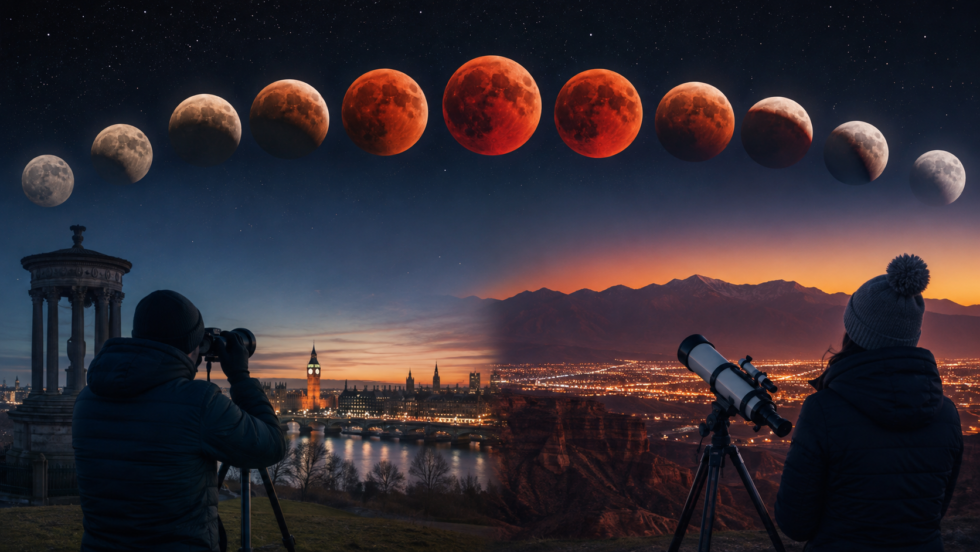
A long focal length gives a detailed Moon, while a shorter lens can place the eclipse within a landscape. That second approach may be particularly effective from Britain because the Moon will be close to the horizon as maximum approaches. The surroundings can provide scale that an isolated telephoto image cannot. For anyone photographing a sequence, keeping the framing and exposure method consistent makes it possible to show the progression of Earth's shadow. NASA's visualisation illustrates why the Moon's brightness changes so dramatically as it crosses from penumbra into umbra.
Why the Moon may turn red during the 2026 eclipse
The lunar eclipse US and UK views should show the same underlying colour effect, although atmosphere, cloud and local sky brightness can change how strongly it appears. During the deep partial phase, Earth blocks direct sunlight from reaching most of the Moon. Some sunlight nevertheless passes through Earth's atmosphere, where shorter blue wavelengths are scattered more efficiently while red and orange light is refracted into the planet's shadow. That filtered light reaches the eclipsed lunar surface. It is the same broad atmospheric process that produces red sunsets, except that during a lunar eclipse the Moon is effectively illuminated by the combined glow of sunrises and sunsets around Earth's limb.
NASA describes the 2026 event as a “deep partial eclipse” and calculates that 96.3 per cent of the Moon's visible disc area will be inside the umbra at greatest eclipse. With only a small portion remaining in direct sunlight, observers' eyes can adapt sufficiently to perceive colour in the shadowed part of the Moon.
“96.3% of the Moon's disk is within Earth's umbra.”
(NASA Scientific Visualization Studio, eclipse visualisation released 21 August 2026.)
The term “blood moon” is frequently attached to red lunar eclipses, but the 28 August event is not a total lunar eclipse. A small section of the Moon remains outside the umbra throughout maximum. That bright edge should make the contrast particularly pronounced: a narrow, directly illuminated section beside a much darker copper-coloured surface. The August eclipse belongs to Saros series 138, a repeating family of lunar eclipses separated by roughly 18 years and 11 days. NASA identifies the previous eclipse in this series as 16 August 2008 and the next as 7 September 2044. The 2026 event is one of two lunar eclipses during the year, following the total lunar eclipse of 3 March.
What time should people in Britain set an alarm
For most UK observers, 3.15am to 3.30am BST provides enough time to reach an observing position before the umbral phase starts at 3.33am. Anyone interested only in the deepest part could arrive later, but waiting until 5am leaves little margin for cloud gaps or finding an unobstructed horizon.
Maximum comes at about 5.12am BST. The Moon is then low and continues descending, so a clear western or south-western outlook matters more as the eclipse progresses. From London the Moon sets at approximately 6.15am, meaning the formal 6.51am end of the partial phase occurs below the horizon.
Is the 2026 lunar eclipse safe to watch
Yes. Looking at a lunar eclipse is as safe as looking at the ordinary full Moon because the observer is not looking at the Sun. Eclipse glasses are unnecessary, and binoculars or telescopes can be used without solar filters.
This is the critical difference from the solar eclipse seen earlier in August 2026. Solar eclipses require certified eye protection for any direct view of the Sun outside totality; lunar eclipses do not.
Will the whole Moon turn red
No. At maximum, a thin part of the Moon remains outside Earth's umbra and continues receiving direct sunlight. NASA's current visualisation places 96.3 per cent of the lunar disc area inside the umbra, while the eclipse has an umbral magnitude of about 0.93.
The shadowed section can appear copper, orange, brick-red or grey depending on atmospheric conditions. There is no single guaranteed shade.
What is the best time to watch in the United States
Eastern US observers should prioritise roughly 10.30pm EDT on 27 August through 2am on 28 August, with maximum at about 12.12am EDT. Central time-zone observers get maximum near 11.12pm CDT, Mountain time around 10.12pm MDT and Pacific time around 9.12pm PDT. The western United States has the convenience of an evening eclipse, but the Moon's altitude around the early stages varies with location. Central and eastern areas have a higher Moon for more of the main umbral phase.
The defining moment comes around 04:13 UTC on 28 August, when the eclipse stops just short of totality and almost the entire lunar disc lies inside Earth's dark central shadow.
For Britain, the 28 August lunar eclipse is an early-morning horizon event; for most of the United States, it is an evening and midnight event on 27–28 August. The practical essentials are a clear view of the Moon, accurate local timing and patience through the approach to maximum. Official eclipse data and visibility material used for this article: NASA Science, NASA Scientific Visualization Studio, Royal Observatory Greenwich.
Read about the life of Westminster and Pimlico district, London and the world. 24/7 news with fresh and useful updates on culture,
business, technology and city life: What Time Is the Solar Eclipse 2026 in the UK, Where to Watch It and How to Get Eclipse Glasses