
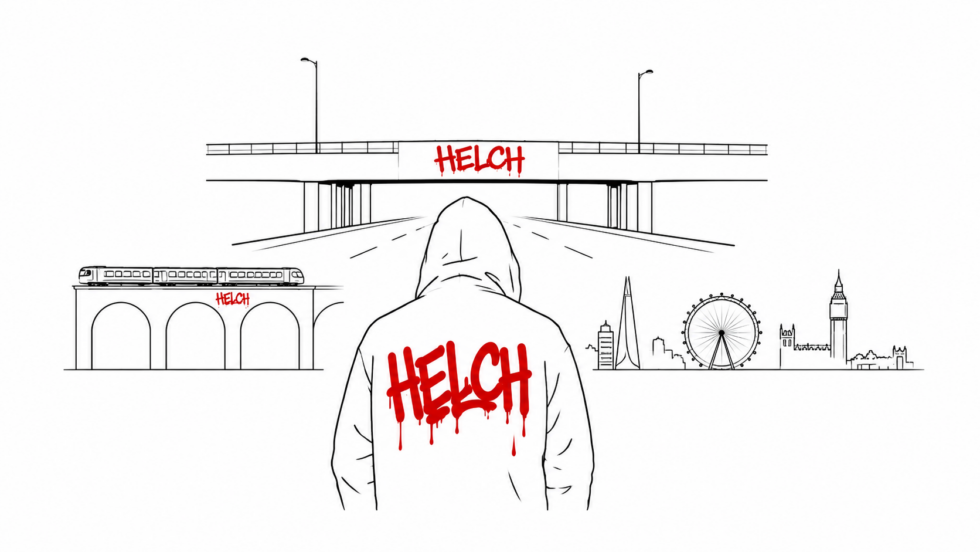
1 September 2026 — Helch graffiti artist, the anonymous British graffiti writer whose enormous HELCH letters became familiar sights beside motorways, railway lines and rooftops, has died aged 34. BSMT Gallery in east London, which staged his first solo exhibition less than a year ago, announced his death and described his passing as “untimely”. For years, Helch had managed an unusual contradiction: his real identity remained hidden while his name was visible to millions of people travelling along the M25, M4 and M1 or through London by train. His work ranged from five-letter HELCH pieces to the distinctive dropped H that appeared on bridges, viaducts and buildings, while one intervention transformed the familiar M25 slogan “Give Peas A Chance” into “Give Helch A Chance”. No cause of death has been publicly confirmed by the gallery, and the available primary material does not establish where or how he died, The WP Times reports.
Helch’s death comes only months after a significant change in a career previously built almost entirely outside conventional galleries. His debut solo exhibition, No Half Measures, opened at BSMT Gallery in Dalston on 4 December 2025 and ran until 18 January 2026. The gallery described it as the first comprehensive solo presentation of original Helch works and a rare transition “from motorway walls to gallery walls”. BSMT’s own record says the HELCH tag had spread across London and beyond since 2018, appearing on railway viaducts, motorway bridges, rooftops and train lines while the person behind it remained anonymous.
What happened to Helch and what is known about his death
The central confirmed fact is that Helch has died. BSMT Gallery, which worked directly with the artist and presented his first solo show, said it had received news of his “untimely passing”. The gallery’s tribute did not publicly identify a cause of death in the material available on 1 September, nor did it disclose a location or detailed circumstances. That means the answer to what happened to Helch remains deliberately limited. Reports can establish his death, his age and the reaction from people who knew or followed his work, but they cannot responsibly assign a medical cause or reconstruct circumstances that have not been made public.
“Receiving news today of the untimely passing of Helch has left us broken-hearted. It felt like he stepped into our lives out of the ether,” BSMT said in its tribute to the artist.
The wording fits the way Helch had occupied British public space for much of his career. The work was highly visible; the individual was not. His identity was reportedly known to a relatively small circle, while the public encountered HELCH as lettering rather than as a personality giving interviews, appearing at events or building a celebrity profile.
At the time of writing, no primary source cited in this report has publicly established the cause of Helch’s death.
BSMT’s connection with Helch also predates No Half Measures. According to the gallery’s account reproduced in contemporary reporting, its interest began after seeing his large roller graffiti in Shoreditch. It then took around six months to persuade the anonymous artist to meet in person. That relationship produced Helch’s first print with BSMT in 2022. The gallery said the edition sold out within an hour, an early indication that the recognition created beside roads and railways could transfer into the commercial art market. The sequence is important:
- Helch’s large-scale tags began becoming widely visible from around 2018.
- The name spread across London, motorway infrastructure and railway routes.
- BSMT established direct contact with the artist.
- The gallery released a Helch print in 2022.
- His first solo exhibition opened in December 2025.
- BSMT announced his death on 1 September 2026.
There was therefore only a short period between Helch’s formal emergence inside a gallery and his death.
Why did Helch become famous on the M25 motorway
The M25 motorway graffiti associated with Helch matters because Britain’s orbital motorway provided exactly the environment in which his work was most effective: enormous surfaces, constant traffic and only seconds for a piece to register with a passing driver. Helch’s visual language was built for those conditions. The full name appeared in uncompromising capital letters, while other pieces reduced it to an H that could be recognised at a distance. Repetition across different routes gradually turned the tag into something approaching an unofficial road landmark. One intervention attracted particular attention. A bridge beside the M25 had for years carried the phrase “Give Peas A Chance”, itself a familiar sight to motorists. After alterations to the lettering, it became associated with Helch through the phrase “Give Helch A Chance”. Contemporary reporting identified that episode as one of the moments that pushed an already active graffiti writer into much wider public recognition. Helch was not confined to one road. His work was associated with major routes including:
- the M25 around London;
- the M4 corridor between London and the west of England;
- the M1 and other motorway approaches;
- railway viaducts and trackside structures;
- rooftops and high walls across London;
- prominent sites in Shoreditch and other parts of east and west London.
BSMT’s official artist biography says HELCH had appeared since 2018 on railway viaducts, motorway bridges, rooftops and train lines. It specifically describes the lettering as one of the most recognised words across London’s infrastructure. That infrastructure was effectively Helch’s medium as much as concrete or paint. A small street-level tag can disappear among shopfronts and signs; a five-metre name above a railway or beside a motorway occupies the entire sightline.
Helch did not need a portrait, biography or public identity for recognition: the repeated word itself became the identity.
| Helch landmark | Why it mattered |
|---|---|
| M25 bridge | Connected the name with one of Britain’s busiest roads |
| “Give Helch A Chance” | Altered an already familiar motorway landmark |
| M4 bridge work | Extended recognition beyond London |
| Railway viaducts | Put HELCH directly into commuter sightlines |
| Shoreditch pieces | Embedded the tag in east London’s urban landscape |
| Windsor-area work | Brought wider national attention to the artist |
| Large dropped H | Created a recognisable visual shorthand for HELCH |
How Helch’s motorway tags became part of the British landscape
The scale of Helch graffiti on the M25 explains only part of the phenomenon. Frequency mattered just as much. A person might first notice HELCH from a train entering London. Weeks later, the same letters could appear on a motorway bridge. Another H might then emerge on a building in Shoreditch. Recognition accumulated through repeated encounters that had no scheduled exhibition time and no single location. One person responding to news of his death described a Helch mark on an M25 bridge as something that signalled being close to home. Another said members of the family would point out HELCH whenever they unexpectedly saw the name on a road or railway journey, comparing the experience to a graffiti version of Where’s Wally?
That reaction explains why Helch was different from many anonymous graffiti writers whose work remains primarily significant inside graffiti culture. His lettering crossed into the visual memory of people who may never have known the terminology, history or internal conventions of graffiti. The motorway also changed how the work had to function. A piece beside the M25 cannot rely on intricate detail. Drivers are moving at speed and their attention belongs to the road. Large capitals and simple forms are therefore more legible than complex imagery. Helch repeatedly used that limitation rather than fighting it. The result was a form of public recognition built on four characteristics:
- exceptionally large lettering;
- placement above or alongside heavily travelled routes;
- repetition of the same five-letter name;
- an identifiable H that could work without the complete tag.
His anonymity strengthened the effect. HELCH was simultaneously a word, a signature and an unanswered question.
What was the Boris is Helch graffiti on the M4
Another widely reported work appeared on an M4 bridge in 2019. The words “Boris is Helch” were painted prominently enough to become visible from the motorway and attracted attention during Boris Johnson’s period at the centre of British politics. The phrase did not reveal anything about Helch’s identity. Its strength was its absurd ambiguity: motorists were presented with what looked like a declarative political statement while the central term remained the pseudonym of an anonymous graffiti writer. The M4 episode helped widen the geographical reach of the name. Helch could no longer be understood simply as a recurring east London tag once the same visual identity was appearing beside major roads well outside his immediate urban territory. His large work around Windsor attracted another kind of attention. BSMT’s official biography records a 20-metre piece on a railway viaduct near Windsor Castle in 2019 and says it reportedly upset the late Queen Elizabeth II. The claim has become part of the Helch story, but the underlying work is more relevant than the anecdote. Painting letters at that scale required Helch to think in relation to architecture and visibility rather than simply the dimensions of a conventional wall.
The H could occupy concrete in much the same way a commercial logo occupies a billboard, except nobody had commissioned it.
Who was Helch if his identity remained secret
Publicly, Helch was a name rather than a conventional artist biography. BSMT describes him as a London-based graffiti writer, but his legal identity was never part of the presentation through which most people encountered the work. This places who was Helch among the questions that cannot be fully answered from reliable public records without overriding the anonymity he maintained.
What can be reconstructed is his artistic record. BSMT dates the widespread appearance of the tag to 2018. It says Helch’s name moved through west and east London, including Shoreditch, Paddington and South Kensington, before becoming associated with infrastructure well beyond those neighbourhoods. The artist increasingly used what BSMT calls “dropped H’s”, variations on the letter that allowed a single character to carry the identity of the full word.
That development gave Helch two complementary signatures. HELCH worked as a blunt declaration; H worked as a recognition test. Anyone unfamiliar with the artist could see an abstract or decorative letter, while people who had followed the tags knew immediately what it represented. BSMT described him as “a true perfectionist”, saying he would not present anything that failed to meet his own standard.
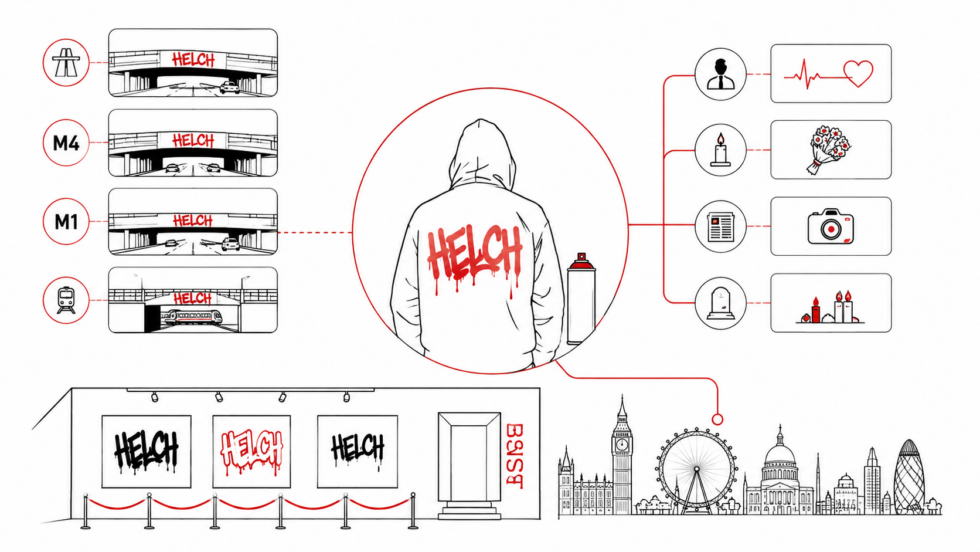
The gallery said his work had progressed markedly over the year before its tribute. That period overlaps with the preparations for his first solo exhibition and suggests Helch was developing a studio practice alongside the large-scale public work for which he was already known.
How No Half Measures took Helch from motorway walls into a gallery
The sharpest change in Helch’s career arrived in December 2025.BSMT Gallery opened No Half Measures at its Kingsland Road space in Dalston on 4 December. It ran until 18 January 2026 and was billed by the gallery as Helch’s first-ever solo exhibition. The exhibition was significant precisely because Helch’s reputation had developed “outside the system”, as BSMT put it. His audience usually encountered the work while travelling rather than deliberately entering an art space. The gallery described the move succinctly as a transition from motorway walls to gallery walls. That shift changed several things at once.
What No Half Measures changed for Helch
First, original works became objects that could be acquired rather than temporary interventions subject to removal, repainting or redevelopment. Second, an audience could examine the visual language at close range instead of seeing it for seconds from a car or train. Third, the exhibition placed prices and a conventional market around an identity that had previously spread largely through unauthorised public placement. BSMT’s current Helch catalogue lists works including Reminiscent, Symbolic, Infinite Nostalgia, The Wave, Pixels, Brick by Brick, Off the Rails and several versions of Third Rail. The gallery lists many original pieces between hundreds and several thousands of pounds, with the works currently marked sold out.
Examples from the official catalogue include:
| Work | Listed BSMT price |
|---|---|
| Reminiscent | £4,500 |
| Symbolic | £3,750 |
| Infinite Nostalgia | £3,750 |
| Third Rail series | Up to £3,000 |
| The Wave | £2,600 |
| Pixels | £2,600 |
| Off the Rails variants | Around £900 |
The prices show how far Helch’s name had travelled from infrastructure to a formal art market. They also reveal the peculiarity of the transition: collectors could own an authenticated Helch work while the artist himself remained publicly anonymous.
BSMT currently describes the debut exhibition as sold out.
The gallery did not remove Helch’s anonymity from the work; it turned anonymity into part of the exhibition’s structure.
What did BSMT Gallery say after Helch died
BSMT’s tribute provides the most personal account publicly associated with the announcement. The gallery said Helch seemed to enter its life “out of the ether”. It recalled being drawn to his Shoreditch roller graffiti, attempting to find out more about the person behind the name and then spending six months getting him to agree to an in-person meeting. That account places considerable distance between the public phenomenon and the private person. By the time the gallery began working with him, HELCH was already part of London’s streetscape, but gaining access to the individual behind it remained difficult. BSMT said the first print released with Helch in 2022 sold out within an hour. Over the following years, that working relationship eventually produced No Half Measures. The gallery’s tribute also stressed his development as an artist during the final year.
“Over the past year, his work progressed exponentially; he was coming into his own as an artist,” BSMT said.
Its final assessment returned to the places where most people first saw him.
“An urban landscape without an H in it seems unfathomable,” the gallery said, adding: “There will never be another like him.”
That response is unusually literal for an obituary. Some Helch works will disappear through cleaning, demolition and redevelopment. Others remain attached to the routes on which the artist built his public identity.
The gallery’s official record of No Half Measures remains available alongside its Helch artist page and catalogue, documenting the point at which one of Britain’s most elusive graffiti names crossed from bypasses, railway lines and motorway bridges into a formal exhibition. BSMT Gallery’s official Helch profile BSMT’s No Half Measures exhibition record
What happens to Helch’s motorway graffiti now
Helch’s death does not produce a single permanent monument because the body of work was never concentrated in one place. It exists across roads, railway infrastructure, walls, rooftops and photographs accumulated over almost a decade. Some pieces have already been altered or removed. Others continue to be encountered exactly as Helch intended: unexpectedly, at scale and in motion. The M25 remains central to that story because the motorway helped transform a private pseudonym into a nationally recognisable visual signature. The changed “Give Peas A Chance” bridge gave the public a particularly memorable reference point, but Helch’s reputation was built through hundreds of encounters rather than one definitive mural. His gallery career was much shorter. No Half Measures opened in December 2025; Helch’s death was announced on 1 September 2026.
Those two parts of the record now sit beside each other: the anonymous name painted across British transport infrastructure and the finite collection of works documented by BSMT. The cause and circumstances of his death remain undisclosed in the available primary material, but the places through which HELCH became known are already visible from the road.
Materials used: BSMT Gallery official HELCH artist profile, BSMT Gallery official No Half Measures exhibition archive and catalogue, BSMT Gallery tribute quoted in contemporary reporting, source material supplied to The WP Times.