
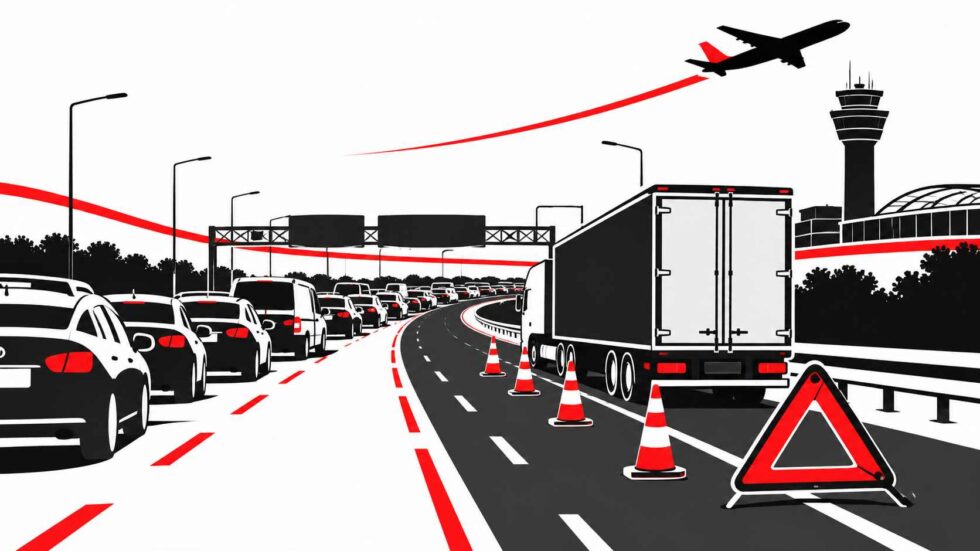
M23 traffic delays near Gatwick Airport eased after a broken-down lorry blocked one southbound lane before Junction 9 on Wednesday, 14 October 2026. The AA reported that the incident began at approximately 7.30am, with a queue of around two miles developing as traffic passed the obstruction. One of four lanes remained closed during the morning, and the live coverage recorded the incident as cleared at 11.37am. The disruption affected a motorway approach used by airport passengers, employees, delivery vehicles and other motorists travelling through the area, according to the road network's role in Gatwick's published surface-access strategy. The incident was covered in a live report by Emily Elliott, with the AA providing updates on the lane restriction and queue length.
The latest confirmed position in the supplied incident report is that the obstruction had cleared by 11.37am. That is the recorded end of the incident, not a verified time for the return of normal traffic speeds. The available information does not establish the lorry's mechanical fault, the precise time it was recovered, the total delay experienced by individual drivers or any direct effect on flights. National Highways provides a separate live travel updates service for checking road incidents, while The WP Times provides a publication channel for related UK news coverage.
What happened on the M23 southbound near Gatwick Airport
The incident occurred on the M23 southbound carriageway before Junction 9, the interchange serving Gatwick Airport. The AA identified a broken-down lorry in lane one of a four-lane section, leaving three lanes not identified as closed in the incident updates. Traffic was reported to be queueing for around two miles, with the lane restriction continuing into the morning. The live report first described a stranded vehicle at 9.45am and subsequently reproduced the AA's account of the queue and closure. At 11.37am, the report stated that the incident had cleared and ended its live coverage.
The first recorded time in the AA's account was approximately 7.30am. This places the beginning of the reported disruption in the morning travel period, when the motorway carries a mixture of commuter traffic and journeys associated with the airport. The time between 7.30am and the 11.37am clearance announcement is four hours and seven minutes, although the start time was approximate and the duration of any individual driver's delay is not known. The AA's first statement said: "One lane closed and queueing traffic for two miles due to broken down vehicle on M23 Southbound before J9 (Gatwick Airport). In lane one (of four)." The wording identified the immediate obstruction, its location and the reported queue length, but did not give an average speed or a forecast for when the road would return to normal.
The confirmed incident was a vehicle breakdown and a lane restriction, not a reported full closure of the southbound motorway.
A later AA update identified the vehicle as a lorry and confirmed that slow traffic and the lane closure were continuing. The supplied report does not say whether the lorry had suffered an engine failure, a tyre problem or another mechanical fault. It also does not identify the recovery operator or state how the vehicle was removed.
What did the AA say about the M23 lane closure
The AA provided two descriptions of the disruption during the live coverage. Its earlier statement referred to a broken-down vehicle and a queue extending for two miles. The subsequent update specified a broken-down lorry and recorded the restriction as having been in place since 7.30am.
The later statement read: "One lane closed and slow traffic due to broken down lorry on M23 Southbound before J9 (Gatwick Airport). In lane one (of four), since 07:30."
The two statements describe the same reported incident. Both place the obstruction on the southbound carriageway before Junction 9 and identify lane one as the affected lane. The change from "broken down vehicle" to "broken down lorry" adds detail about the vehicle but does not establish a second event. The distinction between a lane closure and a full motorway closure is central to an accurate account. The AA's wording indicates that one of four lanes was unavailable, while its reports describe queueing and slow traffic rather than the complete stoppage of all southbound traffic. The available information does not provide evidence of a formal diversion, a closure of the whole carriageway or restrictions on the northbound M23.
| Reported detail | What the available evidence establishes |
|---|---|
| Location | M23 southbound before Junction 9 for Gatwick Airport |
| Cause | A broken-down lorry |
| Affected lane | Lane one of four |
| Approximate start | 7.30am on 14 October 2026 |
| Queue length | Around two miles, according to the AA |
| Continuing disruption | One lane remained closed at 10.16am |
| Clearance | 11.37am, according to the live report |
| Individual journey delays | Not quantified |
| Mechanical cause | Not specified |
The table separates recorded details from information that remains unknown. It would be inaccurate to turn the reported queue length into a precise delay in minutes or to claim that all motorists experienced the same journey conditions.
Why does Junction 9 matter for Gatwick Airport traffic
Junction 9 is the main motorway access point for Gatwick Airport. The airport's published surface-access strategy says the M23 connects directly to Junction 9, just over a mile from the South Terminal, and identifies the motorway as an important route for passengers, staff and goods. The document also says that approximately three-quarters of airport traffic arrives through this route, based on the figures used in the strategy.
That connection explains why a lane restriction before Junction 9 can affect more than ordinary commuter journeys. Vehicles approaching the interchange may include passengers travelling to catch flights, airport workers starting shifts, taxis, private-hire vehicles, coaches and commercial deliveries. The incident report, however, does not identify individual drivers or provide figures showing how many airport journeys were affected on 14 October. The motorway's importance should not be confused with proof of an operational problem at the airport. The supplied coverage contains no confirmed flight cancellations, missed departures, terminal closures or airline statements linked to the breakdown. The evidence supports a report about road congestion near an airport access route, not a claim that air travel was disrupted. Gatwick's surface-access strategy also explains that the motorway connection serves local traffic as well as airport journeys. This means congestion around Junction 9 can affect road users whose destination is not the airport. The available incident report does not distinguish between airport-bound traffic and other journeys.
The location establishes the potential reach of the disruption, but the number of affected passengers and motorists remains unknown.
For current conditions, National Highways maintains a live travel updates service covering incidents and road restrictions on England's motorways and major A roads. Its service is separate from the historical live report, which records the breakdown as cleared at 11.37am.
How long did the M23 traffic delays last
The AA recorded the breakdown as beginning at approximately 7.30am. The live report then documented continuing disruption during the morning, including confirmation at 10.16am that one lane remained closed. At 11.37am, the coverage stated that the incident had cleared. The difference between the approximate start time and the clearance announcement is four hours and seven minutes. This is the reported incident window, rather than a confirmed measure of how long the queue lasted or how much extra time motorists needed to complete their journeys.
The timeline provides several distinct points that should not be treated as interchangeable:
- The breakdown was recorded at approximately 7.30am. This is the start time given in the AA update.
- A queue of around two miles was reported. The AA described queueing traffic in its earlier statement.
- The restriction was still active at 10.16am. The live coverage confirmed that one lane remained closed and traffic was slow.
- The incident was reported cleared at 11.37am. This is the final time recorded in the supplied live report.
The available material does not establish the exact moment the queue reached two miles, whether it subsequently grew or how quickly vehicles moved through the restricted section. It also does not provide a final average speed or a comparison with normal journey times. A cleared incident and a cleared queue are not necessarily the same thing. Removing a broken-down vehicle can restore the available road space, but traffic already held behind the obstruction still needs time to pass through the affected stretch. This is a general distinction in traffic reporting; the supplied report does not measure the time required for congestion to dissipate on this occasion.
The final update therefore establishes that the reported obstruction had been cleared by 11.37am. It does not establish that the M23 immediately returned to its usual traffic conditions.
Was the M23 closed completely near Gatwick Airport
No full southbound motorway closure is identified in the supplied account. The AA described a restriction affecting lane one of four, with queueing traffic and later slow-moving traffic. The report does not state that all four southbound lanes were closed or that motorists were ordered to leave the motorway. That distinction matters because descriptions such as "motorway shut" or "M23 closed" would imply a more extensive restriction than the available evidence supports. The documented incident involved a single-lane closure caused by a broken-down lorry, while traffic congestion extended for around two miles.
The supplied coverage does not name an official diversion route or record instructions for drivers to use alternative roads. It would therefore be inappropriate to publish a specific diversion as though it had been issued by National Highways or the police for this incident.
National Highways publishes information about planned roadworks, unplanned incidents and restrictions through its official travel service. The agency's wider road-closure reporting also distinguishes between carriageway closures, lane restrictions and scheduled maintenance, although the existence of a general reporting service does not independently confirm the details of this particular breakdown. For the incident on 14 October, the most precise description remains a broken-down lorry in lane one of the southbound M23 before Junction 9, with three other lanes not reported as closed and the incident cleared at 11.37am.
What remains unconfirmed about the Gatwick motorway incident
The live coverage and AA statements establish the location, vehicle type, lane restriction, approximate start time, reported queue length and clearance time. They do not provide a complete account of the breakdown or its consequences.
Several details remain unconfirmed:
- The precise mechanical fault that caused the lorry to stop.
- The time the recovery operation began and the time the lorry was removed.
- Whether any other vehicles were involved in a separate incident.
- Whether anyone was injured.
- The exact number of vehicles caught in the queue.
- The average additional journey time for motorists.
- The time traffic speeds returned to normal.
- Whether any airport passengers missed flights as a direct result.
These are gaps in the available reporting, not evidence that any particular consequence occurred. No injuries are described in the supplied material, but the absence of injury information cannot establish that no one was injured. Likewise, the lack of a flight-delay report does not prove that every airport journey proceeded as planned.
The live blog included an invitation for motorists caught in traffic to contact reporter Emily Elliott by email. That request indicates that the publication was seeking information from people affected by the disruption; it does not itself confirm any additional accounts or establish the scale of the impact. A further statement from National Highways, the police or the recovery operator could provide additional operational detail, but no incident-specific statement from those organisations is established in the supplied material. The AA's recorded updates remain the direct source for the quoted traffic conditions.
M23 traffic delays near Gatwick Airport: questions answered
What caused the M23 traffic delays on 14 October 2026?
A broken-down lorry blocked lane one of the southbound M23 before Junction 9, which serves Gatwick Airport. The AA reported slow traffic and a queue of around two miles.
When did the M23 incident start?
The AA recorded the breakdown as beginning at approximately 7.30am on Wednesday, 14 October 2026. The lane restriction was still in place at 10.16am, according to the live coverage.
When was the M23 lorry breakdown cleared?
The live report recorded the incident as cleared at 11.37am. The report did not specify when the queue disappeared or when traffic speeds returned to normal.
How many lanes were affected?
One of four lanes was closed. The AA identified lane one as the affected lane and described the remaining traffic as queueing and slow-moving.
Were flights at Gatwick Airport delayed?
The supplied coverage does not confirm any flight cancellations or delays caused by the breakdown. The incident affected a road serving the airport, but no direct impact on flight operations is established.
Where can motorists check current M23 traffic conditions?
National Highways publishes road incident and travel information through its official live travel updates service. The 11.37am clearance time in the live report is a record of the incident's reported status, not a guarantee of current traffic conditions.
Sources used: AA incident statements reproduced in the live coverage, Emily Elliott's live report dated 14 October 2026, Gatwick Airport's published surface-access strategy, National Highways live travel updates and road-closure information.
Read about the life of Westminster and Pimlico district, London and the world. 24/7 news with fresh and useful updates on culture, business, technology and city life: What will Ruthin School closure mean after 742 years of
teaching in North Wales