
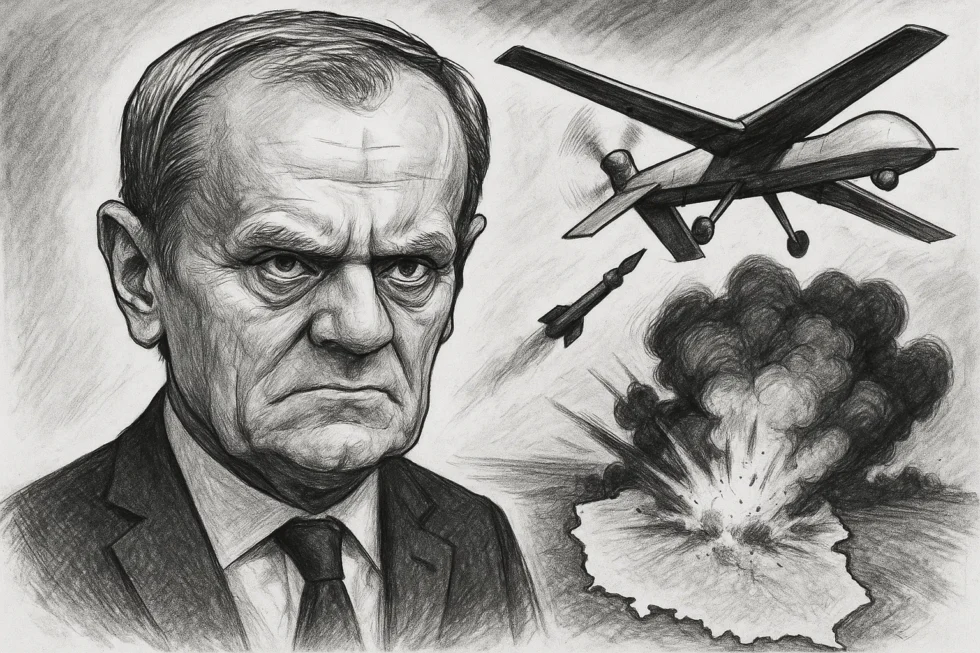
Warsaw, 10 September 2025. Polish Prime Minister Donald Tusk has confirmed that Russian drones violated Polish airspace overnight in one of the most serious cross-border incidents of the war. According to Tusk, 19 Russian dronesentered Polish territory during the night of 9–10 September, but only four were shot down by Polish air defences. He described the incident as a “massive provocation” and called an emergency government session. This was reported by The WP Times, citing Reuters.
Tusk on X (formerly Twitter): “Last night the Polish airspace was violated by a huge number of Russian drones. Those drones that posed a direct threat were shot down. I remain in constant contact with the NATO Secretary General and our allies.”
Tusk added that many of the drones crossed into Poland from Belarusian territory, underlining what Warsaw views as a deliberate escalation.
Emergency government statement
During the extraordinary cabinet meeting, Tusk told ministers:
“We are most likely dealing with a massive provocation. We are in consultations with our allies. Poland is ready to respond.” He further confirmed that Poland had formally requested consultations under Article 4 of the NATO Treaty, saying: “Poland needs more than expressions of solidarity. We have requested consultations under Article 4.” Article 4 obliges NATO members to hold urgent discussions if a member feels its security is threatened, but it does not trigger a military response.
Military operations
The Operational Command of the Polish Armed Forces reported that all drones posing an immediate danger were neutralised, but acknowledged that the majority crossed Polish airspace before being intercepted. Polish F-16s, Dutch F-35s, Italian AWACS surveillance aircraft and NATO refuelling planes took part in the operation. Patriot air-defence systems tracked the drones but were not used to fire.
It was the first time that NATO aircraft had engaged potentially hostile objects in the skies of an allied member. A NATO source told Reuters that preliminary data indicated a deliberate penetration by six to ten drones, though Poland’s own figures put the number at 19 incursions.
Airports closed, airspace disrupted
The incursions forced the temporary closure of four airports, including Warsaw Chopin, Lublin and Rzeszów. Flights were diverted, and notices to airmen cited “unplanned military activity related to state security.” By Wednesday morning, Poland’s air-defence and radar systems had returned to standard mode, but ground teams continued searching for debris.
NATO reaction
NATO declined to classify the drone incident as an attack on Poland, stressing instead that it was a provocationrequiring consultations but not collective defence under Article 5.
A NATO source told Reuters: “This was the first time NATO aircraft attacked potentially dangerous objects in allied airspace, but it does not amount to an attack on Poland.”
Regional and European reactions
Ukrainian President Volodymyr Zelensky confirmed that at least eight Shahed drones had flown towards Poland during the night, and offered Warsaw access to Ukraine’s intelligence and radar data.
“Ukraine is ready to provide Poland with all the data we have and to support the development of joint warning and defence systems,” Zelensky said.
EU foreign policy chief Kaja Kallas described the drone violations as a deliberate breach of European airspace by Russia, stressing that “this was not accidental.”
Analysts quoted by European media suggested that Russia had prepared such operations for months, with Shahed drones modified using locally sourced components in Belarus and Russia.
Read about the life of Westminster and Pimlico district, London and the world. 24/7 news with fresh and useful updates on culture, business, technology and city life: Russia’s Kh-101 cruise missile: expensive weapon at the centre of the Ukraine war