
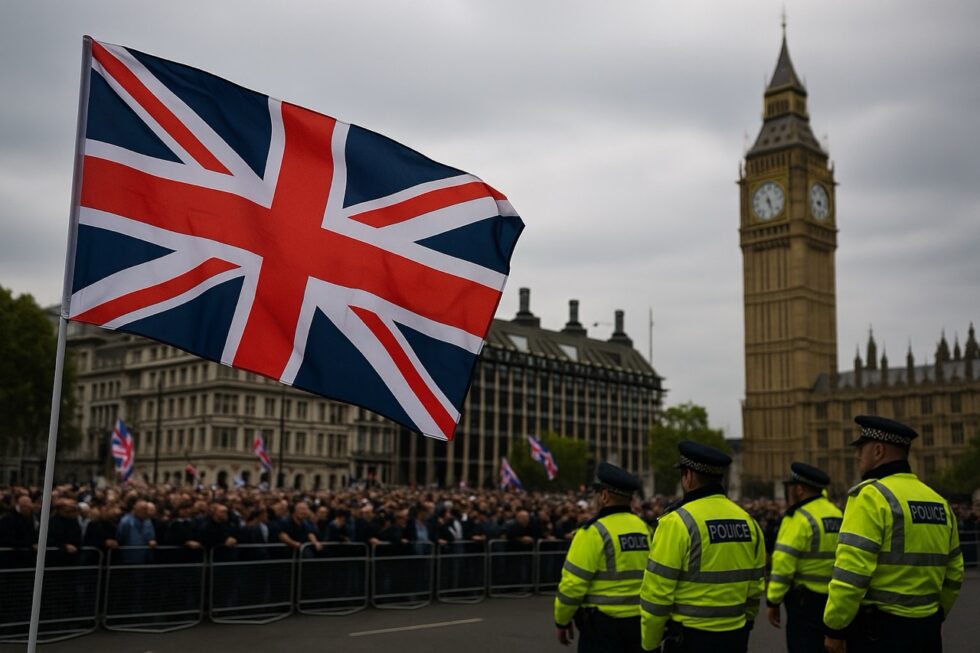
On 13 September 2025, London witnessed one of the largest far-right gatherings in recent memory as Tommy Robinson, the former English Defence League leader, drew an estimated 110,000 supporters under the slogan Unite the Kingdom. The event, described as unprecedented by police, spiralled into violent clashes. Тhe WP Times reports on the rally, citing official figures and accounts published by Reuters.
13 September: The day of the protest
The march through Westminster carried chants of “Stop the boats” and “Send them home”, targeting the government’s migration policy. Robinson told the crowd: “Today is the spark of a cultural revolution in Great Britain, this is our moment.”
Counter-protesters from Stand Up to Racism brought around 5,000 people. Teacher Ben Hitchen, among them, said: “The idea of hate is dividing us and I think the more that we welcome people the stronger we are as a country.” Despite heavy police presence, tensions erupted. Protesters hurled bottles and flares. 26 police officers were injured, four seriously. 25 arrests were made for violent disorder. Assistant Commissioner Matt Twist warned: “We are identifying those who were involved in the disorder and they can expect to face robust police action in the coming days and weeks.”
14 September: Political and public reactions
By Sunday, 14 September, the fallout dominated headlines. Prime Minister Keir Starmer condemned the violence, calling it “a dangerous exploitation of fear and anger for political ends.” Human rights groups warned of the growing visibility of far-right networks. Sandra Mitchell, a supporter at the rally, countered: “We want our country back; we want our free speech back on track.”
Even billionaire Elon Musk intervened with a video message: “You either fight back or you die.” He described migration as “massive and uncontrolled”, contributing to the “destruction of Britain,” and called for the “dissolution of Parliament.” The Metropolitan Police announced an internal inquiry into the scale of the rally and the severity of the clashes.
What it means for Britain
The events of 13–14 September highlight a volatile political climate. The rally’s route cut through some of the most symbolic streets in Britain — from Whitehall past Parliament Square and the Houses of Parliament, underlining the deliberate choice of a location tied to British democracy and state power. Nearby landmarks such as Downing Street, home of the Prime Minister, and Westminster Abbey became the backdrop for chants of “Stop the boats”.
Robinson, though lacking mainstream political standing, has proved his capacity to mobilise six-figure crowds in the very heart of London’s political quarter. Analysts argue that such movements feed off disenchantment with the government and rising anxieties over migration, particularly as Channel crossings remain a divisive issue.
For Britain, the weekend stands as both a warning and a test: how to balance free expression with public order while preventing the far-right from reshaping the national conversation. The symbolic choice of Westminster as the stage ensures that the images and confrontations of 13–14 September will remain etched into the political memory of 2025.
Read about the life of Westminster and Pimlico district, London and the world. 24/7 news with fresh and useful updates on culture, business, technology and city life: Traditions and holidays of Great Britain in a modern context.