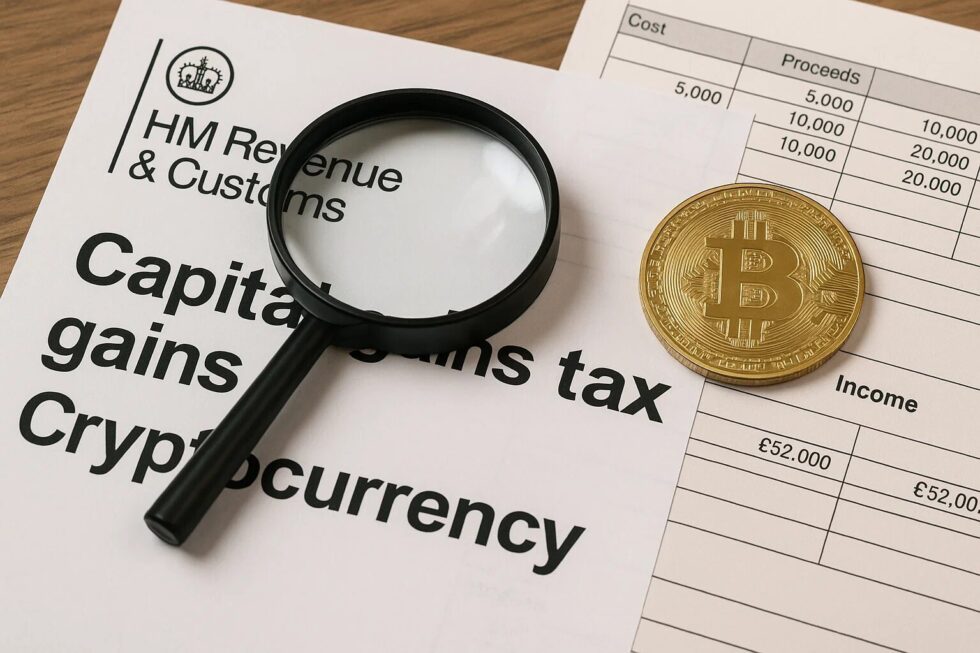
Cryptocurrency taxation in the UK is no longer a blurry frontier. HMRC now actively monitors cryptoasset transactions and demands clarity from private investors on gains, income, and disposals. As the regime tightens, individuals who trade, stake, mine, or simply spend crypto must understand exactly what to report — and how. Big changes lie ahead with the introduction of the OECD’s CARF framework, mandating data sharing between platforms and HMRC. Already, the 2024/25 Self Assessment includes a dedicated crypto section to ensure greater transparency. As The WP Times notes suggests, taxpayers must stay alert to evolving rules and new reporting responsibilities.
In this article, you will discover:
- How HMRC defines taxable crypto events and distinguishes capital gains from income
- Which transactions you must report, and how to compute gains and losses
- What new obligations crypto exchanges and service providers will face from 2026
- Practical advice and examples to help UK private investors meet compliance
What counts as a taxable crypto event and how HMRC defines taxable transactions
In the eyes of HMRC, many — though not all — crypto operations qualify as “disposals,” triggering Capital Gains Tax (CGT). Disposal can mean selling crypto for fiat, swapping one token for another, spending crypto on goods or services, or gifting it (except to a spouse or civil partner).
Notably, simply holding crypto does not incur tax.But when you dispose, you must compute the difference between proceeds and your acquisition cost (the “cost basis”), applying rules such as share pooling (grouping same-token acquisitions). Transactions such as mining rewards, staking income, airdrops, or receiving crypto as payment may fall under Income Tax rather than CGT, depending on whether HMRC considers them ordinary income or capital gains. HMRC guidance warns that in complex cases — e.g. DeFi protocols, liquidity pools, yield farming — the nature of the transaction determines whether it is treated as capital or income. You must maintain robust records, because many crypto exchanges keep limited histories, or may disappear. HMRC expects records to include transaction date, type of crypto, number of units, value in pounds at acquisition and disposal, costs incurred, and the counterparty (or wallet) where relevant. If Crypto-to-Crypto trades occur (e.g. BTC → ETH), that is also considered a disposal and should be treated as if you sold one and bought another.
Below is a tabulated illustration of common crypto events and their HMRC tax treatment:
| Type of Transaction | HMRC Classification | Reporting Obligation |
|---|---|---|
| Sell crypto for GBP | Capital gains disposal | If gains above allowance, include in SA108 |
| Swap crypto A → crypto B | Disposal + acquisition | Must compute gain & cost basis |
| Spend crypto on goods / services | Disposal | Report gain if above threshold |
| Gift crypto (not spouse) | Disposal | Report gain accordingly |
| Mining, staking, airdrop, rewards | Income (or mixed) | Include in self-assessment income section |
| Losses from crypto disposals | Capital loss | Can offset against gains, carried forward |
Rates, allowances and thresholds: how much tax might you owe
HMRC distinguishes two main tax regimes: Capital Gains Tax for disposals and Income Tax (plus potentially National Insurance) for crypto income.
Under CGT rules, each individual is granted an annual tax-free allowance, currently £3,000 for 2024/25 (reduced from previous years). Only gains exceeding that allowance are taxable.
The applicable CGT rate depends on your total taxable income bracket. For basic rate taxpayers, the gain above allowance is taxed at 18%, while for higher rate taxpayers, it's 24%. (These rates are effective post-30 October 2024; earlier disposals may bear 10% / 20% rates). By comparison, crypto income (from mining, staking, airdrops, or remuneration) is taxed at Income Tax rates (0 %–45 %), depending on total income, and may also incur National Insurance contributions.
You only pay CGT or income tax (plus NI) when a taxable event occurs. Holding crypto without transacting doesn’t trigger tax. If you incur capital losses (e.g. selling at a loss), you can offset these losses against gains in that tax year, or carry them forward indefinitely (provided you’ve registered the loss in your tax return). If your total gain doesn’t exceed the allowance and you have no other capital gains, you may not owe CGT — but you may still need to report the gain, depending on HMRC rules and your taxpayer status. As a practical example: if you are a higher-rate taxpayer and realize a gain of £6,000 (above allowance), the taxable portion could be £3,000 taxed at 24% = £720 tax liability.
Here is an example table of CGT liability under differing scenarios:
| Gain Above Allowance | Taxpayer Band | Rate Applied | Tax Owed |
|---|---|---|---|
| £1,000 | Basic rate | 18 % | £180 |
| £5,000 | Higher rate | 24 % | £1,200 |
| £10,000 | Higher rate | 24 % | £2,400 |
| Losses offset | — | — | Reduces gains / carry forward |
What HMRC can do to trace your crypto activity — methods and enforcement
HMRC has significantly enhanced its surveillance tools and cooperative frameworks to track crypto flows.
Starting January 2026, UK cryptoasset service providers (exchanges, brokers, wallets) operating as Reporting Crypto-Asset Service Providers (RCASPs) must collect detailed user information and report it to HMRC under the OECD’s Crypto-Asset Reporting Framework (CARF). These providers will be required to submit data on users’ identities, wallet addresses, transaction types and values for users resident in the UK or participating jurisdictions. Failure to comply may incur £300 fines per non-compliant user for providers.
HMRC already receives transaction and customer data via exchange data-sharing agreements, including with overseas platforms (back to 2014). The inclusion of a dedicated crypto section in the new 2024/25 Self Assessment form signals HMRC’s priority in flagging crypto-related entries and clearance.
Moreover, HMRC routinely issues “nudge letters” to taxpayers suspected of underreporting crypto activity. Penalties, interest, and enforcement actions may follow if HMRC determines underpayment or misreporting, and there is little tolerance for oversight in future audits. Given all this, private investors cannot rely on anonymity — they should expect their crypto flows may be traced and linked to their tax returns.
Steps for private investors: how to comply, calculate, report and reduce risk
Here are eight crucial steps for private UK crypto investors to keep in compliance:
- Register for Self Assessment if you have taxable crypto activity not covered under PAYE.
- Maintain detailed records of every transaction: date, amounts, counterparties, values in GBP, costs, wallet addresses.
- Classify each transaction as capital (disposal) or income (reward, airdrop, staking) based on nature.
- Apply pooling rules: for multiple acquisitions of the same crypto, use averaging methods to compute cost basis.
- Calculate gains and losses annually, subtract the £3,000 allowance, offset losses, compute CGT due.
- Report in Self Assessment: fill in SA108 (Capital Gains summary) and the crypto section, include income if applicable.
- Declare and pay tax within specified windows: tax owed must be paid within 30 days of disclosure.
- Review your tax strategy annually, considering new changes from HMRC and CARF; consider engaging a crypto-aware tax advisor.

Below is a checklist summarizing your compliance path:
- Self Assessment registration
- Detailed record system in place
- Transaction classification (capital vs income)
- Pooling costs computed correctly
- Annual gain/loss calculation
- Losses claimed and carried forward
- SA108 + crypto section completed
- Payment of tax on time
Case studies and illustrative examples
Let’s walk through two examples:
Example A: Disposing tokens
Alice purchases 1 BTC in January at £20,000. In July, she sells it for £28,000. Disposal gain = £8,000. She subtracts the £3,000 allowance, leaving £5,000 taxable. If she is a higher-rate taxpayer at 24%, tax owed = £1,200.
Example B: Staking income + disposal
Bob earns staking rewards of ETH worth £2,000 in May (treated as income). He includes this in his income tax return. Later, he sells ETH at gain of £4,000 above cost basis. He reports the gain under CGT (net £1,000 after allowance). He pays income tax on £2,000 and CGT on £1,000.
In countries such as Germany or Poland, tax regimes may differ, but the UK places emphasis on treating crypto as property and linking each disposal/income event to taxation.
Another sample: say you swap 100 ADA for 0.01 BTC. That is a disposal of ADA; you must compute the value of ADA in GBP at that moment, subtract your cost basis, and recognize gain or loss. Then treat acquisition of BTC as new cost base.
A third scenario: you give 0.5 ETH to a friend (non-spouse). Even though no money exchanged, HMRC sees it as disposal; you compute NG gain and report if above threshold.
Always retain proof (screenshots, wallet history, exchange statements) in case HMRC requests verification.
How upcoming CARF rules transform the landscape for UK crypto taxation
Beginning January 1, 2026, new UK rules mandate cryptoasset providers to report customer data and transactions to HMRC under CARF. CRA frameworks will require providers to collect full identity (name, address, tax residency) and wallet/transaction history. Reporting deadlines: the first reporting window covers January–December 2026, to be submitted by 31 May 2027. UK’s HMRC guidance imposes £300 penalties per user for supplier noncompliance. This global standard helps HMRC align with over 70 jurisdictions, enabling cross-border asset tracking. As a result, expecting anonymity or opacity will become harder; data matching between exchange reports and declared returns will be routine.
For investors, this raises the stakes: errors, omissions or ambiguous records may trigger audits or penalties.
Strategically, investors should anticipate more stringent compliance and consider professional auditing of historic crypto transactions prior to 2026.
Read about the life of Westminster and Pimlico district, London and the world. 24/7 news with fresh and useful updates on culture, business, technology and city life: Why Peter Lynch Refuses to Join the AI Frenzy — A Warning From Wall Street’s Most Disciplined Mind