
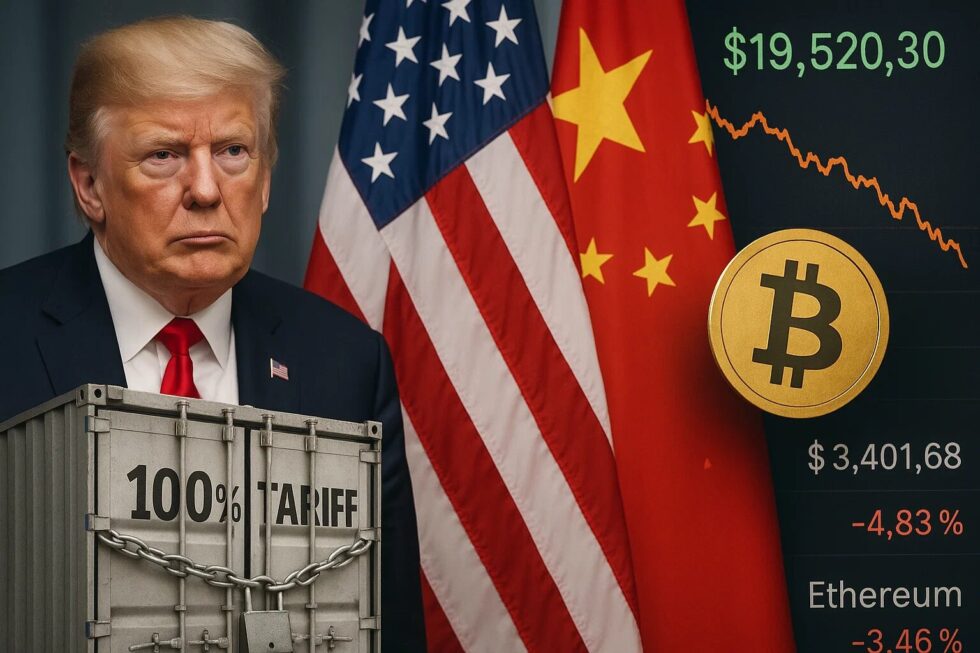
Cryptocurrency markets in the United States and globally experienced a historic collapse on October 10, 2025, triggered by former President Donald Trump's announcement of a 100% tariff on Chinese imports, effective November 1, 2025. Bitcoin, Ethereum, and other major cryptocurrencies plummeted, causing over $19 billion in liquidations within a single hour. The announcement came in response to China's recent restrictions on the export of rare earth minerals, critical for high-tech industries and electronics production. This sudden escalation in the U.S.-China trade war immediately sent shockwaves through global financial markets, prompting panic among retail and institutional investors alike. Trading volumes surged across major exchanges as investors rushed to close leveraged positions. The total cryptocurrency market capitalization fell by 10.91%, landing at $3.69 trillion. The Crypto Fear & Greed Index tumbled to 35 points, signaling extreme investor anxiety. As noted by The WP Times, the volatility reached levels unseen since the market peak in early 2022.
Market Reaction and Immediate Impact
The initial market reaction to Trump's tariff announcement was swift and severe. Bitcoin dropped 8.4%, falling to $104,782, while Ethereum declined 5.8% to $3,637. Other major cryptocurrencies, including Solana, XRP, Cardano, and Polkadot, experienced losses ranging from 15% to 30%, reflecting widespread panic. Exchange platforms reported massive liquidation events, with over 1.6 million traders affected in the span of one hour. The surge in forced liquidations intensified price volatility, creating a feedback loop of selling pressure. Futures and margin trading amplified the crash, as automated stop-loss orders triggered additional sell-offs. Institutional investors also sold positions to mitigate risk exposure, contributing to the sharp declines. Trading volumes across Binance, Coinbase, and Kraken exceeded record highs. Analysts noted that the combination of geopolitical tension, leveraged positions, and sentiment-driven selling created a perfect storm for this unprecedented crypto meltdown.
Key Metrics During the Crash:
| Cryptocurrency | Price Drop | Liquidations (1 hour) |
|---|---|---|
| Bitcoin (BTC) | -8.4% | $6.3B |
| Ethereum (ETH) | -5.8% | $3.2B |
| Solana (SOL) | -15.2% | $1.1B |
| XRP | -22% | $0.8B |
| Cardano (ADA) | -17% | $0.7B |
Fear and Greed Index Plummets
Investor sentiment experienced a sharp reversal as the Crypto Fear & Greed Index dropped from 64 ("Greed") to 27 ("Fear") in a single day. This dramatic shift reflects heightened uncertainty, risk aversion, and panic-driven trading. Investors, fearing further devaluation, rushed to liquidate positions or move assets into perceived safe havens such as stablecoins, gold, and U.S. Treasury bonds. Social media sentiment analysis showed a surge in bearish discussions, with Twitter mentions of “Bitcoin crash” and “crypto liquidation” spiking by over 250%. Retail traders were particularly vulnerable to emotional selling, exacerbating downward pressure on prices. Exchange platforms reported increased traffic on margin call alerts and stop-loss triggers. Analysts warned that continued escalation of U.S.-China tensions could prolong market uncertainty. This sudden shift in sentiment also coincided with increased volatility in related markets such as tech stocks and semiconductor equities, reflecting investor interconnectedness between crypto and broader financial markets.
Global Market Repercussions
The U.S.-China trade escalation did not only impact cryptocurrencies. Traditional financial markets also reacted sharply. The S&P 500 fell by 2.3%, the Nasdaq by 3.1%, and the Dow Jones Industrial Average by 1.9% within hours. European stock markets, including the DAX and FTSE 100, recorded declines of 2-3%. Asian markets experienced similar turbulence: the Hang Seng Index dropped 3%, Japan's Nikkei 225 declined 2.8%, and the Shanghai Composite decreased by 3.5%. Commodity markets saw increased volatility, with gold rising 2% as investors sought safe-haven assets, while oil prices fell 4% due to expectations of reduced industrial demand. Currency markets also shifted, with the Japanese yen and Swiss franc strengthening against the U.S. dollar. This global ripple effect underscored the deep integration between cryptocurrencies and traditional financial systems, illustrating the systemic risk posed by geopolitical developments. Analysts highlighted that trade tensions often have amplified effects in highly speculative asset classes like cryptocurrencies.
Investor Strategies Amidst Volatility
Amid the turbulence, investors adopted diverse strategies to mitigate risk. Conservative traders moved holdings into Bitcoin and Binance Coin, historically more resilient in high-volatility periods. Others shifted capital into stablecoins like USDC and Tether to preserve liquidity. Diversification strategies expanded to include traditional safe-haven assets such as gold, U.S. Treasury bonds, and high-grade corporate bonds. Portfolio rebalancing tools saw record usage as algorithmic trading systems adjusted exposure automatically. Some investors took advantage of lower prices to accumulate high-potential altcoins, viewing the dip as a buying opportunity. Technical analysts emphasized monitoring support levels, moving averages, and Relative Strength Index (RSI) indicators to predict potential rebounds. Risk management practices, including reducing leverage and setting tighter stop-loss thresholds, became standard among retail and institutional participants. Financial advisors recommended that investors remain patient and informed regarding evolving U.S.-China trade policies.

Investor Strategy Checklist:
- Move a portion of portfolio to stablecoins or cash
- Rebalance diversified holdings including gold and bonds
- Reduce leverage and margin exposure
- Monitor technical indicators for support/resistance levels
- Avoid panic-driven trading and emotional decisions
Long-Term Outlook
The long-term outlook for cryptocurrency markets remains uncertain, heavily dependent on U.S.-China trade developments. Analysts forecast multiple scenarios: a moderate recovery if tensions stabilize, prolonged volatility if tariffs escalate further, or systemic downturns in correlated assets. Market experts advise continuous monitoring of macroeconomic indicators, such as industrial output, semiconductor supply chains, and global trade flows. Institutional adoption and regulatory clarity could provide stabilizing factors, supporting long-term resilience. Conversely, persistent geopolitical risks and speculative trading may continue to fuel sudden, sharp price movements. Cryptocurrency investors are encouraged to follow expert analyses, diversify portfolios, and maintain liquidity to navigate ongoing uncertainty. Long-term strategies may include strategic accumulation, hedging through derivatives, or participation in decentralized finance (DeFi) platforms with risk management protocols. Historical patterns suggest that markets often recover after high-volatility events, but timing and magnitude remain unpredictable.
Read about the life of Westminster and Pimlico district, London and the world. 24/7 news with fresh and useful updates on culture, business, technology and city life: How does HMRC track crypto profits — What UK investors must declare to stay legal