
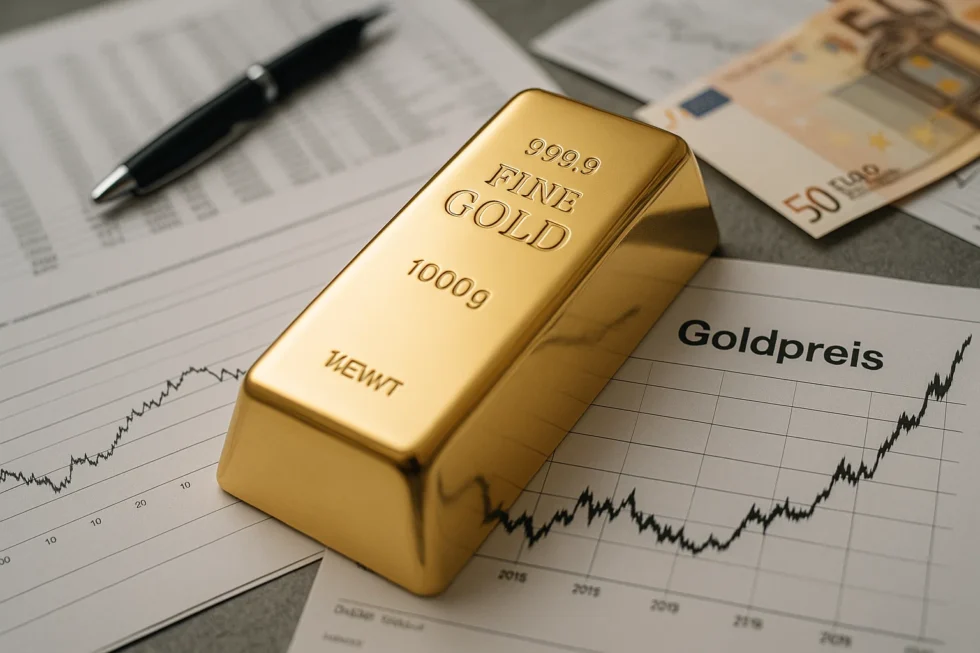
Gold has reached a historic milestone, climbing above $4,130 per ounce for the first time on record — a 56 % surge since January, according to Bloomberg and Reuters. Despite resilient stock markets and strong corporate earnings, global investors continue to shift into the metal long regarded as the ultimate safe haven.
The rally has been fuelled by aggressive central bank purchases, persistent inflation, and a sweeping reallocation of capital from volatile equities and digital assets into tangible stores of value. Analysts see it not as a temporary spike, but as part of a broader monetary realignment — a shift that challenges traditional notions of stability in an era of geopolitical fragmentation. According to the World Gold Council, the structural demand from central banks and institutional investors has reached its highest level in over a decade, with net buying from Asia and the Middle East leading the surge, reports The WP Times.
Central Banks Lead the Charge
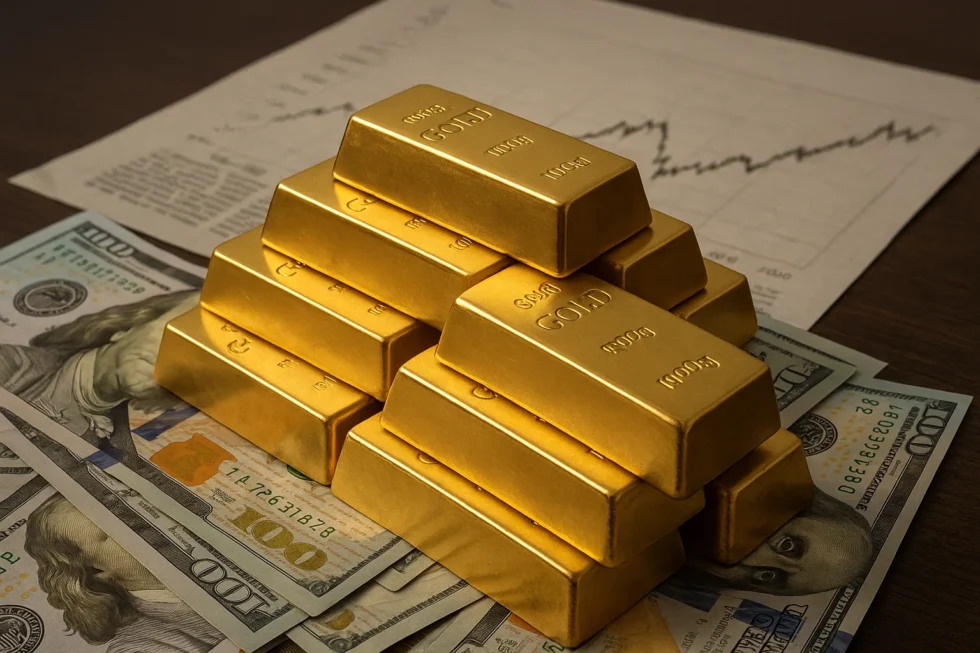
Data from the World Gold Council (WGC) show that central banks bought roughly 1,100 tonnes of gold in the first half of 2025, marking the strongest start to a year since records began. Major buyers include China, India, Poland, Turkey, and Russia, all seeking to hedge against currency volatility and diversify reserves.
The WGC’s Central Bank Gold Reserves Survey 2025 revealed that 95 % of respondents plan to increase gold holdings in the next 12 months, while three-quarters expect to reduce exposure to the U.S. dollar.
Analysts interpret this as a strategic response to the long-term weakening of confidence in fiat currencies, particularly amid Washington’s recurring debt ceiling battles and the U.S. government shutdown. “Gold is becoming the world’s silent reserve currency — an anchor outside the digital financial system,” said Amrita Sen, Chief Analyst at Energy Aspects, in a comment to Bloomberg.
Macro Forces: Inflation, Real Yields and the Dollar
Global inflation remains stubborn. The IMF estimates average worldwide inflation at 4.3 % for 2025, with the U.S. at 3.7 %, the Eurozone at 3.9 %, and Switzerland at 2.2 %. Even with higher nominal rates, real yields remain near zero, reducing the opportunity cost of holding gold. The U.S. dollar index has fallen around 9 % year-to-date, making gold cheaper for buyers outside the U.S.
“Investors increasingly view gold as a hedge against fiscal disorder and geopolitical risk, rather than simply inflation,” said Jeffrey Hochegger, investment strategist at Raiffeisen Schweiz, in an interview with Reuters.
| Year | Gold Price (USD/oz) | Annual Change | GBP/kg |
|---|---|---|---|
| 2020 | 1,890 | +25 % | £44,000 |
| 2021 | 1,800 | –5 % | £42,000 |
| 2022 | 1,970 | +9 % | £47,000 |
| 2023 | 2,250 | +14 % | £54,000 |
| 2024 | 2,640 | +17 % | £66,000 |
| 2025 | 4,131 | +56 % | £86,000 |
Source: World Gold Council / Bloomberg Markets, October 2025
London’s Bullion Market: The Global Nerve Centre
London remains the heartbeat of the gold trade. The London Bullion Market Association (LBMA) oversees one of the largest over-the-counter markets for gold and silver globally.
Twice-daily benchmarks — the LBMA Gold Price AM and PM — determine settlement values across central banks, refiners, and ETF custodians. As trading volumes surged in 2025, the LBMA reported record inflows into physically backed ETFs and vaults. Institutional demand from Europe and Asia has surged, with ETF inflows rising by 28 % in Q3 — the strongest increase since 2020.
“The market is now driven less by fear and more by portfolio reallocation,” said Simon Murry, metals strategist at UBS London. “Gold has reclaimed its strategic role in global asset management.”
Switzerland’s Strategic Role
Switzerland refines nearly 60 % of the world’s gold, with key facilities in Ticino and Neuchâtel operated by Valcambi, PAMP, Metalor, and Argor-Heraeus. The Swiss Federal Customs Office (BAZG) reports 2024 exports of 2,730 tonnes and imports of 2,850 tonnes — underscoring the country’s dominance in processing and re-exporting bullion. For private Swiss investors, gold has become both a psychological and financial safe haven. The ZKB Gold ETF reached a record CHF 14.5 billion in assets this autumn, while physical bullion sales remain strong despite rising premiums.
Financial advisers recommend a 5–10 % gold allocation within diversified portfolios, especially amid ongoing monetary policy uncertainty and slowing growth in China.
Digital Uncertainty and De-Dollarisation
The global rush into gold also reflects distrust in digital assets and fiat systems. Following a series of high-profile crypto exchange failures and U.S. regulatory crackdowns, institutional investors have redirected liquidity toward tangible hedges.
Meanwhile, the global debt load has hit $315 trillion (IMF data), amplifying systemic risk. The move away from the dollar — often termed de-dollarisation — is accelerating. Russia, China and Gulf states increasingly settle bilateral trade in local currencies or gold. As a result, gold’s function as a neutral asset outside political influence is strengthening.
What investors should do now
1 — Treat gold as strategic insurance.
Keep a 5–10 percent allocation within diversified portfolios. Gold is designed to preserve value, not outperform equities.
2 — Blend instruments.
Hold physical bullion for security, ETFs for liquidity, and mining equities for cyclical upside to balance stability with opportunity.
3 — Think across currencies.
Sterling investors may hedge part of their holdings in CHF or EUR denominated gold to offset U.S.-dollar swings.
4 — Track real yields and central-bank flows.
As long as real interest rates remain below 2 percent and official buyers remain net accumulators, the structural bias stays positive.
5 — Avoid emotional timing.
Build exposure gradually through disciplined, systematic purchases rather than chasing peaks.
According to the World Gold Council, total global gold demand in 2025 is projected to exceed 4,800 tonnes, compared with 4,471 tonnes in 2024 — driven by record central-bank purchases and ETF inflows exceeding 250 tonnes in the first three quarters alone. Asia continues to dominate consumption: China’s private demand rose by +28% year-on-year, and India’s importsclimbed above 900 tonnes, their highest since 2019.
The average gold price for 2025 now stands at $3,720 per ounce, with year-end targets ranging from $3,800 to $4,500, according to Bloomberg Economics and Bank of America. In a prolonged geopolitical risk scenario — persistent inflation, weak U.S. dollar, and continued central-bank diversification — analysts forecast a possible test of $5,000/oz in the first half of 2026.
Silver, often a secondary beneficiary, is expected to average $58/oz in 2026, with a potential spike to $65/oz if industrial demand rebounds in China and Europe. Meanwhile, the global ETF market has already absorbed more than $45 billion in new gold-linked inflows this year, marking the strongest capital shift toward tangible assets since 2008.
For policymakers, this sustained rally has become a barometer of confidence: a signal that the world’s liquidity is seeking solidity. For investors, it reaffirms what the markets have quietly priced in — that gold is no longer a hedge against crisis, but a benchmark for trust itself.
Read about the life of Westminster and Pimlico district, London and the world. 24/7 news with fresh and useful updates on culture, business, technology and city life: How does HMRC track crypto profits — What UK investors must declare to stay legal
Sources: Reuters Commodities, Bloomberg Markets, World Gold Council Q3 Report 2025, IMF World Economic Outlook 2025, Bank of America, LBMA, Raiffeisen Schweiz, Swiss Federal Customs (BAZG), Energy Aspects.