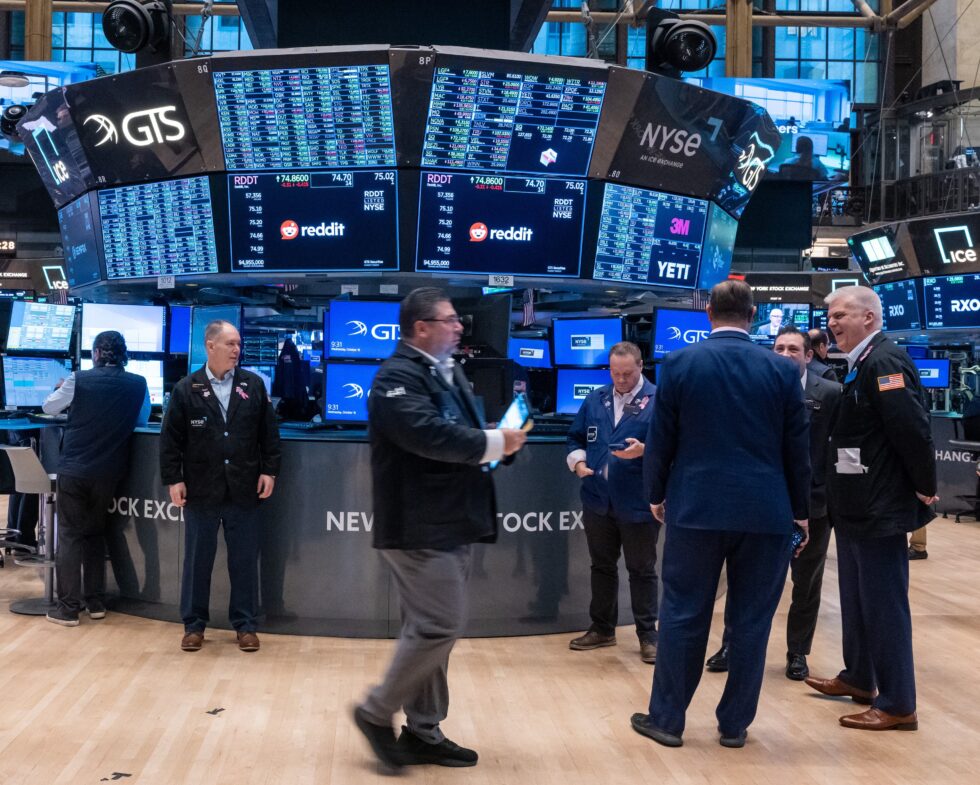
Global stock markets plunged while gold surged to an all-time high after two US regional lenders revealed millions of dollars in losses linked to bad loans and alleged fraud, reports The WP Times citing The Guardian.
Signs of credit strain spread rapidly across Europe and Asia. In London, the FTSE 100 slid 1.5%, Germany’s Dax dropped 2%, Spain’s Ibex fell 0.8%, and France’s Cac 40 declined 1.5% before slightly recovering. The sharpest declines hit the banking sector, with around £9.5bn erased from the market value of the UK’s five largest listed lenders. Barclays suffered the biggest loss, with its shares tumbling 6%. Across Europe, approximately €45bn (£39bn) was wiped off the continent’s banking sector, including the UK.
Concerns over credit quality across the US economy triggered further turmoil on Wall Street and sent Asian markets lower. Japan’s Nikkei 225 fell 1.6%, while Hong Kong’s Hang Seng lost 2%. US markets were also expected to open lower on Friday. Investors, seeking stability, turned to safe-haven assets as gold reached a new record of $4,378 (£3,262) per ounce, marking a weekly gain of nearly 8.5% — the strongest rise since the 2008 financial crisis.
The sell-off followed disclosures from Zions Bancorporation, a Utah-based bank, which said it would write off $50 million on two loans, and Western Alliance Bancorp, headquartered in Phoenix, which launched legal action over a bad loan worth $100 million. Shares in Zions fell by more than 10%, while Western Alliance dropped over 9%.
Analyst Jim Reid of Deutsche Bank noted that although the incidents involved relatively small lenders, they revived memories of the 2023 regional banking turmoil that followed the collapse of Silicon Valley Bank (SVB). Reid warned that prolonged high interest rates and the rapid expansion of private credit could be exposing broader risks to loan quality.
SVB, once the 16th largest US bank with $212bn in assets, collapsed after announcing a $1.75bn capital raise to cover losses from its bond portfolio, sparking a run on deposits and the largest US bank failure since 2008.
Market analysts also pointed to fears of a potential domino effect after the bankruptcy of subprime auto lender Tricolor last month. The sector has been under increased scrutiny since First Brands, an auto parts supplier, filed for Chapter 11 bankruptcy in late September, revealing liabilities between $10bn and $50bn against assets of only $1bn to $10bn due to risky off-balance-sheet financing.
Richard Hunter, head of markets at Interactive Investor, said investors are now facing “a gathering storm” driven by high stock valuations in the AI sector, a looming US government shutdown, and strained relations between Beijing and Washington, all compounded by growing fears over lending practices in American regional banks.
Derren Nathan, head of equity research at Hargreaves Lansdown, added that despite hopes of further rate cuts this year, markets are increasingly focused on the underlying health of the economy amid rising credit losses among regional lenders.
Market volatility intensified, with the VIX index — known as the “fear gauge” — surging more than 22% on Thursday to its highest level since April, and climbing another 6% on Friday morning. Earlier in the week, Jamie Dimon, CEO of JP Morgan, warned that more “cockroaches” could emerge following the collapses of Tricolor and First Brands.
Read about the life of Westminster and Pimlico district, London and the world. 24/7 news with fresh and useful updates on culture, business, technology and city life: Britain Publishes Evidence of Large-Scale China Espionage Operations Threatening Security
Photo: Spencer Platt