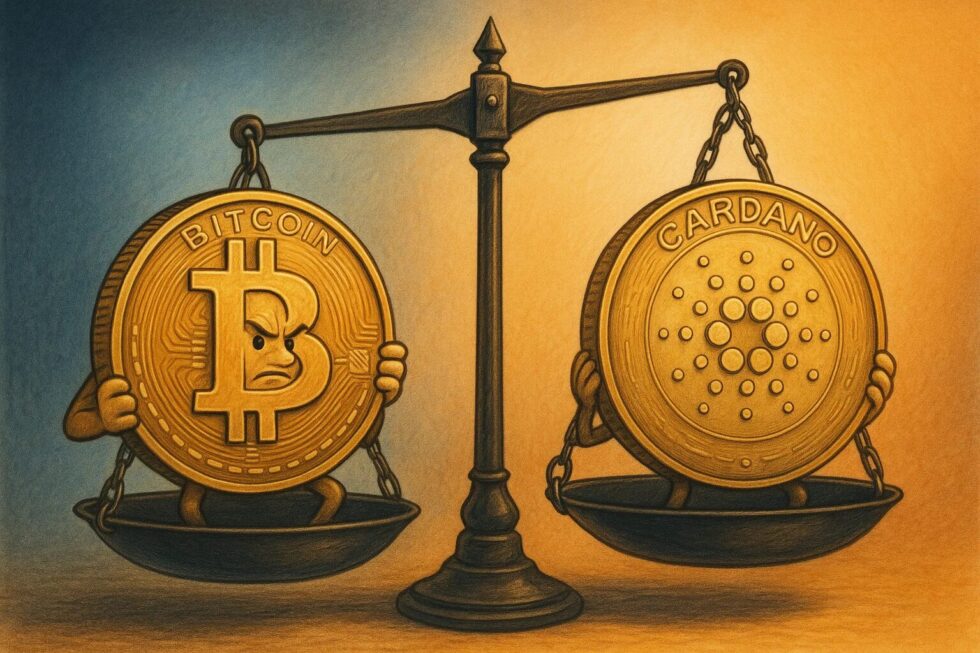
Which cryptocurrency has more upside: the established market leader Bitcoin, or the smart-contract platform Cardano? This is a fundamental question facing investors seeking to optimize their portfolio's growth over the next 18 months, as the two assets represent vastly different risk and reward profiles within the digital asset space. Bitcoin has successfully navigated many initial growth challenges and achieved significant institutional adoption, solidifying its position as a digital store of value and reserve asset. Cardano, conversely, is positioned to enter a major expansion phase, leveraging its unique research-driven approach to decentralized finance and smart contracts. The divergence in their maturity means that their performance over the near term could vary dramatically, forcing investors to weigh the security of an established asset against the exponential possibility of a developing technology. It is essential to analyze the underlying technology, market positioning, and community support of each to determine which asset aligns best with an individual's investment strategy and risk tolerance. This comparative analysis provides a foundational look at the factors determining future growth, reports The WP Times with reference to Telegram.
Understanding the Investment Case for Bitcoin (BTC)
Bitcoin, often called digital gold, holds the status of the first and most widely recognized cryptocurrency, defined by its decentralized nature and fixed supply cap of 21 million coins. Its primary investment thesis revolves around its function as a hedge against inflation and a store of value, drawing parallels to traditional commodities like gold. The asset has successfully cleared numerous regulatory and market hurdles, culminating in substantial institutional interest, particularly with the introduction of spot Exchange-Traded Funds (ETFs) in major jurisdictions. This institutional adoption has significantly de-risked Bitcoin, stabilizing its position in global finance and enhancing its liquidity, though its growth potential may be inherently capped by its immense existing market capitalization. Its network effects are unparalleled, offering the deepest liquidity and the strongest brand recognition in the entire crypto ecosystem. Therefore, investors often view Bitcoin as the less volatile foundation of a digital asset portfolio. Its position as the benchmark asset means that all other cryptocurrencies are often measured against its performance and stability.
Key Characteristics of Bitcoin Investment:
- Market Position: Established digital store of value and reserve asset.
- Supply Cap: Hard limit of 21 million coins, creating scarcity.
- Institutional Adoption: Supported by spot ETFs and major financial institutions.
- Network Effect: Largest and most secure network, facilitating high liquidity.
- Risk Profile: Considered lower risk compared to other altcoins due to maturity.
Cardano (ADA): The Potential for Higher-Risk, Exponential Upside
Cardano, represented by its native token ADA, is often categorized as a "next-generation" smart contract platform, distinguishing itself through a formal, research-driven development methodology. The project emphasizes peer-reviewed scientific studies and secure engineering principles, aiming to build a highly scalable and sustainable blockchain infrastructure for decentralized applications (dApps). Its current market capitalization is significantly smaller than Bitcoin's, which mathematically allows for a higher percentage return should it achieve broader platform adoption and successful scaling. The investment case for Cardano rests on its potential to capture a substantial share of the decentralized finance (DeFi) and dApp market by offering a technically superior and more energy-efficient alternative to older platforms. This potential for exponential growth, however, comes with inherently higher technological and adoption risk compared to the established stability of Bitcoin. The next 18 months are crucial for Cardano as it transitions fully into a self-sustaining and fully decentralized system, potentially unlocking its major expansion phase.
Factors Driving Cardano’s Upside Potential:
- Development Methodology: Peer-reviewed, academic approach focused on security and scalability.
- Market Position: Smart contract platform targeting decentralized finance and dApps.
- Growth Potential: Smaller market capitalization permits mathematically higher percentage returns.
- Technology Risk: Success is contingent upon broader adoption of its unique scaling solutions and protocols.
- Energy Efficiency: Operates on the Ouroboros Proof-of-Stake consensus, making it highly energy efficient.
Comparative Analysis: Upside Potential Over the Next 18 Months
Over the specified 18-month horizon, the performance of Bitcoin and Cardano is expected to be dictated by different market forces, leading to a potential divergence in returns. Bitcoin’s growth is likely to be characterized by steady appreciation, driven primarily by macroeconomic factors like interest rate decisions and continued institutional capital inflows from major financial hubs. Its upside may be significant in dollar terms, but the percentage growth is likely to be measured, following historical patterns observed after major halving cycles. Cardano's performance, conversely, will be primarily dependent on the successful execution of its development roadmap and tangible metrics demonstrating platform adoption, such as the total value locked (TVL) in its DeFi ecosystem and the proliferation of quality dApps. For a high-risk investor seeking aggressive percentage gains, Cardano offers a greater theoretical upside due to its smaller size, while a more conservative approach would favour the reliable, albeit slower, appreciation of Bitcoin. Factual data shows that in preceding crypto bull cycles, smaller capitalization altcoins routinely surpassed Bitcoin in percentage growth, though they also suffered steeper drawdowns.
Investment Profile Comparison:
| Feature | Bitcoin (BTC) | Cardano (ADA) |
| Primary Growth Driver | Institutional Flow, Macroeconomics | Platform Adoption, Technological Execution |
| Risk Level (18 Months) | Moderate | High |
| Expected Percentage Upside | Measured, Lower Volatility | Exponential, Higher Volatility |
| Key Metric to Watch | ETF Inflows, Central Bank Policy | Total Value Locked (TVL), dApp Count |
Investment Strategies and Risk Management
The choice between Bitcoin and Cardano ultimately reflects the investor's individual risk tolerance and long-term financial objectives within the digital asset class. Investors prioritizing capital preservation and consistent exposure to the crypto market's overall growth should lean towards Bitcoin, treating it as a foundational commodity or reserve asset. Its established infrastructure provides a reliable anchor during market volatility, making it suitable for long-term holders with lower risk appetites. Conversely, investors willing to accept greater volatility in exchange for the chance of exponential returns—often seen in the early stages of successful smart contract platforms—might find Cardano more appealing. Diversification is a common strategy to mitigate the binary risk associated with platform-specific tokens like ADA. For instance, allocating a majority to BTC for stability while dedicating a smaller, riskier portion to ADA can balance the portfolio. Research from major financial institutions consistently recommends that highly volatile assets like cryptocurrencies should not exceed a specific percentage of a general investment portfolio, often citing a maximum of 5% for high-growth segments.
Regulatory and Market Maturity: A Key Distinction
The market and regulatory maturity of these two assets present a crucial distinction for institutional and traditional investors. Bitcoin has successfully navigated significant regulatory scrutiny in markets across North America and Europe, positioning it as a quasi-regulated asset through instruments like spot ETFs, which appeal to risk-averse capital. This regulatory clarity is a major factor limiting its downside and attracting large-scale capital. Cardano, however, is still subject to the evolving and less clear regulatory frameworks that apply to smart contract platforms, particularly concerning decentralized autonomous organizations (DAOs) and securities laws. This regulatory uncertainty creates an inherent risk premium, but the successful navigation of these legal hurdles could act as a powerful catalyst for future growth. The difference in maturity dictates that Bitcoin responds more predictably to macro trends, whereas Cardano is more sensitive to internal developmental and regulatory news specific to the smart contract domain.
The comparison between Bitcoin and Cardano highlights the classic investment dilemma: choosing between the security and established value of a market leader and the potential for greater percentage upside offered by a high-growth technological challenger. Bitcoin provides a foundational exposure to the digital asset revolution with reduced volatility, suitable for preserving wealth. Cardano, through its scientific approach and focus on decentralized finance, offers the possibility of outsized gains if its technical roadmap and adoption metrics meet market expectations over the crucial next 18 months.
Read about the life of Westminster and Pimlico district, London and the world. 24/7 news with fresh and useful updates on culture, business, technology and city life: Solana ETF Defy Market Downturn: Institutional Inflows Remain Strong