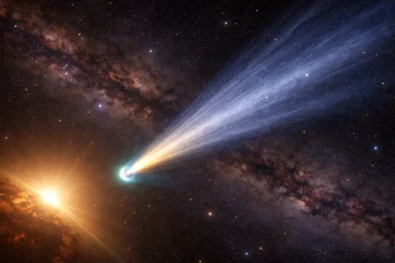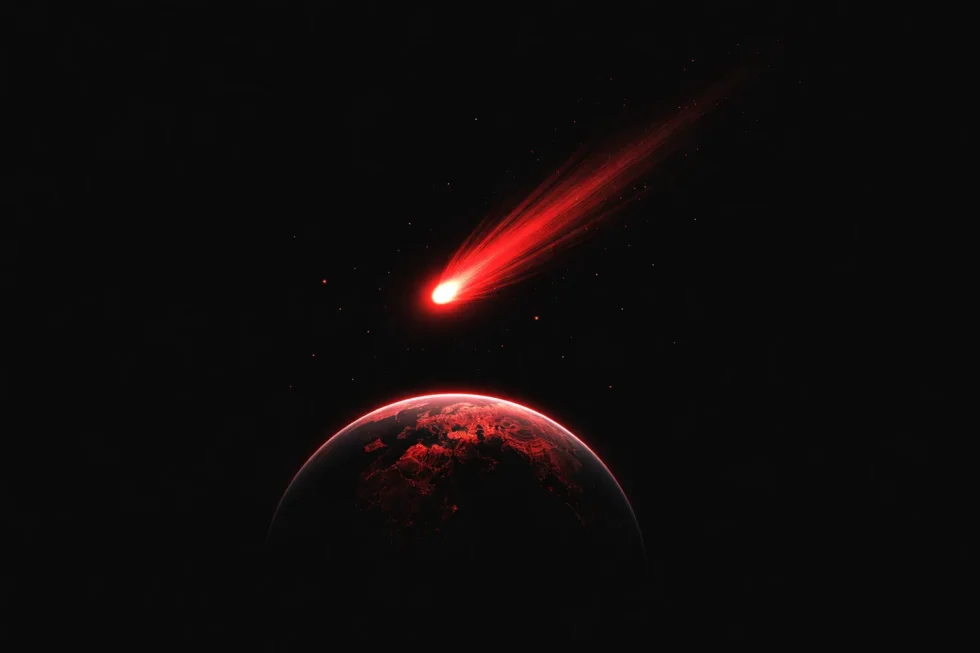
On 19 December 2025, the interstellar comet 3I/ATLAS will pass its closest point to Earth, marking the final and most valuable opportunity for astronomers to observe the object before it exits the Solar System forever. At its nearest, the comet will be around 270 million kilometres from Earth, close enough for detailed ground-based and space-based observations despite being nearly twice the Earth–Sun distance. This is reported by The WP Times, citing ScienceAlert as the primary source.
Discovered on 1 July 2025, 3I/ATLAS is only the third confirmed interstellar object ever observed passing through the Solar System, and it has stood out from the outset for its highly unusual behaviour. As it travelled inward past the orbits of Mars and the Sun, scientists recorded chemical and physical characteristics rarely, if ever, seen in comets originating within our own planetary system.
Unusual chemistry and extreme composition
Early measurements of the comet’s coma — the cloud of gas and dust surrounding its nucleus — revealed unexpectedly early outgassing, with large quantities of carbon dioxide released far sooner than anticipated. As solar heating intensified, astronomers detected significant amounts of hydrogen cyanide (HCN) and methanol (CH₃OH), produced as frozen ices sublimated into gas.
In the weeks following discovery, researchers also identified exceptionally high concentrations of nickel and iron, prompting scientists to describe the object as having a “potentially extreme composition” unlike that of known Solar System comets. These findings have fuelled debate about whether 3I/ATLAS formed in a radically different stellar environment.
The comet’s trajectory briefly brought it close to Mars in early October, an encounter observed by both Martian and solar spacecraft. Shortly afterwards, Earth-based observations were interrupted when the comet passed behind the Sun during perihelion on 29 October, temporarily hiding it from view.
X-rays, colour shifts and competing theories

When 3I/ATLAS re-emerged from the Sun’s glare, observations resumed across multiple wavelengths. In early December, the ESA’s XMM-Newton space telescope spent around 20 hours observing the comet, detecting soft X-ray emissionsgenerated as charged particles from the solar wind collided with neutral gases in the expanding coma.
Optical observations added another layer of intrigue. Late-November images from Gemini North, operated by NOIRLab, revealed a greenish tint in the coma. Earlier images had shown a more reddish colour, associated with organic surface compounds known as tholins. The green glow is linked to diatomic carbon (C₂), a molecule commonly seen in comets but previously thought to be scarce in 3I/ATLAS. Its late appearance suggests that C₂ began forming only in the later stages of the comet’s passage through the Solar System.
Scientists remain divided on how to interpret these signals. Some researchers suggest the object may be metal-rich, possibly venting gases through cryovolcanic activity. Others argue that the comet could be running out of ice, evolving towards a more asteroid-like state as volatile materials are depleted.
Despite the speculation, scientists are clear on one point. “This object is a comet,” NASA associate administrator Amit Kshatriya said in November. “It looks and behaves like a comet, and all evidence points to it being a comet. But this one came from outside the Solar System, which makes it fascinating, exciting, and scientifically very important.”
The days surrounding 19 December are expected to deliver a final surge of observations. Researchers hope the data will not only clarify the nature of 3I/ATLAS, but also provide rare insight into the conditions of interstellar space — a region usually studied only indirectly, now briefly revealed by a visitor passing through our cosmic neighbourhood.
Read about the life of Westminster and Pimlico district, London and the world. 24/7 news with fresh and useful updates on culture, business, technology and city life: Major Video Game Releases for December 2025: A Critical Guide to the Holiday Season