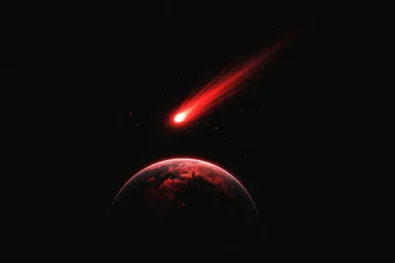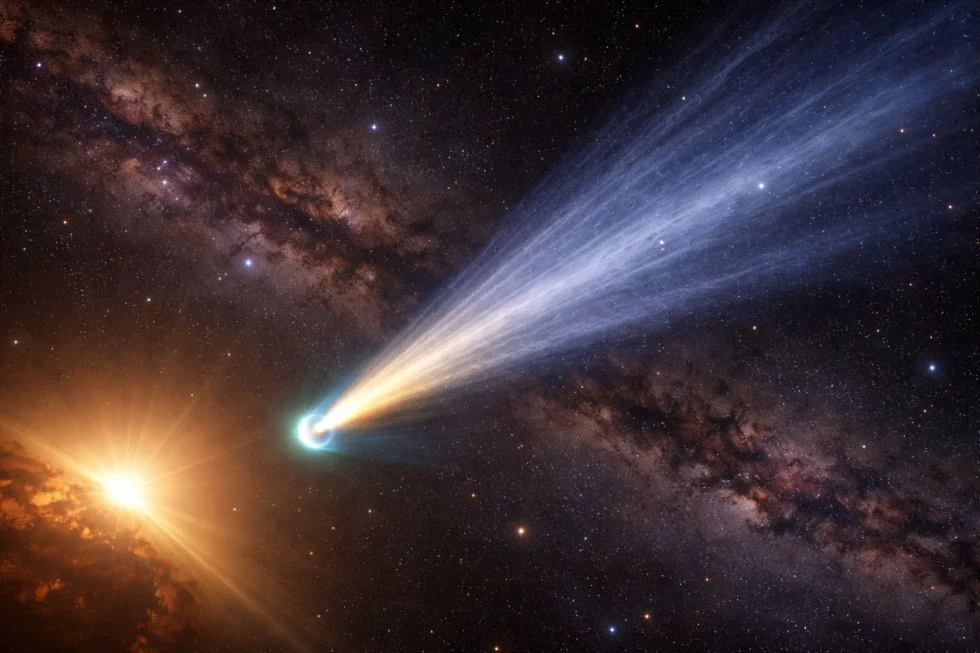
On 28 December 2025, international science desks are focused on the strange and highly revealing behaviour of interstellar Comet 3I/ATLAS, even as it continues its departure from the solar system. Today’s coverage highlights a rare sun-facing “anti-tail” and a system of wobbling jets inside it — features that are providing astronomers with one of the most detailed views ever of material formed around another star. As the comet moves steadily outward beyond the inner planets, scientists are using the final observing window of late December and early January to extract as much information as possible about how alien ice and dust react when heated by our Sun. This is reported by The WP Times, citing NASA, the SETI Institute and European observatories as the primary sources.
Comet 3I/ATLAS, also known as C/2025 N1 (ATLAS), is only the third confirmed interstellar object ever detected passing through our celestial neighbourhood, following the mysterious ‘Oumuamua in 2017 and the more conventional comet 2I/Borisov in 2019. Unlike ‘Oumuamua, which showed little clear cometary activity, 3I/ATLAS behaves like a fully active icy comet, making it a rare and valuable physical sample of another planetary system.
The comet was first detected on 1 July 2025 by the NASA-funded ATLAS survey telescope in Chile, with archived images pushing its discovery back into mid-June. Orbital calculations quickly confirmed that it is travelling on a hyperbolic path, meaning it is not gravitationally bound to the Sun and will leave the solar system forever. It passed closest to the Sun on 30 October 2025 at about 1.4 astronomical units, just inside the orbit of Mars, and made its nearest approach to Earth on 19 December, remaining a safe 1.8 astronomical units away.
Why Comet 3I/ATLAS has a rare sun-facing anti-tail and what it reveals
Most comets develop tails that stream away from the Sun as dust and gas are pushed outward by solar radiation and the solar wind. 3I/ATLAS, however, developed a striking anti-tail — a dust structure that appears to point toward the Sun. This rare effect is caused by the geometry of the comet’s orbit and the way dust particles spread along it, combined with the viewing angle from Earth.
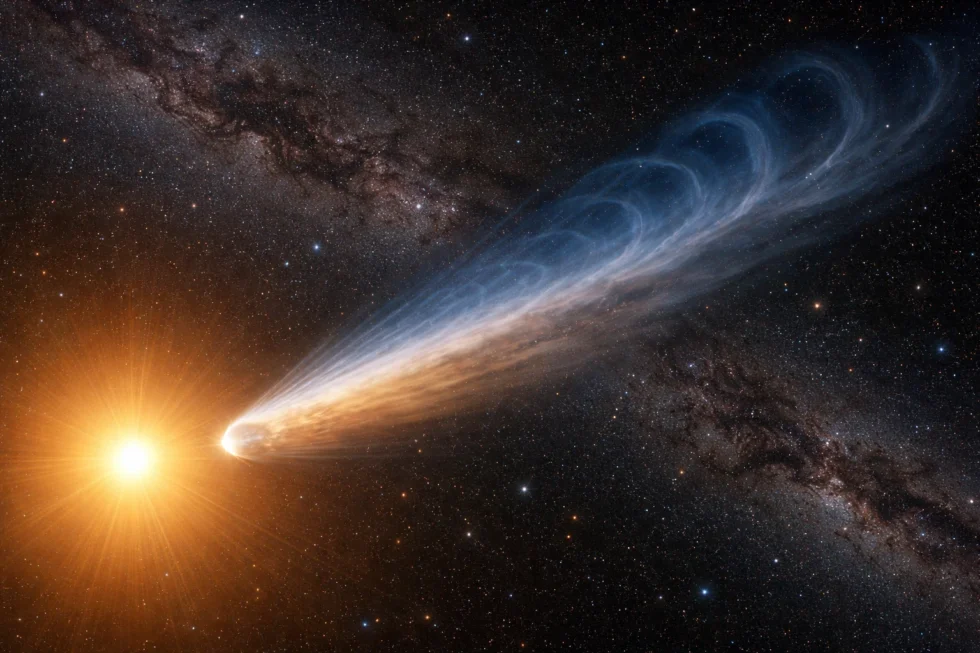
In the case of 3I/ATLAS, this sun-facing structure became unusually large and sharply defined, stretching hundreds of thousands of miles across space. For scientists, this is especially valuable because it reveals the size, weight and distribution of dust grains released from the comet. In an interstellar visitor, those grains are fragments of material formed around another star, now briefly visible in our own solar system.
How the wobbling jets were detected and why they matter
Inside this rare anti-tail, astronomers detected narrow jets of gas and dust that shift back and forth with a regular rhythm. Observations collected across late 2025 show that these jets wobble roughly every 7 hours and 45 minutes, indicating that the comet’s nucleus rotates once every 15 to 16 hours.
These measurements come from an intensive observing campaign led by European astronomers using the Two-metre Twin Telescope in Tenerife, supported by telescopes worldwide. The data show that 3I/ATLAS has active surface regions that vent gas and dust as they rotate into sunlight — behaviour that is familiar in comets from our own solar system, but now seen in material from another star.
At the same time, NASA placed the comet under a multi-mission watch involving Hubble, the James Webb Space Telescope, TESS, Swift, Parker Solar Probe and spacecraft operating near Mars, allowing scientists to confirm that the wobbling jets are real physical structures rather than optical effects.
Because it is an interstellar object, 3I/ATLAS was also examined for any signs of artificial radio emissions. Between 18 and 19 December 2025, the SETI Institute and the Breakthrough Listen programme used the Green Bank Telescope to search for signals. None were detected, confirming that the comet is a natural celestial body.
The comet will remain visible to telescopes into early 2026 and is expected to pass through the region of Jupiter’s orbit in March 2026, one of the last major opportunities to observe it before it disappears into interstellar space.
As 2025 draws to a close, Comet 3I/ATLAS stands as one of the most scientifically important visitors in decades — a normal comet from another star system, revealing through its wobbling jets and sun-facing tail how alien worlds leave their traces in the light of our Sun.
Read about the life of Westminster and Pimlico district, London and the world. 24/7 news with fresh and useful updates on culture, business, technology and city life: What makes interstellar comet 3I/ATLAS so unusual as it nears Earth this week