
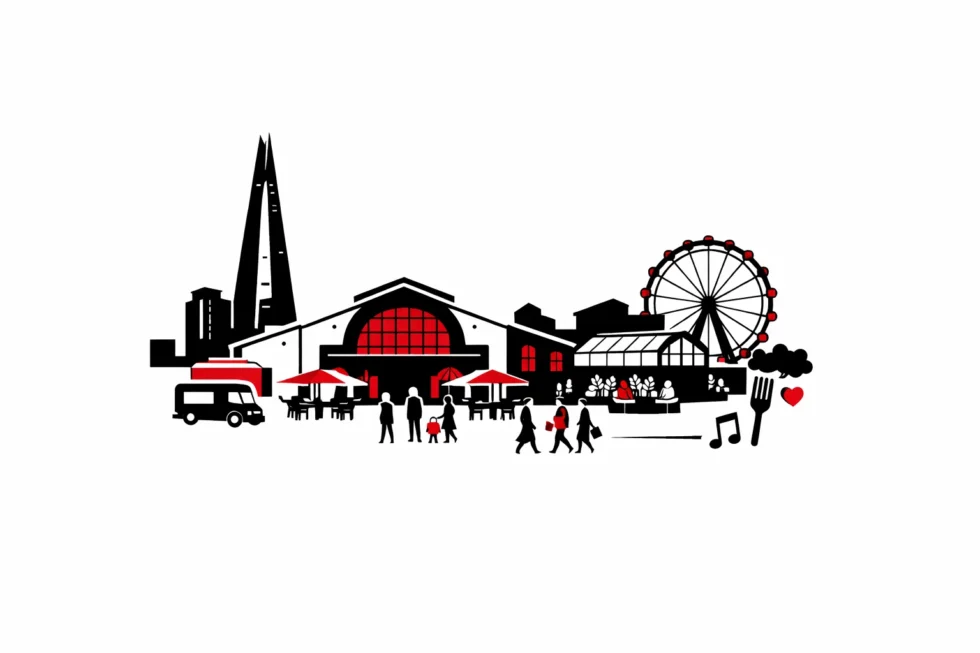
Food hall to stay open in 2026 is now the official status attached to Mercato Metropolitano in Elephant & Castle, one of south London’s most recognisable food and leisure destinations, after Southwark Council confirmed that the site will not be cleared before the end of next year despite having full planning approval for demolition. The decision comes as the market faces removal under the Borough Triangle redevelopment, which will replace it with almost 900 homes in high-rise towers — a shift that has turned a once-stable cultural venue into a temporary occupant on its own land. As reported by The WP Times reports, citing the BBC, Local Democracy Reporting Service, the food hall will remain open through 2026 but has no long-term security.

Mercato Metropolitano has operated from a former paper-making factory near Newington Causeway for almost nine years, becoming a major centre for independent food traders, bars and community events. The building, once an industrial relic, was converted into a dense, informal marketplace that drew large daily footfall and helped reframe Elephant & Castle as a destination rather than just a transport hub.
That success, however, no longer determines its future. In March, Southwark Council approved the Borough Trianglescheme, granting Berkeley Homes permission to demolish the existing buildings and construct a high-density residential quarter. The approved development includes 892 homes in towers rising to 44 storeys, together with office space, cafés, retail units, a new community centre and publicly accessible open space.
From a planning perspective, the site has already crossed a legal threshold. The land on which Mercato Metropolitano stands is now allocated for redevelopment. The reason the market can continue trading into 2026 is not protection or preservation, but timing: the project has not yet entered its demolition and main construction phase.
This distinction is critical. In large London schemes, the period between planning consent and physical clearance can last many months or even years. During that interval, existing uses are allowed to operate, but they do so on borrowed time. Mercato’s current lease and occupation sit inside that pre-construction window.
For the roughly 40 independent traders inside the market, this creates uncertainty. Berkeley Homes has indicated that up to 12 traders may be offered space in a temporary nearby site while construction takes place. The rest are expected to rely on a developer-funded relocation package administered through the council, intended to cover reasonable moving costs.
Relocation, however, does not guarantee continuity. Temporary sites typically deliver lower footfall, reduced visibility and weaker trading conditions, particularly for food businesses that depend on volume and repeat custom. Even short interruptions can undermine businesses operating on narrow margins.
The redevelopment also sits within a broader transformation of Elephant & Castle. Over the past decade, large parts of the area have been cleared and rebuilt with tall residential towers, private investment and more managed retail environments. While the Borough Triangle scheme includes 35 per cent affordable housing, critics argue that this does not compensate for the loss of informal, low-cost commercial space that venues like Mercato provide.
For visitors, 2026 is likely to be the final full year in which Mercato Metropolitano operates in anything close to its current form. The food hall will still be there, still busy and still part of the area’s daily life — but it will be doing so on land already scheduled for clearance.
So when the BBC says the food hall will stay open in 2026, it is describing the development timetable, not a guarantee of survival. The market is not being protected from redevelopment. It is being allowed to operate until the redevelopment process reaches the point at which its continued presence becomes impractical.
Read about the life of Westminster and Pimlico district, London and the world. 24/7 news with fresh and useful updates on culture, business, technology and city life: Why black tea became a symbol of comfort and stability in London and Britain