Across Europe and the United Kingdom, the debate around Microsoft 365 has shifted from a question of software choice to one of data control and legal sovereignty. In response to mounting regulatory and political pressure, Microsoft has launched what it calls the EU Data Boundary — a formal commitment to keep customer and personal data from its cloud services within Europe. For London’s financial, legal and media sectors, the policy marks a fundamental shift in how cloud risk is assessed.
Microsoft’s move comes at a moment when governments, regulators and major enterprises across Europe and the United Kingdom are openly questioning who truly controls their digital infrastructure, as the The WP Times editorial team reports, citing regulatory filings and cloud-governance documents. With US-based cloud providers legally bound by American law — including the US CLOUD Act, which allows US authorities to demand access to data held by American technology firms — European and UK institutions are increasingly seeking to prevent financial records, legal files, medical data and journalistic material from being exposed to foreign jurisdictions beyond their democratic and judicial oversight.
What the EU Data Boundary actually is
The EU Data Boundary is Microsoft’s official framework for keeping data generated by services such as Microsoft 365, Azure, Dynamics 365 and Power Platform within the EU and EFTA region. It applies to three main categories of information:
- Customer data – documents, emails, spreadsheets, Teams chats and files created by users
- Personal data – information linked to individual users
- Professional services data – support logs and service interactions
Microsoft rolled out the programme in three phases between 2023 and early 2025, expanding it from core data to pseudonymised data and finally to support and operational records. The goal was to make Europe one of the few regions in the world where Microsoft offers a broad, legally defined data-residency zone.
For organisations in Germany, France, the Nordics and the UK, this allows Microsoft 365 environments to be hosted and processed inside Europe by default, rather than in a global cloud pool.
What it does — and what it does not do
The Data Boundary significantly reduces international data transfers, but it does not create an absolute digital border.
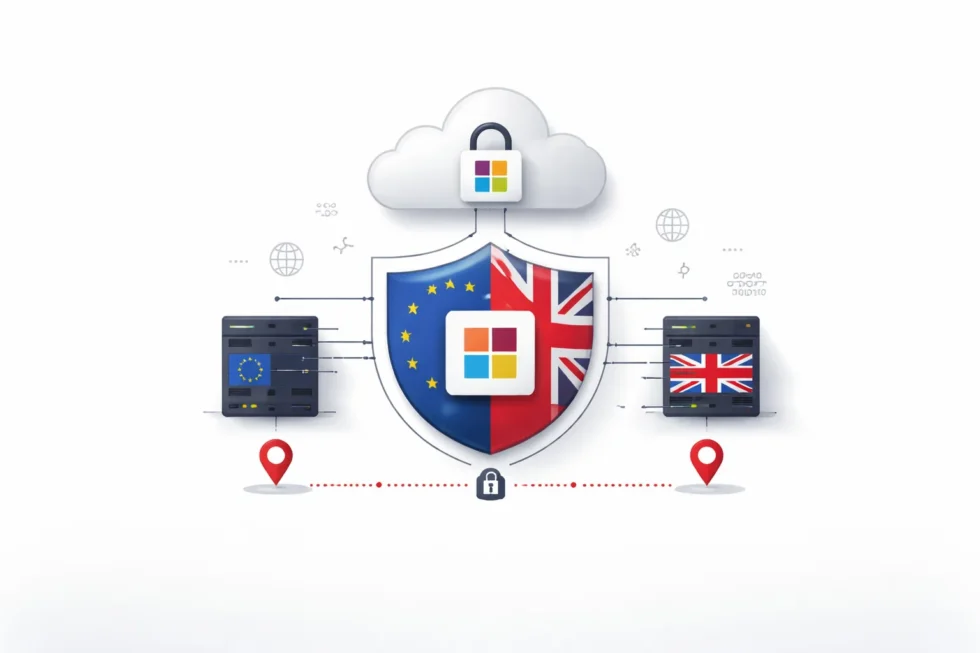
Microsoft’s own documentation makes clear that limited cross-border access can still occur in cases such as:
- cyber-security monitoring
- technical troubleshooting
- system maintenance
- customer-initiated cross-border communication (for example, emailing or calling someone outside Europe)
In other words, data is designed to live inside Europe, but operational and security needs mean it cannot be completely isolated from Microsoft’s global infrastructure.
This distinction matters for compliance officers and regulators: data residency is strengthened, not made legally watertight.
Why this matters for the UK
Although the UK left the EU, it still operates under a GDPR-style regime through the Data Protection Act 2018. For banks, law firms, media groups and government bodies in London, cross-border data transfers remain a regulatory risk.
By allowing UK customers to host Microsoft 365 data in EU data centres covered by the Data Boundary, Microsoft provides a way to:
- meet UK and EU contractual data-location requirements
- reassure clients that documents and emails are not freely moving into US jurisdictions
- reduce exposure to legal challenges over international data transfers
For highly regulated sectors — from investment banking to journalism — this is not an abstract issue. It affects client confidentiality, regulatory audits and even litigation risk.
AI, Copilot and the next layer of risk
The arrival of Microsoft 365 Copilot and other AI tools has made data residency even more sensitive. These systems process and analyse documents, emails and meeting transcripts to generate summaries, drafts and insights.
Under the EU Data Boundary, Microsoft states that this AI-processed data also falls under the same regional controls — provided customers configure their tenants correctly. That means European and UK users can, in principle, use Copilot without sending their working documents outside Europe.
For law firms, consultancies and media organisations, this is crucial: AI can only be trusted if it runs on data that stays inside the same legal environment.
What organisations need to do in practice
The EU Data Boundary is not automatic. To benefit from it, organisations must:
- ensure their Microsoft 365 and Azure tenants are deployed in EU/EFTA regions
- review which services are included in the boundary
- configure data-location, logging and compliance settings correctly
- verify how Copilot and other AI services are enabled
For UK companies, this is now part of cloud due diligence, just like cybersecurity or financial audits.
A strategic shift, not just a technical one
Microsoft’s EU Data Boundary is best understood as a geopolitical and regulatory response, not merely a technical upgrade. It reflects Europe’s determination to keep control over its digital infrastructure and Britain’s need to remain compatible with both EU and global data regimes.
For London’s economy — built on trust, contracts and confidential information — the question is no longer whether to use cloud software, but under whose laws that cloud operates. Microsoft has drawn a clearer line on the map. It is now up to European and UK organisations to decide how firmly they want to stay inside it.
Read about the life of Westminster and Pimlico district, London and the world. 24/7 news with fresh and useful updates on culture, business, technology and city life: Microsoft faces Australian lawsuit over Copilot AI pricing transparency