
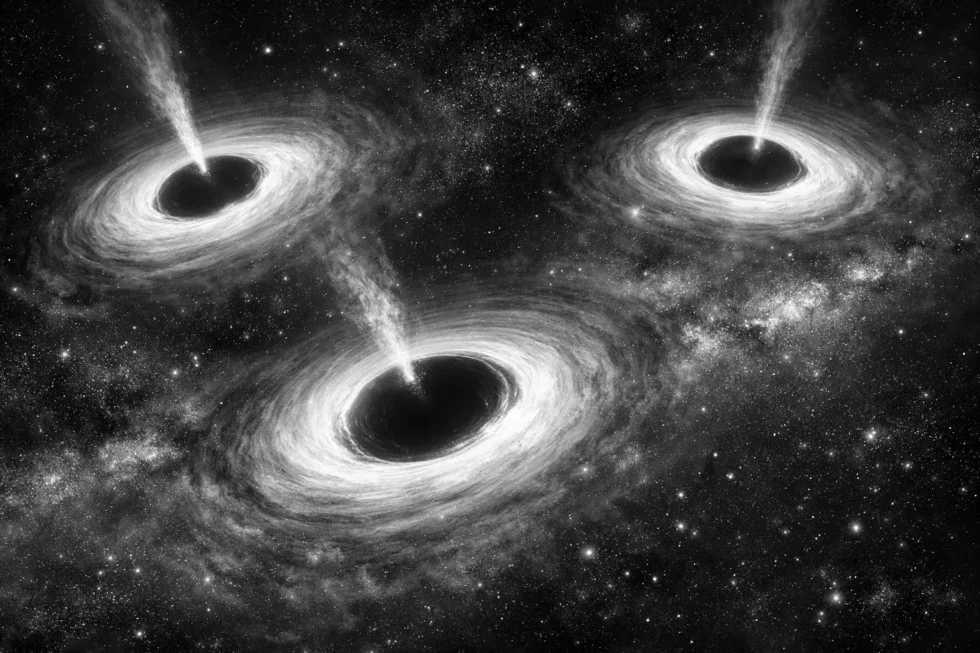
Black hole astronomy has crossed a historic threshold after scientists confirmed the existence of a system where three supermassive black holes are simultaneously active and merging inside three colliding galaxies. The object, known as J1218/1219+1035, lies around 1.2 billion light-years from Earth and represents the most complex black hole merger ever directly observed. This rare cosmic configuration shows not only galaxies colliding, but the central black holes themselves growing, feeding and interacting in real time — a phenomenon long predicted but never verified until now. As The WP Times reports, this discovery provides a direct window into how the largest structures in the universe are built.
At the heart of each of the three galaxies is a supermassive black hole, each weighing millions to billions of times the mass of the Sun. What makes this system exceptional is that all three are actively consuming matter, producing intense radiation and powerful radio jets — a state known as active galactic nuclei, or AGN. Until now, astronomers had only observed pairs of such active black holes. A triple configuration had remained largely theoretical.
How scientists found the triple black hole system
The discovery began when astronomers examined infrared data from NASA’s Wide-field Infrared Survey Explorer (WISE). One region appeared unusually bright and chaotic, suggesting multiple energetic sources packed into a small area of space.
Follow-up observations using radio and optical telescopes revealed that the light was coming not from one or two galaxies — but from three.
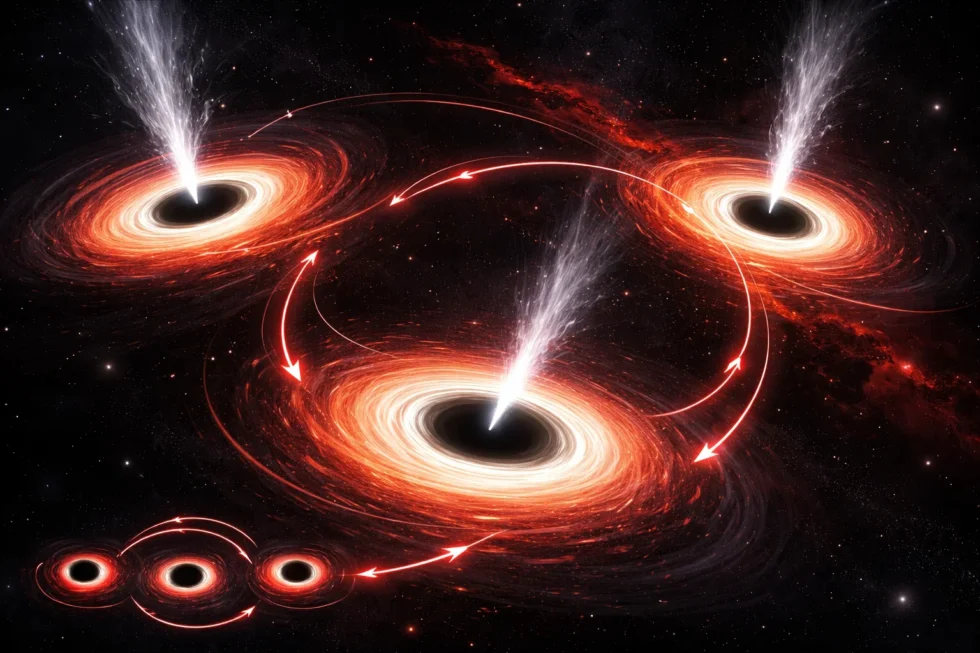
Two of the galaxies were already overlapping, while a third sat slightly apart, connected by a long stream of gas being pulled into the merger. At the centre of each galaxy, researchers identified a radio-bright black hole, proving that all three were actively accreting matter.
This combination makes the system unique.
Key measured distances inside the system
| Object | Distance |
|---|---|
| Between the two merging galaxies | ~74,000 light-years |
| Distance to the third galaxy | ~316,000 light-years |
| Distance from Earth | ~1.2 billion light-years |
These separations show that the galaxies are gravitationally bound and will eventually become one massive galaxy.
Why triple black holes are so rare
Galaxy mergers are common in cosmic history. Our own Milky Way has swallowed several smaller galaxies over billions of years. But triple mergers are exceptionally uncommon because they require three galaxies to arrive at the same time, rather than in a slow sequence. Having three active black holes at once is rarer still.
Most black holes spend long periods in a quiet state. Only when gas and dust fall into them do they light up as AGN. For three galaxies to collide and for all three black holes to be feeding at the same moment is statistically extraordinary.
This makes J1218/1219+1035 only the third known triple-AGN system in the nearby universe — and the first where all three emit strongly in radio waves.
What happens next in this cosmic collision
Over the next hundreds of millions of years, gravity will pull the three galaxies together into a single massive galaxy. As their stars, gas and dark matter merge, the black holes will slowly spiral toward one another. Eventually, they will form a tightly bound trio, before finally merging into one enormous black hole.
When that happens, the system will release powerful gravitational waves — ripples in spacetime that future space-based detectors such as LISA (planned by ESA and NASA) are designed to detect. These waves carry information about black hole mass, spin and structure, making systems like this a key target for next-generation astronomy.
What this tells us about the universe
This discovery answers a long-standing question in astrophysics: How do supermassive black holes grow so large so quickly?
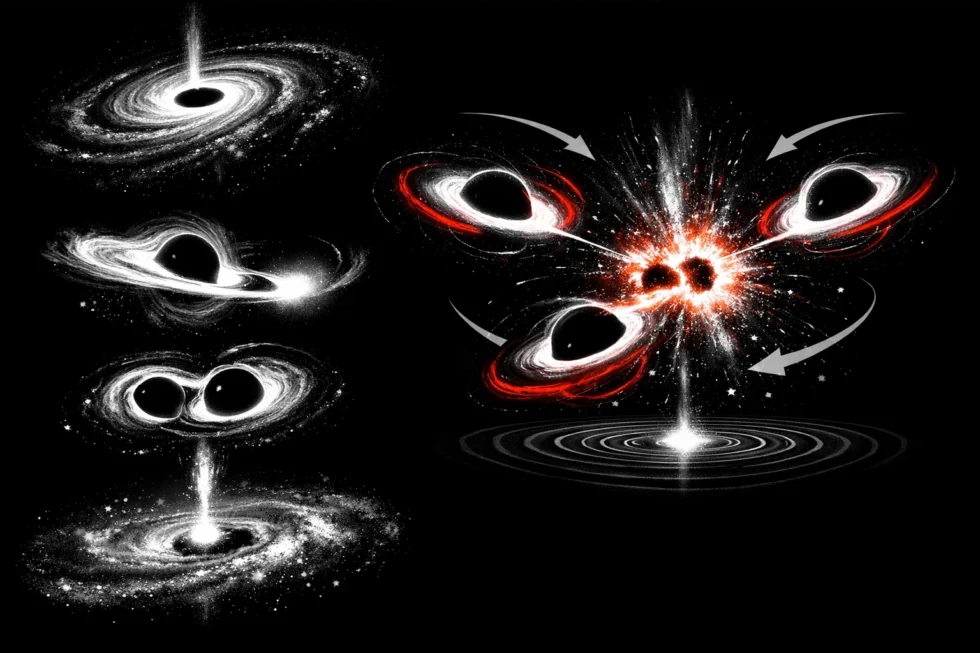
The triple system shows that black holes do not only grow by feeding on gas — they also grow by merging with other black holes during galaxy collisions. Over billions of years, repeated mergers can create the cosmic giants we observe today. It also suggests that triple black hole systems may be more common than previously thought, simply harder to detect. By combining infrared, optical and radio surveys, astronomers now have a blueprint for finding more of these hidden giants across the universe.
Could this ever affect Earth
No.
The system is so far away that even if it exploded, collapsed or merged tomorrow, the light and gravitational effects would take over a billion years to reach us. This is a scientific discovery, not a threat. What we are seeing is effectively a time capsule — a record of a cosmic event that happened long before humans existed.
In around 4 to 5 billion years, the Milky Way will collide with the Andromeda galaxy. Their central black holes will also merge, forming a single, larger black hole. The triple system J1218/1219+1035 is an even more dramatic version of that future — showing what happens when three galaxies, not two, come together. It is the clearest real-world example yet of how the universe builds its largest structures from smaller ones.
Read about the life of Westminster and Pimlico district, London and the world. 24/7 news with fresh and useful updates on culture, business, technology and city life: Black Moon 2026 UK: When is it and how will it affect your health
Sources used in preparation: NASA’s Wide-field Infrared Survey Explorer (WISE), The Astrophysical Journal Letters, the US Naval Research Laboratory, the DECaLS Sky Survey