
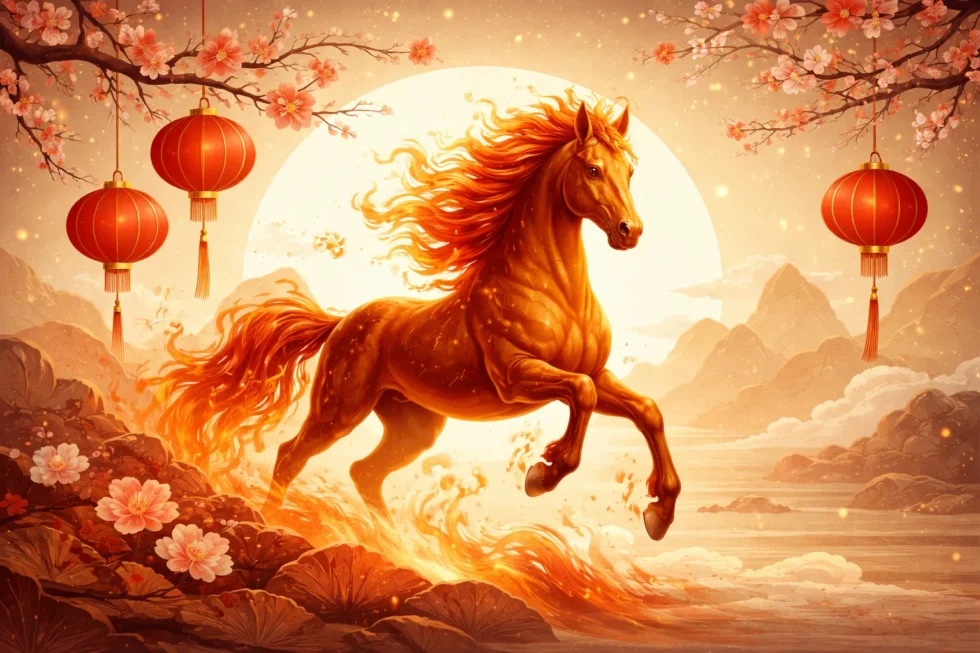
Chinese New Year 2026 and the Fire Horse year will begin on 17 February 2026, when more than two billion people across Asia, Europe and the global Chinese diaspora reset their economic, family and cultural calendars at the same moment. The Lunar New Year is not only the world’s most widely observed festival — it also triggers the largest annual human migration on Earth, temporarily closing factories, emptying megacities and reshaping global supply chains.
On that date, the Year of the Fire Horse officially replaces the Year of the Snake — a zodiac cycle that appears only once every 60 years and is traditionally associated with rapid change, financial risk, political tension and bold personal decisions. In London, Chinatown will turn red with lanterns and drums. Across Asian financial hubs, traders quietly note the arrival of a year that history has linked with upheaval and opportunity.
This is not a zodiac year that moves slowly. It is one that, according to centuries of Chinese tradition, forces the world to move with it, reports the The WP Times editorial desk.
When does Chinese New Year 2026 begin
Chinese New Year 2026 begins on Tuesday, 17 February. Until midnight of that day, the global lunar calendar remains in the Year of the Snake. From the first new moon on 17 February, the Year of the Fire Horse officially starts and will continue until 5 February 2027.
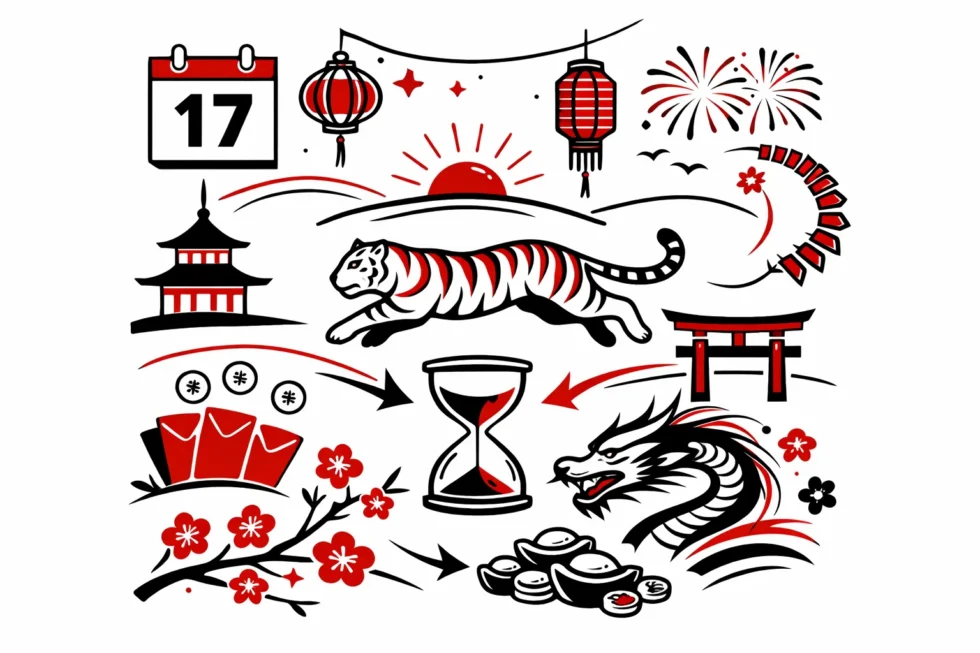
This date matters far beyond culture. Every year, the Lunar New Year triggers Asia’s largest shutdown of factories, offices and transport networks, directly affecting global shipping, retail supply chains, airline prices and financial markets. For companies trading with China, Vietnam, Singapore, South Korea and Taiwan, this week is one of the most disruptive periods of the year.
The reason is simple: the Chinese calendar follows the moon, not the sun. The New Year always begins on the new moon between 21 January and 20 February, which is why it shifts annually. This lunar timing has governed tax deadlines, agricultural cycles, travel patterns and family reunions across East Asia for more than three millennia — and in a globalised economy, it now shapes business well beyond Asia.
Why the Fire Horse has a reputation
The Chinese zodiac is not simply a cycle of 12 animals. It is built on a deeper system that combines those animals with five classical elements — wood, fire, earth, metal and water — creating a 60-year rhythm that shapes how each year is interpreted. The Fire Horse appears only once in that full cycle, making it one of the rarest and most closely watched combinations.
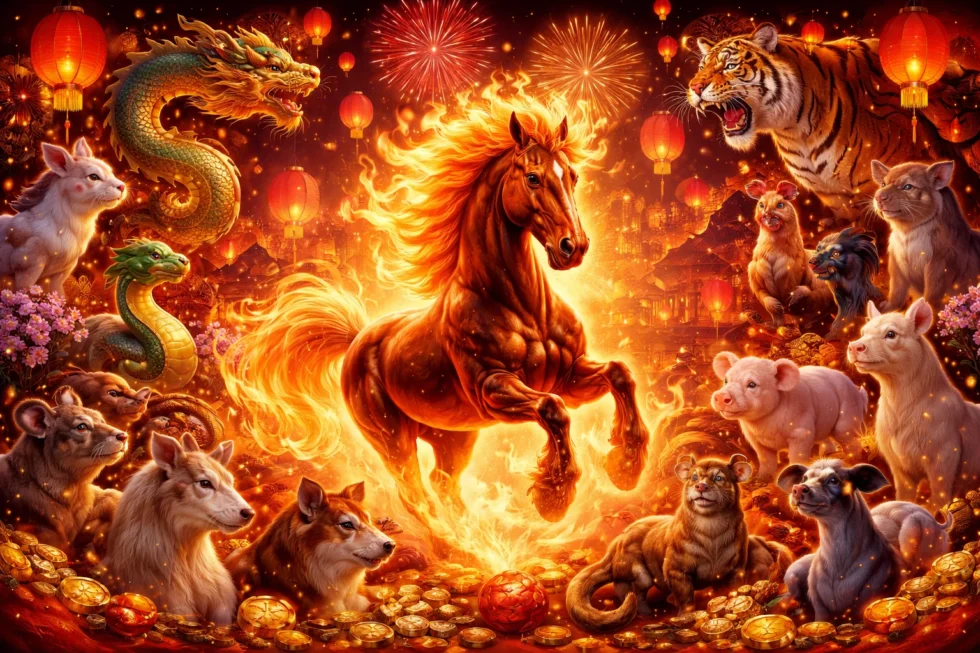
The previous Fire Horse year was 1966 — a period marked by global protest movements, political instability, generational conflict and cultural revolutions from East Asia to Europe and the United States. In Chinese historical tradition, this is no coincidence. Fire Horse years are believed to unleash high energy, impatience and confrontation with established systems.
They are associated with:
- intense ambition and competition
- sharp rises and falls in wealth
- large-scale migration and relocation
- social and political friction
- sudden breakthroughs in technology and culture
In practical terms, Fire Horse years are seen as moments when people stop waiting and start acting — changing jobs, launching businesses, moving countries and challenging authority. These are not quiet years. They are years when the status quo comes under pressure and the pace of change accelerates.
How long the Lunar New Year lasts
Chinese New Year is not a single night but a 16-day national cycle that in 2026 runs from 17 February to 3 March, finishing with the Lantern Festival. During this period, millions of people across China and East Asia remain on holiday, while factories, ports and government offices operate at reduced capacity — a pattern that ripples through global trade, shipping and tourism.
In 2026, the final day of the festival coincides with a total lunar eclipse — a so-called blood moon. In Chinese cosmology, such eclipses have long been viewed as markers of political shifts, leadership change and turning points in fortune, adding symbolic weight to a Fire Horse year already associated with upheaval and momentum.
What is your Chinese zodiac sign
Your Chinese zodiac sign is determined by your lunar birth year, not the Western calendar. This matters because Chinese New Year moves every year, falling between 21 January and 20 February. As a result, anyone born in January or the first half of February is at high risk of having the wrong zodiac sign.
Here is how it works in practice:
If you were born before Chinese New Year in your birth year, you belong to the previous animal.
If you were born on or after Chinese New Year, you belong to the new animal.
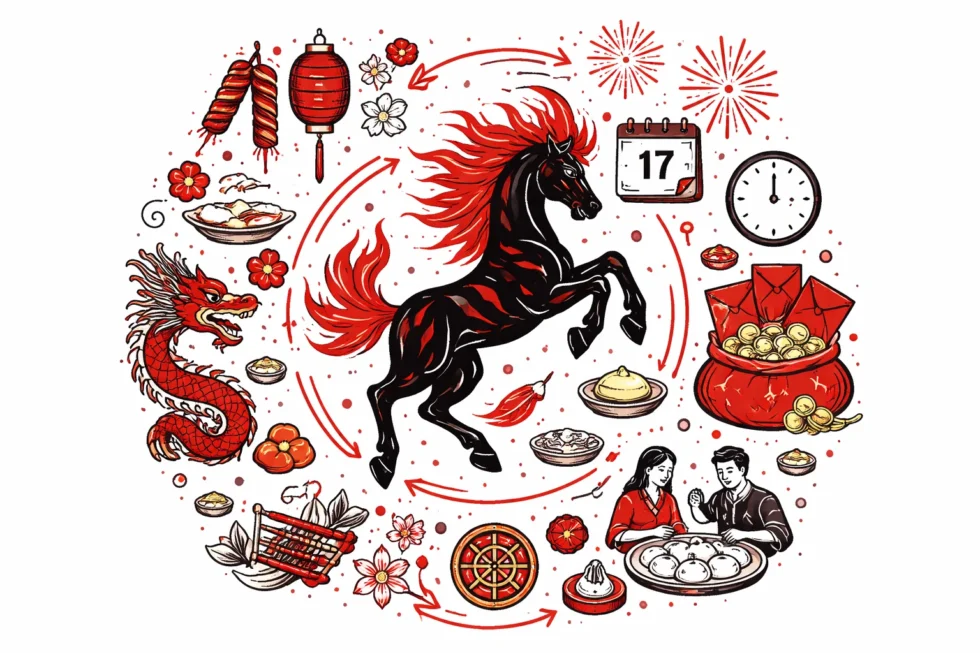
For example:
- A child born on 5 February 1990 was born before that year’s Chinese New Year and is therefore a Snake.
- A child born on 20 February 1990 was born after Chinese New Year and is a Horse.
This affects millions of people worldwide. Many personal horoscopes, compatibility charts and even business timing traditions in East Asia are based on these signs — which means using the wrong animal can completely change the reading.
The zodiac cycle ahead
| Year | Animal |
|---|---|
| 2025 | Snake |
| 2026 | Horse |
| 2027 | Goat |
| 2028 | Monkey |
| 2029 | Rooster |
| 2030 | Dog |
| 2031 | Pig |
| 2032 | Rat |
| 2033 | Ox |
| 2034 | Tiger |
| 2035 | Rabbit |
| 2036 | Dragon |
The Horse returns every 12 years. Fire Horse does not.
What Fire Horse years mean for luck and money
In Chinese astrology, Fire Horse years are not treated as “lucky” in a passive sense. They are viewed as high-volatility cycles — periods when money, power and opportunity move faster than usual. Historically, these years are associated with sharp swings in markets, rapid business formation and aggressive career shifts.
Fire Horse years are traditionally considered favourable for:
- launching companies and startups, when risk appetite is high
- changing jobs or industries, as hierarchies loosen
- moving abroad or expanding internationally, as borders and markets become more fluid
- investing in growth sectors, particularly technology, energy and infrastructure
- cutting off failing projects and relationships, freeing capital and time
They are less supportive for:
- fixed-income strategies
- slow bureaucratic careers
- long-term stability without growth
- highly leveraged positions that cannot absorb volatility
In practical terms, Fire Horse years reward people who reposition themselves early, while those who wait often find that conditions have already shifted. In Chinese financial tradition, these are years when capital flows towards speed, innovation and bold leadership — and away from hesitation.
How London will mark Chinese New Year 2026
London hosts the largest Lunar New Year celebration outside Asia. While the year officially begins on 17 February, the capital’s main public festival is expected on 21–22 February 2026.
Chinatown, Trafalgar Square and the West End will become a sea of red lanterns, lion dances and street performances. Thousands gather along Charing Cross Road to watch the annual parade — one of the biggest Chinese New Year processions in Europe.
Restaurants in Gerrard Street serve symbolic dishes: dumplings for wealth, long noodles for longevity, whole chicken for family unity. Lion dances move from doorway to doorway, believed to bring luck to businesses for the coming year. For London, this weekend has become a ritual in its own right — a fusion of ancient Chinese tradition and modern global city life.
Why 2026 is expected to feel different
The Year of the Fire Horse in 2026 is framed by two rare astronomical markers: a ring-of-fire solar eclipse near the start of the cycle and a total lunar eclipse — a blood moon — at the end of the Lunar New Year period. In traditional Chinese state astrology, eclipses were not superstition — they were treated as signals of political stress, leadership change and social instability, closely observed by imperial courts.
What makes 2026 stand out is that these symbolic markers arrive at a moment when the real world already looks unstable. Major elections, shifting military alliances, the acceleration of artificial intelligence, energy transition and a fragile global economy all converge in the same year. In Chinese historical thinking, this is exactly the kind of environment in which a Fire Horse cycle becomes visible — not because it causes events, but because it reflects a period of rapid reordering.
In practical terms, 2026 is expected to feel different because multiple systems are under pressure at the same time — political authority, technology, trade and labour markets — creating the conditions for sudden change rather than gradual evolution. That is the essence of a Fire Horse year: when momentum replaces stability, and those who move first shape the outcome.
Chinese New Year 2026 begins on 17 February, launching the rare Year of the Fire Horse — a high-impact cycle linked to movement, risk and decisive change. In Chinese tradition, this is a year for action, not delay. In London, the Fire Horse will be welcomed with parades, drums and lanterns across Chinatown — a visible sign that a year of speed, ambition and reinvention has begun.
Read about the life of Westminster and Pimlico district, London and the world. 24/7 news with fresh and useful updates on culture, business, technology and city life: Black Moon 2026 UK: When is it and how will it affect your health