
Croydon enters 2026 facing one of the most consequential moments in its modern history. The long-promised Westfield Croydon town-centre regeneration, first announced more than a decade ago and still lacking a full planning application, has now been pushed back to mid-2026 at the earliest. At the same time, Crystal Palace’s Selhurst Park stadium redevelopment, approved in 2018, is scheduled to begin construction in January 2026 and continue through the 2026–27 season, reshaping housing, retail, transport and investment patterns across South London — as reports The WP Times, citing Local Democracy Reporter coverage, Croydon Council planning records and Crystal Palace FC development statements.
Why Croydon 2026 is a defining year
Few London boroughs have their economic and political future so tightly bound to a small number of regeneration schemes. After years of financial crisis, emergency budgets and the appointment of government commissioners, Croydon is no longer judged on ambition, but on whether projects actually materialise. With mayoral and council elections scheduled for May 2026, residents will decide whether their borough is finally moving forward — or remains locked in a cycle of delay, debt and unfulfilled promises.
Westfield Croydon: the regeneration that has yet to begin
The Unibail-Rodamco-Westfield masterplan covers the Whitgift Centre, Centrale Shopping Centre and surrounding streets, and was designed to transform central Croydon into a modern mixed-use district of homes, retail, public squares and leisure venues.
Yet despite years of public consultation and repeated commitments from developers, no full planning application has been submitted. After being expected first in 2024, then in 2025, the earliest realistic submission is now mid-2026.
The consequences are increasingly visible. Major retailers have continued to leave the Whitgift Centre, pedestrian footfall has weakened, and much of the town centre is effectively frozen as investors wait for clarity. For many residents and business owners, Westfield has become the symbol of Croydon’s regeneration crisis — a project permanently described as imminent, yet never delivered.
Selhurst Park: from paper plans to construction
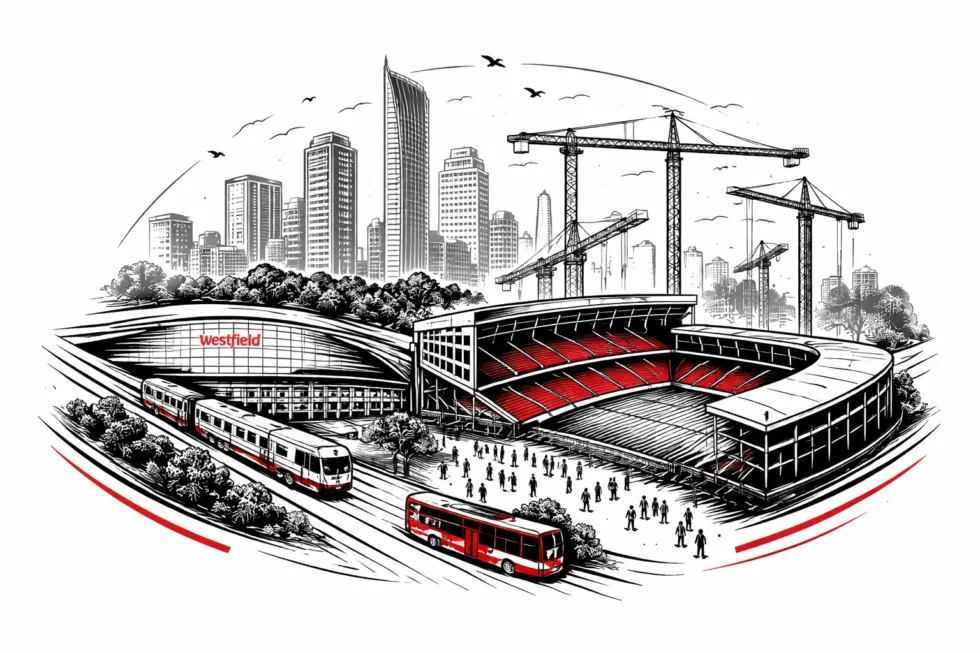
In contrast, Selhurst Park is finally moving from planning to physical change. The Crystal Palace FC Main Stand redevelopment, approved by Croydon Council in 2018, will begin construction in January 2026. The new stand will add 13,500 seats, increasing the stadium’s capacity to more than 34,000, and will include modern hospitality facilities, commercial space, improved disabled access and community-use areas.
After years of delay caused by the pandemic, construction inflation and land negotiations, the project is now expected to become one of the largest active building sites in South London during 2026–27. The economic impact will extend beyond football, bringing construction employment, increased match-day spending and year-round event revenue into the borough.
The wider regeneration picture
Beyond these two flagship schemes, Croydon’s long-term planning framework seeks to deliver new housing, upgraded transport links and improved public spaces well into the 2030s. Estate redevelopments, road and pedestrian improvements, and smaller regeneration schemes are progressing — but they remain overshadowed by the fate of the town centre and the stadium. At the same time, the council’s ability to invest remains constrained. Still operating under external oversight following its debt crisis, Croydon must rely heavily on private-sector delivery to achieve meaningful regeneration.
Politics, capital and credibility
The divergence between Westfield and Selhurst Park creates a stark political and economic narrative in 2026. Westfield represents delay, uncertainty and stalled capital.Selhurst Park represents delivery, construction and visible investment.For voters, retailers, landlords and property developers alike, that contrast will shape how Croydon’s leadership is judged at the ballot box in May.
What will define Croydon by the end of 2026
By December, cranes will be firmly established above Selhurst Park, marking the first time in a generation that one of Croydon’s biggest regeneration promises is being delivered in steel and concrete rather than in planning documents.
The more uncertain test will be Westfield Croydon. If a full planning application is finally submitted in 2026, the borough’s long-stalled town centre could at last move from managed decline to active renewal. If it is not, Croydon risks entering yet another year of commercial drift, empty units and investor hesitation. In that sense, 2026 will not be remembered for what was announced, but for what was actually built — the year when Croydon’s regeneration was no longer judged by ambition, but by physical, measurable change.
Read about the life of Westminster and Pimlico district, London and the world. 24/7 news with fresh and useful updates on culture, business, technology and city life: Royal Mail confirms delivery delays across 28 UK postcode areas, including London, as Christmas pressure peaks