
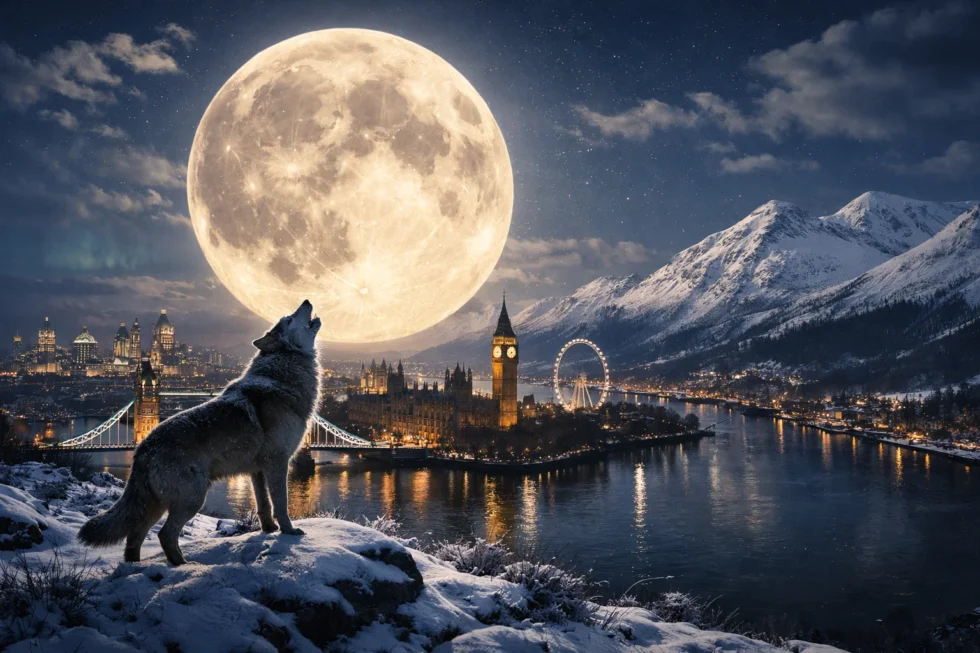
January Wolf Moon 2026 will be the last supermoon visible over Britain until the end of 2026, offering unusually bright and dramatic moonrises across London, England and Scotland in the first days of the New Year.
This rare lunar event will dominate UK skies on Friday 3 January 2026, when the full January Wolf Moon reaches perigee — its closest orbital point to Earth — creating a true supermoon over London, England and Scotland. Because of this alignment, the Moon will appear up to 14 per cent larger and around 30 per cent brighter than a typical full Moon, making it one of the most visually striking and photogenic night-sky events of 2026. After January, no supermoon will be visible from Britain again until late 2026, giving this Wolf Moon exceptional importance for UK stargazers, astrophotographers and winter skywatchers. This is reported by The WP Times.
A supermoon occurs when a full Moon coincides with perigee, the point in the Moon’s elliptical orbit when it is closest to Earth. In January’s case, this will place the Moon roughly 356,000 kilometres from Earth, compared with more than 406,000 kilometres during a micromoon. This difference in distance explains why the Moon will look unusually large, bright and sharply defined in the winter sky.
Why it is called the Wolf Moon
The term Wolf Moon originates from early European and North American winter traditions. January was historically the month when wolves were heard howling outside villages as food became scarce during the deepest cold. Over time, this seasonal image became attached to the January full Moon.
In Britain, the Wolf Moon has also become associated with clear, cold winter nights, which often provide some of the best astronomical visibility of the year, particularly in Scotland, northern England and rural Wales where light pollution is lower.
When to see the supermoon in the UK
The Moon reaches its exact full phase in the early hours of Friday 3 January 2026, but the most impressive views will be during the evenings of Thursday 2 January and Friday 3 January, when the Moon rises shortly after sunset.
The two most dramatic moments are:
- Moonrise, when the Moon appears large and orange near the horizon
- Moonset, just before sunrise, when it hangs low in the western sky
This visual effect is caused by a combination of the Moon illusion and atmospheric scattering. When the Moon is close to the horizon, the human brain perceives it as larger, while the Earth’s atmosphere filters out blue light, giving it a warm amber or copper colour.
UK Moonrise and Moonset times
| Location | Date | Moonrise | Moonset | Best viewing window |
|---|---|---|---|---|
| London | Thu 2 Jan | 15:57 | 08:18 (3 Jan) | 16:00–18:00 |
| London | Fri 3 Jan | 16:44 | 09:01 (4 Jan) | 16:45–18:30 |
| Edinburgh | Thu 2 Jan | 15:33 | 08:05 (3 Jan) | 15:30–17:30 |
| Edinburgh | Fri 3 Jan | 16:22 | 08:47 (4 Jan) | 16:15–18:15 |
| Manchester | Thu 2 Jan | 15:49 | 08:14 (3 Jan) | 15:45–18:00 |
| Cardiff | Thu 2 Jan | 16:05 | 08:25 (3 Jan) | 16:00–18:15 |
Times are approximate and may vary slightly depending on your exact location.
What else will be visible in the sky
The supermoon coincides with the Quadrantid meteor shower, which peaks during the night of 2–3 January. Although the Moon’s brightness will wash out many faint meteors, the Quadrantids are known for producing bright fireballs that can still be visible, particularly between midnight and dawn.
At the same time, several bright planets and constellations will be visible:
- Jupiter will shine close to the Moon throughout the night
- Orion will rise prominently in the south-east
- Saturn will be visible in the south-west shortly after sunset
Best places to watch in London and Scotland
You do not need dark countryside to see a supermoon. Its brightness allows it to be seen clearly even in city centres. The key factor is having a clear, unobstructed view of the horizon.
London
- Primrose Hill
- Greenwich Park
- Hampstead Heath
- Thames riverside with east-facing views
Scotland
- Calton Hill, Edinburgh
- Arthur’s Seat
- Portobello Beach
- Loch Lomond shoreline
- Aberdeenshire coast
How the Wolf Moon can affect sleep and health
Full moons are known to influence sleep patterns. Studies published in Current Biology show that people tend to fall asleep later and sleep around 20 to 30 minutes less during a full Moon, even without being aware of it. A supermoon amplifies this effect because of its increased brightness.
In January, this impact is stronger because the body is already under stress from short daylight hours, cold temperatures and seasonal low mood. UK doctors commonly report increases in insomnia, headaches, anxiety and heart rhythm disturbances during winter full moons.
Health specialists recommend:
- Closing curtains fully to block moonlight
- Avoiding caffeine after early afternoon
- Using magnesium or herbal teas such as chamomile
- Going to bed slightly earlier on 2–4 January
- Avoiding emotionally stressful activities before sleep
How to photograph the Wolf Moon
Capturing the January Wolf Moon requires careful timing rather than expensive equipment. The most dramatic images are taken at moonrise, when the Moon is low on the horizon and naturally appears larger and warmer in colour due to atmospheric filtering. This brief window, usually lasting less than 30 minutes, is when the supermoon takes on its distinctive orange and copper tones.
For sharp results, a stable tripod is essential, as even slight hand movement will blur fine lunar detail when using zoom. Photographers using DSLR or mirrorless cameras should select a telephoto lens or long focal length to bring out surface contrast, while smartphone users should rely on optical zoom or night mode rather than digital zoom, which degrades image quality.
Including foreground elements such as London’s skyline, bridges, trees or hills allows viewers to appreciate the Moon’s scale and position in the winter sky, turning a simple lunar photograph into a true landscape image rather than just a bright disc against black space.
Read about the life of Westminster and Pimlico district, London and the world. 24/7 news with fresh and useful updates on culture, business, technology and city life: Black Moon 2026 UK: When is it and how will it affect your health