
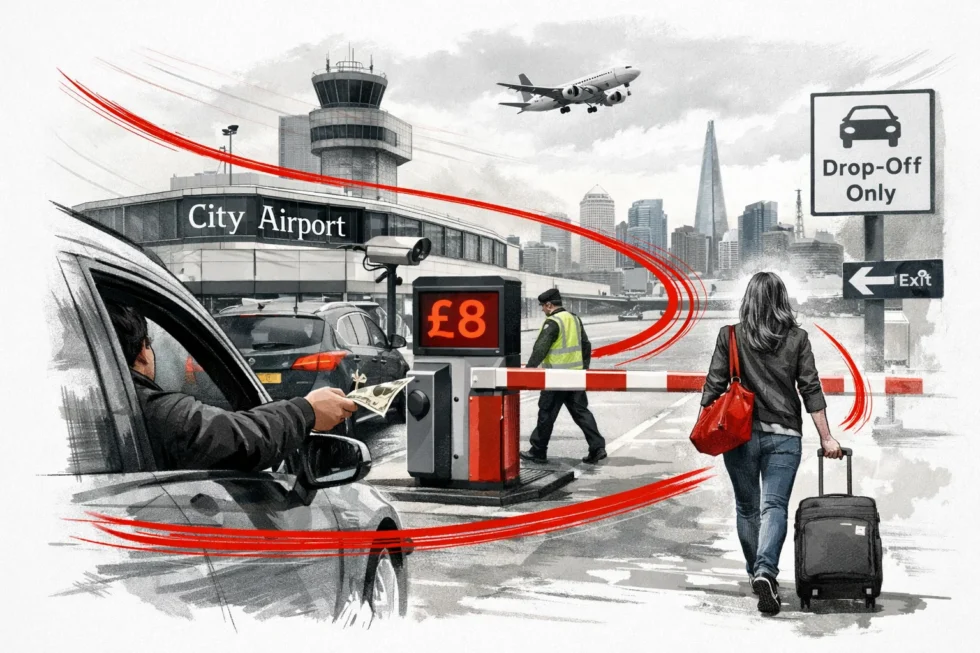
London City Airport will begin charging drivers for passenger drop-offs from Tuesday 6 January, ending its long-standing status as the only major UK airport still offering free kerbside access directly outside the terminal. The decision brings the Docklands hub into line with Heathrow, Gatwick, Stansted, Luton and Manchester, all of which already impose mandatory access fees on private vehicles using terminal forecourts. The WP Times reports, citing official airport guidance and aviation-industry briefings.
Under the new scheme, any vehicle entering the drop-off zone will incur an £8 charge for up to five minutes, with the fee increasing by £1 for every additional minute, up to a maximum stay of 10 minutes. The system will be enforced using automatic number-plate recognition (ANPR) cameras, allowing the airport to record entry and exit times and issue charges electronically without barriers, tickets or cash payments.
The move represents a major policy shift for an airport that has long sold itself on speed, proximity and friction-free access for business travellers flying to and from Canary Wharf, the City of London and short-haul European destinations — a core part of London City’s competitive appeal that will now come at a direct cost.
How the new charge will work
The terminal forecourt will become a fully cashless, camera-controlled zone. Vehicles will be recorded on entry and exit, with the system calculating the fee automatically. The pricing model is deliberately designed to discourage waiting:
- 0–5 minutes: £8
- Each additional minute: £1
- Maximum stay: 10 minutes
Drivers who exceed the 10-minute limit may face a penalty charge, according to the airport’s published terms. Blue Badge holders will be exempt, provided their vehicles are registered in advance. London black cabs will also be allowed to use the forecourt, although the airport says the charge will ultimately be incorporated into metered faresrather than shown as a separate fee.
Anyone who needs more time — families loading luggage, passengers needing assistance, or drivers waiting for delayed arrivals — will be required to use the short-stay car park instead of the terminal kerb.
Why London City is introducing the fee
London City serves one of the most time-sensitive passenger markets in the UK. Located in the heart of the Docklands financial district, it is heavily used by City and Canary Wharf professionals flying short-haul European routes.
That demand has made kerbside access both valuable and congested. Airport management says the charge is intended to achieve three main goals:
- Reduce congestion on the terminal forecourt
- Encourage public-transport use
- Align London City with other UK airports
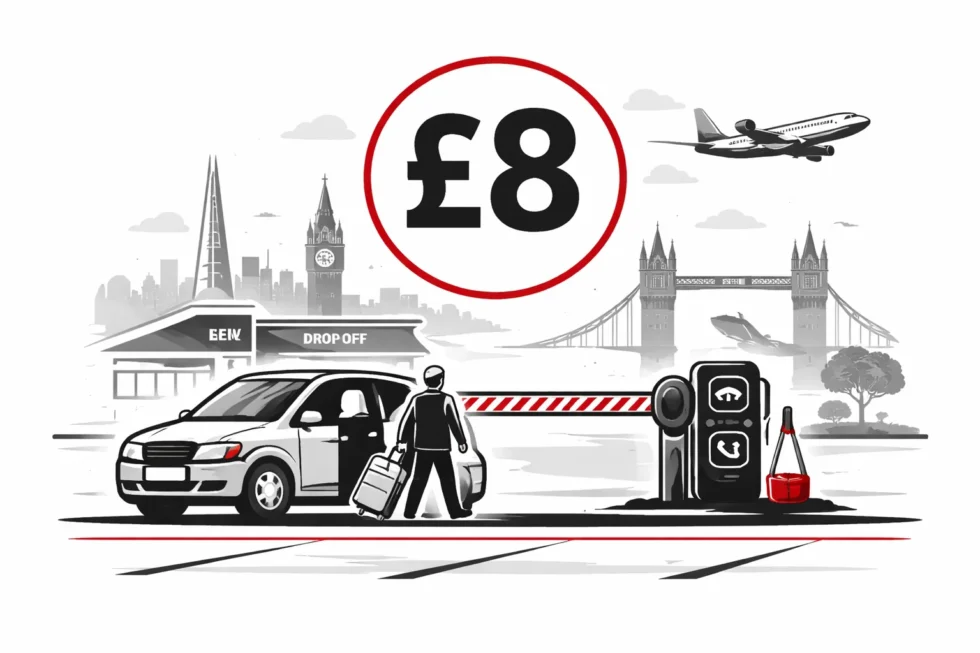
Behind those aims is a clear financial incentive. Across the UK, drop-off fees generate tens of millions of pounds each year for airport operators. Unlike airline charges, these revenues are largely insulated from ticket-price competition. Aviation analysts note that once one major airport introduces a fee, competitive pressure tends to make it permanent across the sector. London City had been the last hold-out.
Public transport is being pushed as the default
London City is one of the best-connected airports in Britain. The Docklands Light Railway (DLR) runs directly into the terminal, linking it to:
- Canary Wharf
- Bank
- Stratford
- Canning Town (for Jubilee line connections)
- Tower Gateway
Around two-thirds of passengers already arrive by public transport, one of the highest proportions of any UK airport. With the new charge, the financial case for avoiding private cars becomes much stronger. A simple drop-off and pick-upfor a single trip could now cost £16, even if both visits last under five minutes.
What happens if you do not pay
Any vehicle that enters the drop-off zone is logged automatically by number-plate recognition cameras. If payment is not made, the registered keeper will be traced through DVLA records and sent a payment demand or penalty charge notice by post.
The airport’s terms make clear that this is not optional. Once a vehicle enters the forecourt, the charge is legally incurred — whether or not the driver stops.
The rules are enforced as follows:
- No waiting — vehicles must leave immediately after setting down passengers
- No unattended vehicles — stopping without an active drop-off may trigger enforcement
- Strict time limits — exceeding five or ten minutes increases the charge or leads to penalties
Failure to pay on time can result in escalating charges, with additional administration and debt-recovery fees added if the notice is ignored. This is the same camera-based civil-enforcement system already used at Heathrow, Gatwick and Luton, where unpaid drop-off charges are routinely pursued in the same way as parking fines. For drivers, the practical message is simple: once you enter the zone, the clock is running — and the bill will follow.
Impact on families and leisure travellers
The new charge disproportionately affects families, elderly passengers and travellers with limited mobility, who are far more likely to rely on being dropped directly at the terminal rather than using public transport.
For a typical family of four with luggage, kerbside drop-off will now cost £8 each way, meaning £16 for a return tripif the same driver drops off and later collects them. If loading or unloading takes longer than five minutes — which is common with pushchairs, mobility aids or large suitcases — the charge rises to £9, £10 or more.
Unlike business travellers, who often travel alone and use taxis or the DLR, leisure passengers usually arrive by private car because it is cheaper, faster and physically easier. Public transport routes involving multiple changes, lifts and platform gaps are often impractical for families and older travellers, especially during early-morning or late-night flights.
Consumer groups argue that these fees function as a flat tax on physical need rather than on choice: the people who most need kerbside access are the ones who now pay for it, while those who can walk easily and travel light avoid the charge entirely. In effect, the £8 fee turns what was once a basic access point into a premium service, shifting the cost burden away from business travellers and onto households and leisure passengers.
A national trend across UK airports
London City’s decision reflects a broader shift in how airports treat private vehicles:
- Heathrow: £5
- Gatwick: £6
- Luton: £5
- Stansted: £7
- Manchester: £5
Airports defend the fees on environmental and traffic-management grounds, but their revenue stability has made them politically difficult to remove. With London City now joining the list, no major UK airport offers free terminal drop-offs.
What travellers should do
Anyone flying from London City after 6 January should factor the charge into their travel plans. The most cost-effective options are:
- DLR from Bank, Canary Wharf or Stratford
- Local buses from east London
- Black cabs, where the charge will be built into the fare
- Short-stay car park for longer stops
Private drivers should aim to keep stops under five minutes and ensure any charge is paid promptly. For London City Airport, the move marks a decisive break with its past. From next Tuesday, even the UK’s most business-focused airport will operate on the same model as every other major hub: fewer private cars at the kerbside, more pressure on public transport — and another unavoidable fee added to the cost of flying in Britain.
Read about the life of Westminster and Pimlico district, London and the world. 24/7 news with fresh and useful updates on culture, business, technology and city life: Why Is London Zipcar free parking being offered in 200 bays as Southwark tries to stop Zipcar leaving