
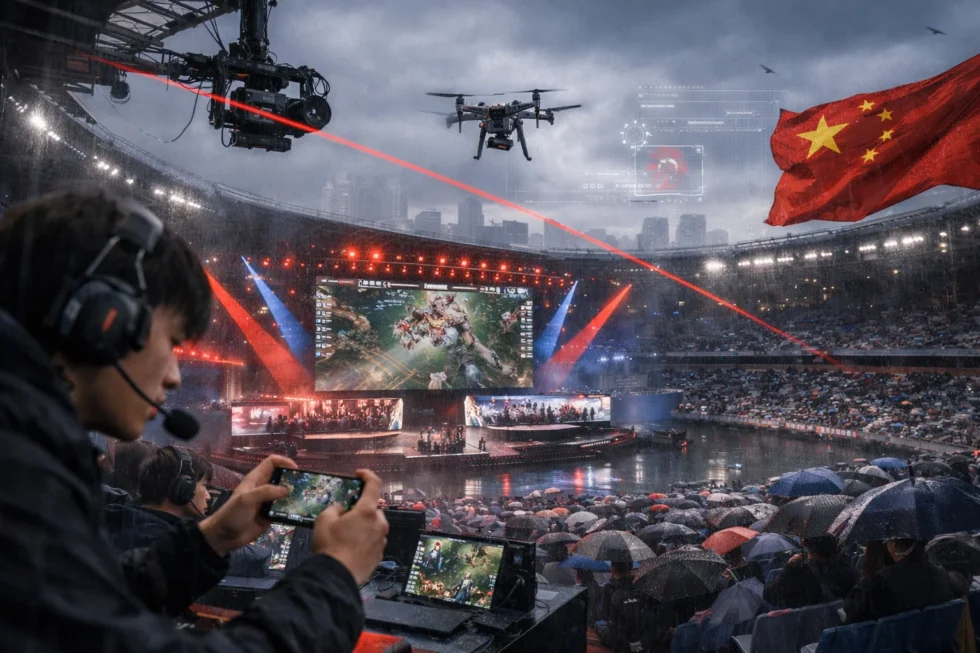
By the start of 2026, China’s King Pro League is no longer just an esports competition — it is a data-driven sports industry built on artificial intelligence, stadium audiences and hundreds of millions of players. That status did not emerge overnight. It was cemented in November 2025, when 62,196 people packed Beijing’s Olympic National Stadium to watch the Honor of Kings Grand Final — the largest live video-game event ever staged. At the same time, Tencent confirmed that KPL teams had begun using AI systems to simulate drafts, predict match outcomes and optimise training for the coming season.
The scale behind those decisions is vast. Honor of Kings now counts 139 million daily players in China and more than 260 million monthly users worldwide, while China’s games market reached 350.79 billion yuan (about $50bn) in 2025. What began as a mobile game has become one of the world’s largest spectator platforms, combining professional competition, broadcast media and consumer commerce into a single ecosystem.
By moving competitive preparation into artificial intelligence, KPL is signalling that the next phase of esports will not be driven by reflexes alone, but by data, modelling and computational advantage. As reported by The WP Times, citing CGTN and Esports Charts.
AI enters the core of Chinese professional esports
Cheng Huang, head of Honor of Kings Esports at Tencent, confirmed in late December that the King Pro League has begun deploying artificial intelligence as part of its competitive infrastructure. The technology is now being used not as an experimental tool but as a core element of team preparation, simulating entire matches and testing thousands of strategic variations before a single game is played.
The AI systems analyse and optimise:
- ban-and-pick decisions
- hero match-ups
- player behaviour patterns
- win-probability models
In elite esports, where outcomes are often decided by fractions of a second and marginal tactical choices, this represents a fundamental shift. Competitive advantage is increasingly produced by computation and modelling rather than intuition alone — a transition similar to what data analytics brought to professional football or what algorithms did to financial markets.
Honor of Kings: a platform larger than most countries
Honor of Kings is not simply China’s most popular game. It is one of the largest active digital platforms on the planet.
| Metric | Latest figures |
|---|---|
| Daily active users (China) | 139 million |
| Monthly active users (global) | 260+ million |
| Chinese games market (2025) | 350.79 billion yuan (~$50bn) |
| Total gamers in China | 683 million |
To put this in perspective, the entire population of the United Kingdom is about 67 million. Honor of Kings reaches roughly four times that number every day inside China alone. For Tencent, this gives KPL the scale of a national broadcasting and advertising ecosystem rather than a conventional sports league.
From smartphone to Olympic stadium
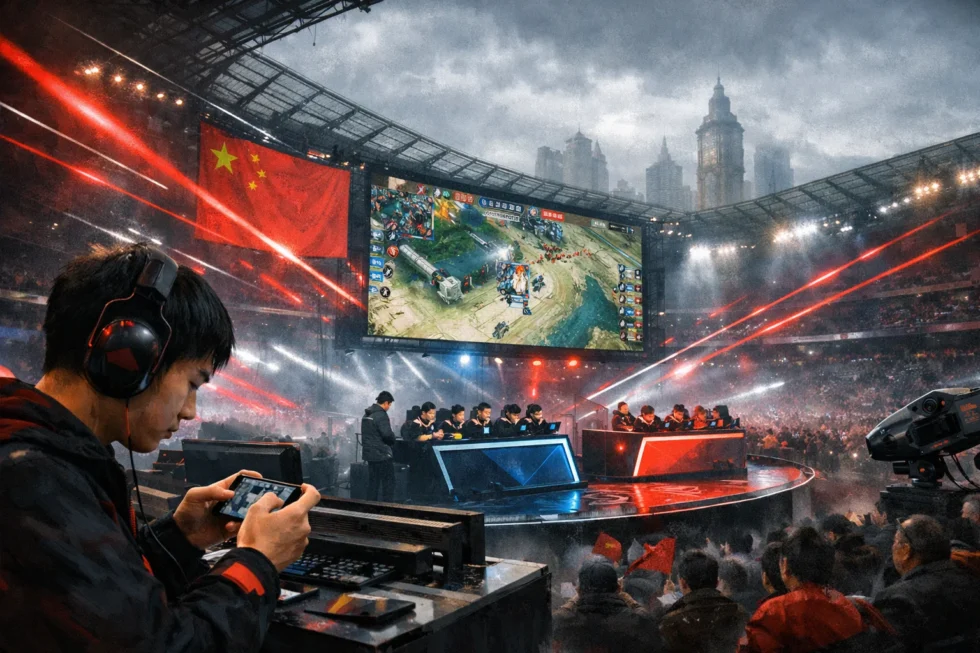
On 8 November 2025, Tencent staged the KPL Grand Final inside Beijing’s National Stadium, the Bird’s Nest — a venue built for the Olympic Games and symbolic of China’s largest national spectacles.
The result was unprecedented:
- 62,196 paying spectators
- tickets sold out in 12 seconds
- the largest live video-game event ever recorded
This was not a marketing stunt. It was the culmination of a decade-long strategy in which mobile gaming was transformed into a fully industrialised ecosystem of leagues, influencers, sponsors and mass-market fandoms. China did not adapt the Western esports model — it rebuilt the entire concept around smartphones and social platforms.
Why China dominates mobile esports
China’s dominance in mobile esports is not the product of taste or fashion. It is the result of three structural advantages that no other market has been able to replicate at the same scale.
Hardware. In China, fully capable gaming smartphones retail for between $150 and $300, eliminating the cost barrier that still limits console and PC gaming in much of the world. This has allowed hundreds of millions of people to participate in competitive gaming without specialised equipment.
Connectivity. With 1.19 billion 5G users and more than 4.8 million base stations, China operates the densest high-speed mobile network on the planet. Low-latency gameplay is available not just at home, but on trains, metros and in public spaces — turning esports into an always-on activity.
Integration. Tencent, NetEase and ByteDance did not leave games isolated inside entertainment apps. They embedded them into commerce, streaming, social networks and payment systems. In China, gaming is not a separate pastime — it is part of the country’s core digital infrastructure.
KPL as a consumer-brand machine
Tencent positioned KPL inside Xiaohongshu (RedNote), China’s lifestyle and social-commerce platform with about 260 million monthly users, roughly 70% of them women. That demographic profile gives KPL something Western esports has often struggled to secure: direct access to high-spending consumer audiences.
As a result, Honor of Kings players now operate more like mainstream celebrities than traditional gamers. They promote cosmetics, fashion and consumer technology alongside team merchandise. KPL has become not just a league, but a powerful marketing and celebrity-creation engine.
Why Western publishers now depend on China
Global publishers increasingly reach Chinese audiences through mobile partnerships:
- Activision Blizzard → Tencent (Call of Duty Mobile)
- Blizzard → NetEase (Diablo Immortal)
- EA → Tencent (Need for Speed Mobile)
Even franchises that were once PC-centric now rely on China’s mobile ecosystems to reach mass audiences. At the same time, China has become a major host for Counter-Strike and League of Legends tournaments, drawing global viewership into Asian time zones.
What this means for the future of esports
China has quietly done what Western esports has struggled to achieve for more than a decade: it has built competitive gaming that works at national scale. It combines mass audiences, stable infrastructure and predictable revenue into a single, functioning system. KPL’s move into artificial intelligence shows that this system is now entering its next phase — one in which performance, scheduling and monetisation are increasingly governed by data rather than instinct.
What happened at the Bird’s Nest was therefore not a spectacular outlier but a structural marker. It revealed where the industry’s centre of gravity now sits. The future of elite competitive gaming is no longer being shaped primarily in Europe or North America, but inside China’s mobile-first, platform-driven esports economy.
Read about the life of Westminster and Pimlico district, London and the world. 24/7 news with fresh and useful updates on culture, business, technology and city life: How is Grok AI being used to digitally undress women on Elon Musk’s X without their consent