
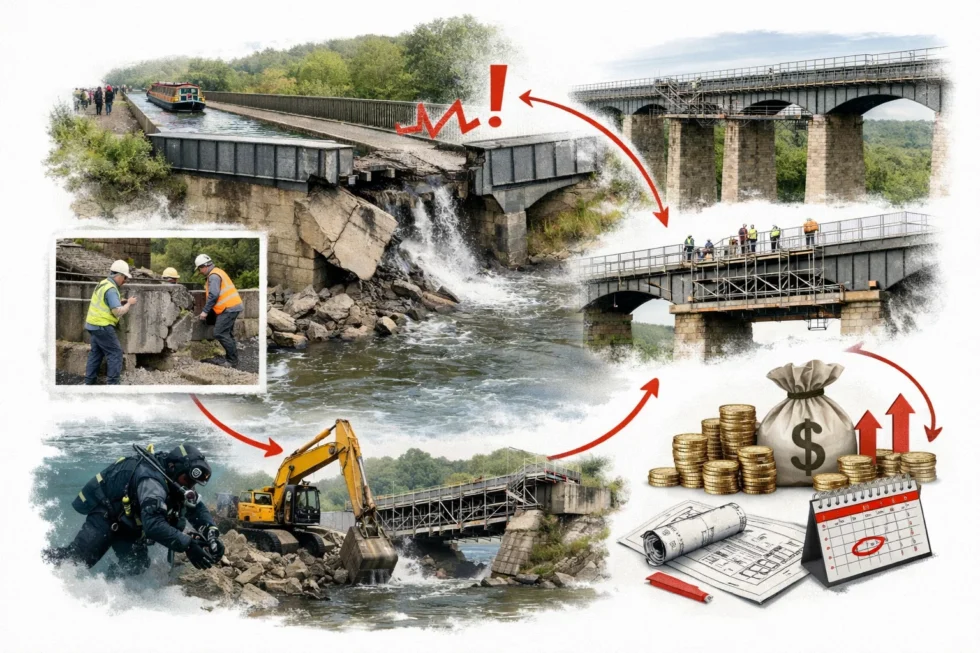
The Montgomery Canal, a historic waterway in Shropshire that feeds into the UNESCO-listed Llangollen–Pontcysyllte canal system in north-east Wales, has entered one of the most serious infrastructure crises in decades after a catastrophic embankment failure near Frankton Locks, close to Whitchurch.
The collapse, which occurred on 22 December 2025, left boats submerged, residents displaced and navigation severed just days before Christmas, cutting off a key route into one of Britain’s most important heritage waterways. Engineers now expect repairs to dominate most of 2026, with reopening only possible towards the end of the year. The WP Times reports this, citing BBC coverage and statements from the Canal & River Trust.
What makes the incident more than a local emergency is its impact on the wider Llangollen–Pontcysyllte waterway system, which underpins one of Britain’s most internationally recognised heritage corridors. Although the breach itself occurred on the Montgomery Canal, it forms part of the network that carries traffic, tourism and economic activity into the UNESCO-listed Llangollen Canal and Pontcysyllte Aqueduct — meaning the disruption reaches far beyond a single stretch of water.
A collapse measured in metres, not inches
The failure occurred in the early hours of 22 December 2025, when a section of the canal embankment suddenly gave way. Water poured out at speed, cutting a deep trench through the bank and draining a long stretch of canal within minutes.
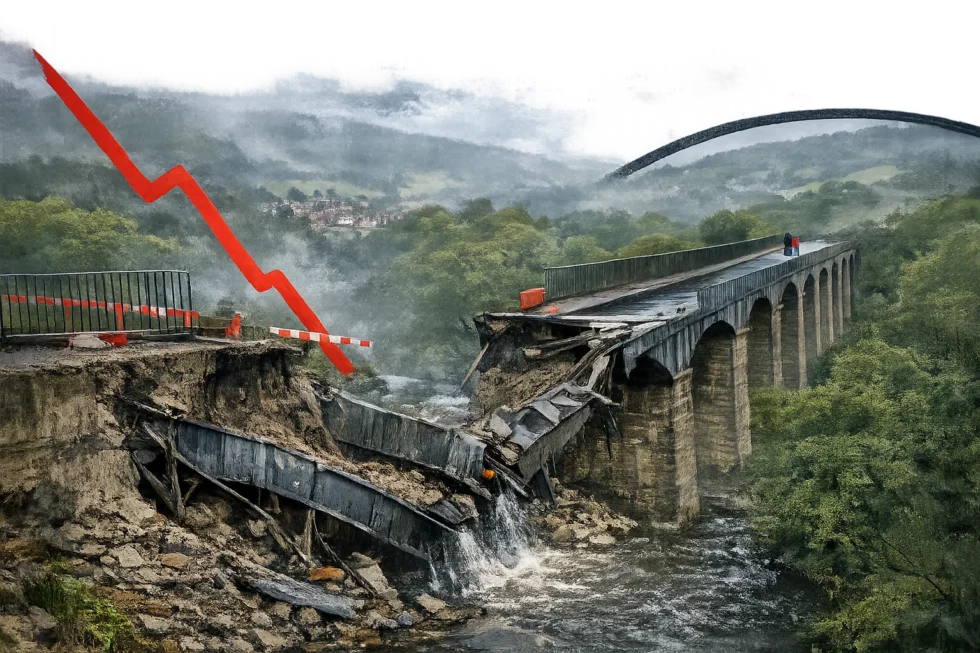
Three narrowboats were caught in the collapse. Two fell directly into the breach, while a third was left hanging at the edge of what had been a navigable waterway only hours earlier. Dozens of other boats were stranded along the drained section, leaving families cut off from their homes and livelihoods.
Julie Sharman, chief operating officer of the Canal & River Trust (CRT), described the event as “catastrophic”, explaining that earth embankments behave differently from concrete structures.
“When you get a water path through an embankment, it unravels as it goes,” she said. “Once that process starts, it becomes catastrophic.”
Boats destroyed, people displaced
The human impact has been immediate and severe. One of the boats, Sefton, is believed to have been badly flooded after plunging into the breach first. Another, Ganymede, may have escaped with less structural damage. The third, Pacemaker, was successfully winched back to safety.
Its owner, Paul Stowe, described being woken as his boat began to tilt while the ground disappeared beneath it.
“You don’t realise how powerful the water is until it’s taking you away. The ground just opened beneath us,” he said.
For many affected residents, their narrowboats were not holiday craft but permanent homes. In the days after the collapse, canal users and the wider community raised more than £100,000 to support those suddenly made homeless.
Why the repair will cost millions and take most of 2026
This is not a hole that can simply be filled in. CRT engineers have confirmed that much of the collapsed material is structurally unusable. The entire damaged section must be cut back, rebuilt in layers using engineered fill, compacted and stabilised, and then sealed with an impermeable lining to prevent future seepage. In practical terms, a section of a 19th-century canal embankment is being rebuilt to modern 21st-century engineering standards.
Two temporary dams have already been installed to isolate the damaged zone and stabilise the rest of the canal. The next step is to recover the two boats still sitting in the trench, likely by constructing a ramp so they can be safely towed out for inspection.
Only once the site is cleared can full reconstruction begin.
CRT has said the total cost will run into “several million pounds” — a significant burden for a charity responsible for more than 2,000 miles of waterways across England and Wales.
Why this matters far beyond one canal
Although the breach occurred on the Montgomery Canal, its effects ripple through the wider Llangollen–Pontcysyllte waterway system, which feeds traffic into one of Britain’s most valuable heritage corridors.
The closure disrupts:
- Heritage tourism across north-east Wales and Shropshire
- Navigation along one of Britain’s most visited canal routes
- Marinas, boatyards, pubs and hotels that depend on canal traffic
- The flow of boats to and from the UNESCO-listed Llangollen Canal
This is why the rebuild will be closely monitored not just by engineers, but by conservation bodies and heritage stakeholders.
What happens next in 2026
CRT’s current timeline is stark: most of 2026 will be taken up by repair work. The sequence is expected to be:
- Recover stranded boats and clear the breach
- Remove unstable embankment material
- Rebuild the structure in engineered layers
- Install a new impermeable lining
- Refill, test and certify the canal for navigation
If all goes to plan, limited reopening could occur late in 2026, but CRT has deliberately avoided promising any earlier date.
A warning for Britain’s waterways
The Montgomery Canal collapse is a reminder that much of Britain’s canal network is held together by ageing earth embankments and Victorian-era assets that were never engineered for today’s operating reality. These waterways now face a harsher mix of pressures: persistent maintenance backlogs, heavier leisure traffic, more frequent extreme rainfall events, and repeated freeze–thaw cycles that weaken ground and linings over time.
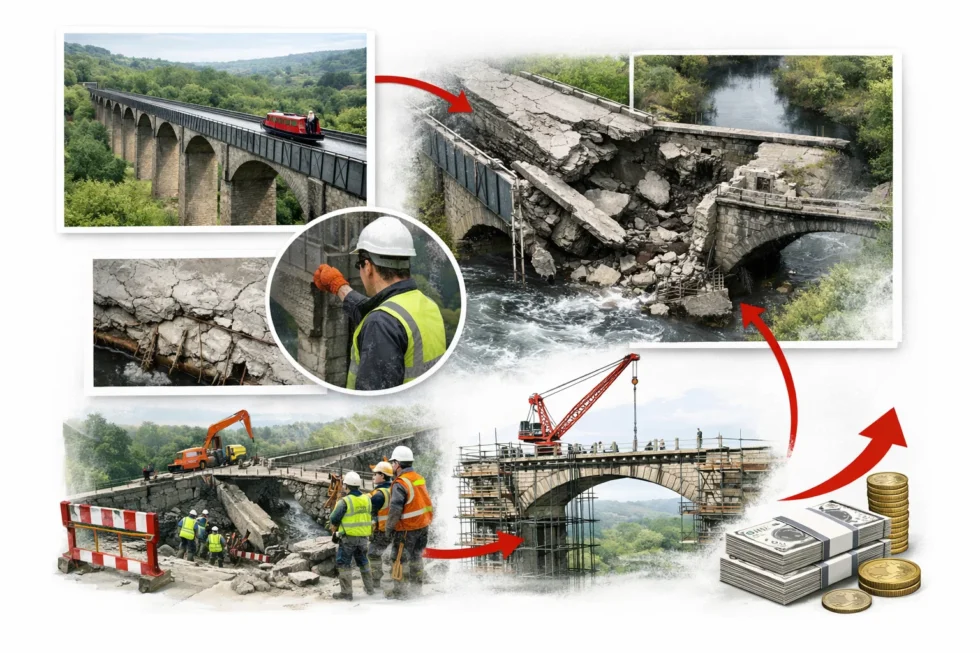
One unseen defect was enough to empty a canal in minutes, damage homes and trigger a multi-million-pound rebuild. That is the uncomfortable lesson: in an ageing network, failures do not stay local — they become expensive, disruptive and nationally visible fast.
Hintergrund: what the Llangollen Canal is and why it matters
The Llangollen Canal is a 46-mile waterway running from Hurleston in Cheshire to Llangollen in north Wales, built in the early 19th century as part of Britain’s industrial canal network. It was designed by two of the most influential engineers of the Industrial Revolution, Thomas Telford and William Jessop, to carry coal, slate, limestone and agricultural goods across the Welsh–English border at a time when canals were the backbone of the British economy.
Its most famous structure, the Pontcysyllte Aqueduct, completed in 1805, carries the canal 38 metres above the River Dee and was regarded as one of the boldest civil-engineering achievements of its age. In 2009, an 11-mile stretch of the canal and aqueduct was awarded UNESCO World Heritage status in recognition of its pioneering iron construction and its role in shaping modern transport engineering.
Over the last century, the Llangollen Canal has evolved from an industrial artery into one of Britain’s most important heritage and leisure waterways. It attracts hundreds of thousands of visitors each year, and its narrowboats, aqueduct crossings and wooded valleys have featured in BBC travel series, historical documentaries and film productions, turning it into a visual symbol of Britain’s canal age.
Before the 2025 Montgomery Canal collapse near Whitchurch, the Llangollen route was one of the busiest tourist waterways in the UK, supporting marinas, boatyards, pubs, hotels and rural communities along its length — making the breach not just a structural failure, but a shock to an entire heritage economy.
Read about the life of Westminster and Pimlico district, London and the world. 24/7 news with fresh and useful updates on culture, business, technology and city life: British Gas bills rise in January as Ofgem lifts the price cap while April cuts promise relief