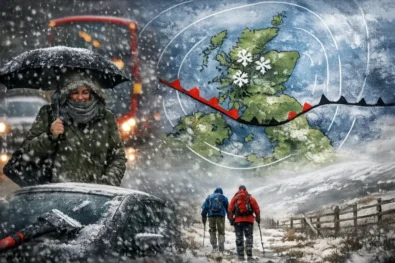
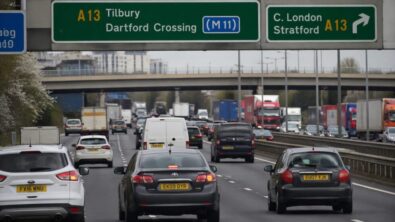
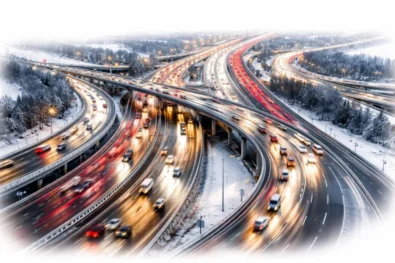
Britain’s road network entered the second full working day of 2026 under severe strain on Wednesday morning as millions of commuters, freight vehicles and airport traffic poured onto roads that were still slick with overnight ice and restricted by winter closures. The heaviest pressure built across the Scotland–England freight spine and the main east–west commuter corridors, with the M8 between Glasgow and Edinburgh, the M62 across the Pennines, the M4 through South Wales and the A55 into North Wales emerging as the key bottlenecks. The WP Times reports this, citing police travel advisories, Met Office warnings and live highway monitoring.
Unlike earlier in the week, when snowfall was the main problem, 7 January is being driven by refreezing, black ice and sheer traffic volume. With schools, offices and logistics hubs fully reopened, roads that are already operating with reduced capacity due to winter restrictions and overnight closures are now struggling to cope.
Where the pressure is building this morning
As Britain wakes up to its second full working day of the year, traffic is pouring back onto a road network that is still cold, icy and running with limited spare capacity. The biggest strain this morning is not coming from one single crash or closure, but from the way commuter traffic, freight and winter conditions are colliding on the same key routes at the same time.
The heaviest pressure is building on the main corridors that link cities, ports and economic centres — where even a small slowdown quickly spreads into long queues.
Scotland: Glasgow–Edinburgh corridor under the heaviest load
The M8 between Glasgow and Livingston is one of the most overloaded sections in the country this morning. It carries:
- Commuters travelling both ways between Glasgow and Edinburgh
- Freight heading south towards the M74 and the English border
- Airport traffic for Glasgow and Edinburgh
This is happening while parts of the M8 around junctions 16 to 18 in Glasgow are running with lane restrictions due to essential bridge repairs, leaving far less room to absorb delays when ice or minor incidents block a lane.
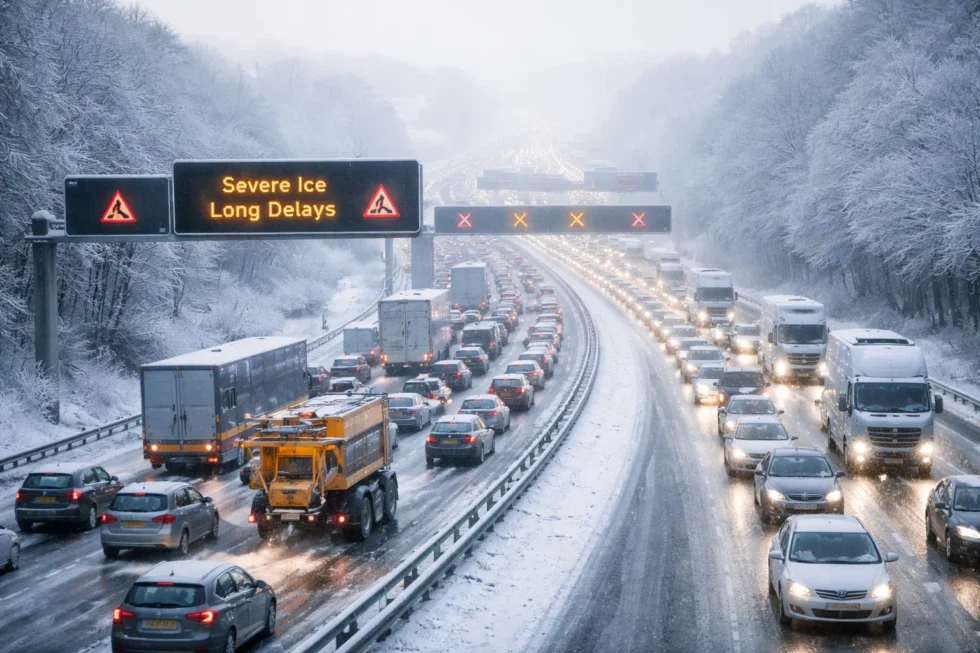
The pressure then spills onto:
- M80 (Glasgow → Stirling / Perth)
- M74 (Glasgow → Carlisle → England)
- M77 (Glasgow → Ayrshire ports and industry)
- A720 Edinburgh City Bypass, which funnels suburban traffic onto already slippery motorways
Northern England: Pennines and north–south freight routes
In England, the main stress line this morning runs through:
- M62 (Manchester ↔ Leeds) – the Pennine crossing for commuters and logistics
- M1 and A1(M) – the north–south freight backbone linking Scotland, the Midlands and London
These routes are not blocked by deep snow, but by black ice on high ground, slow-moving HGVs on gradients and repeated minor incidents, which is enough to cause rolling congestion across entire regions.
Wales: winter restrictions meet commuter and airport traffic
In Wales, the M4 corridor into England and the A55 link between North Wales and the mainland are under added pressure.
The A55 Britannia Bridge is operating under a 30 mph wind restriction, reducing capacity between Anglesey and the North Wales coast, while overnight closures on the M4 and A48(M) around Cardiff, Newport and Bridgend have disrupted early-morning flows and pushed traffic onto fewer lanes.
This affects not only commuters but also:
- Freight heading to and from Irish Sea ports
- Airport traffic for Cardiff and Bristol
- Long-distance drivers crossing South Wales into England
Why 7 January is worse than earlier in the week
Monday and Tuesday were driven mainly by snowfall. Wednesday is different.
Today combines:
- Full post-holiday commuter demand
- Refreezing of treated roads overnight
- Long-running roadworks and winter closures
- Heavy freight volumes restarting after the holiday slowdown
That means the road system has less spare capacity than usual, so even small incidents now cause outsized delays.
What drivers should do today
- Avoid peak periods if you can — 07:00–10:00 and 15:30–18:30 are the most fragile.
- Do not rely on shortcuts — minor roads are more likely to be icy than motorways.
- Plan around the bottlenecks:
- Glasgow ↔ Edinburgh: expect M8 delays
- Manchester ↔ Leeds: expect M62 disruption
- South Wales ↔ England: expect M4 and A48(M) restrictions
- North Wales ↔ mainland: expect A55 slowdown
- Check live updates before and during your journey — conditions can change within minutes when ice is involved.
Why roadworks and reduced capacity are amplifying today’s disruption
What makes today’s disruption more severe is that many of the UK’s most important roads are already operating below full capacity, even before winter weather is factored in. On the M8 through Glasgow, between junctions 16 and 18, essential bridge repairs have reduced the number of available lanes on the main east–west route between Glasgow and Edinburgh, squeezing commuter, airport and freight traffic into a tighter space.
In South Wales, night-time closures and slip-road restrictions on the M4 and A48(M) around Cardiff, Newport and Bridgend are still affecting the flow of vehicles travelling between South Wales, Bristol and London, creating bottlenecks as traffic merges back into fewer open lanes during the morning peak.
Further north, wind restrictions on the A55 Britannia Bridge are slowing traffic between Anglesey and the North Wales coast, an important link for both local commuters and port-bound freight.
When these built-in bottlenecks combine with black ice, refreezing road surfaces and a full return of post-holiday traffic, the network has almost no room to recover. A single slow-moving lorry, a minor skid on a slip road or a brief lane closure is enough to turn already busy routes into long-lasting congestion, which is why delays are spreading so quickly across the UK this morning.
Read about the life of Westminster and Pimlico district, London and the world. 24/7 news with fresh and useful updates on culture, business, technology and city life: Why Is London Zipcar free parking being offered in 200 bays as Southwark tries to stop Zipcar leaving