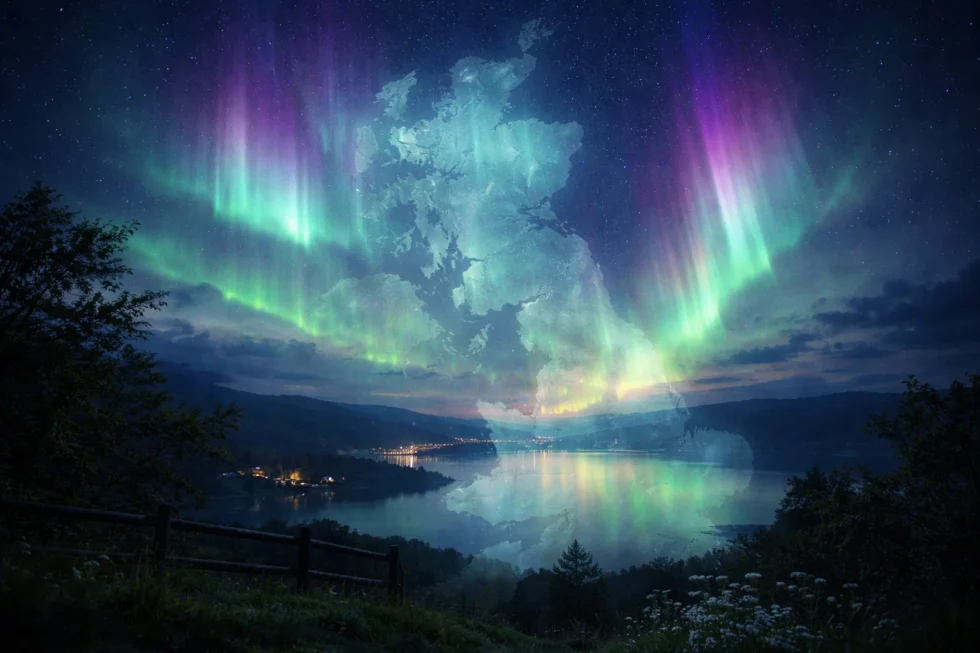
Northern lights aurora borealis are expected to be visible across parts of the United Kingdom this week after space-weather experts confirmed that a major solar storm has reached Earth. As The WP Times reports, scientists in both the United States and the UK say the event ranks among the most significant geomagnetic disturbances of recent years, creating the possibility of rare auroral displays far beyond their usual northern latitudes.
Official alerts have been issued by the US National Weather Service’s Space Weather Prediction Center (SWPC) and the UK Met Office, warning of elevated radiation levels and intensified geomagnetic activity. While the primary impacts are likely to be felt by satellites, aviation systems and high-latitude communications, the most visible effect for the public could be spectacular: widespread sightings of the northern lights aurora borealis over Britain.
The storm began after an intense solar flare and a coronal mass ejection (CME) erupted from the Sun earlier this week, sending a cloud of charged particles directly toward Earth. When those particles collide with the planet’s magnetic field, they create both technical disruptions and colourful atmospheric light shows.
What triggered the northern lights aurora borealis over the UK
Space-weather specialists say the current event is the result of a rare combination of solar activity:
- A powerful X-class solar flare
- A large coronal mass ejection aimed at Earth
- A severe geomagnetic storm reaching high intensity
- Elevated levels of solar radiation
The SWPC confirmed that the solar radiation storm reached level four out of five on the international scale, a category officially classified as “severe.” Such storms are unusual and can have global consequences for space-based technology. Shawn Dahl, a senior forecaster at SWPC, described the scale of the response:
“We’ve been making all these phone calls to ensure that we are keeping all the critical technological infrastructure operators in the know of what’s happening.”
According to both American and British forecasters, this storm has the potential to push the auroral oval – the region where auroras normally appear – much further south than usual. That is why northern lights aurora borealis could be seen over large parts of the UK rather than only in Scotland.
Where and when can people in Britain see the aurora
Experts say that timing and local weather conditions will determine the best opportunities to view the lights.
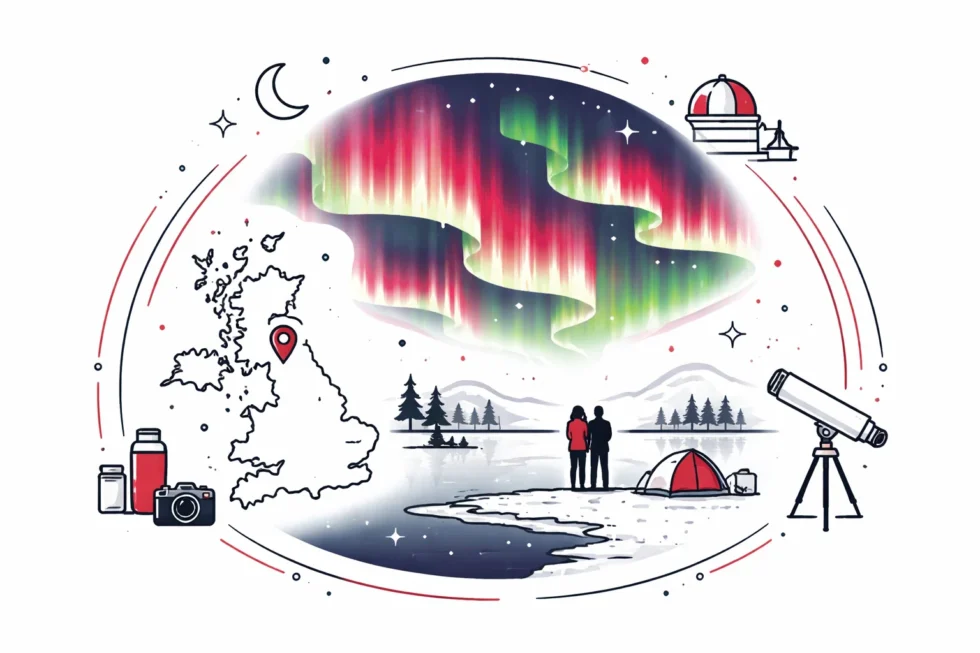
Best chances by region
- Scotland: Highest probability of strong, visible auroras
- Northern Ireland: Good chance if skies are clear
- Northern England: Possible sightings, especially in rural areas
- Wales and Midlands: Sightings possible during peak activity
- Southern England: Unlikely, but not impossible in very strong conditions
The most promising viewing window is expected to be between 22:00 and 02:00, when skies are darkest and geomagnetic activity often peaks.
Practical viewing advice
To improve the odds of seeing the northern lights aurora borealis, experts recommend:
- Find a dark location away from city lights
- Look toward the northern horizon
- Use a camera or smartphone night mode
- Allow time for your eyes to adjust
- Monitor live aurora forecasts
Even if the aurora is faint to the naked eye, long-exposure photographs can often reveal colours and patterns not immediately visible.
Table: Ideal conditions for aurora viewing in the UK
| Factor | Recommended Condition |
|---|---|
| Time | Late evening to early morning |
| Sky | Clear, cloud-free |
| Location | Rural or coastal areas |
| Direction | Facing north |
| Moonlight | Minimal or absent |
| Equipment | Camera with long exposure |
How solar storms affect satellites and aviation
While most people focus on the visual spectacle, space-weather events like this one can have serious technical implications.
Systems most at risk
- Satellite communications
- GPS navigation
- High-frequency radio links
- Polar-route aviation
- Power grid monitoring systems

During radiation storms, airlines flying over polar regions may reroute flights to avoid increased exposure to high-energy particles. Satellite operators often switch sensitive equipment into protective modes to reduce the risk of damage. The SWPC confirmed that astronauts aboard the International Space Station can be moved to more shielded areas during periods of heightened radiation, a procedure used in previous storms. Scientists emphasise that widespread everyday disruptions on the ground are not expected, but specialist sectors are taking precautions.
What scientists say about the current event
Space-weather experts around the world are closely monitoring the storm’s development. Ryan French, a solar physicist at the University of Colorado Boulder, explained the measured approach being taken:
“Operators are preparing for potential technical issues, but widespread technology impacts for the general public are not expected.” British forecasters at the Met Office echoed that message, noting that the primary concern remains for space-based infrastructure rather than domestic electricity or internet services.
Night-time solar energy: a different way to power satellites
Alongside the excitement over auroras, scientists are also working on innovative technologies that could help spacecraft cope with periods of darkness. Researchers at the University of New South Wales (UNSW) in Australia are developing devices known as thermoradiative diodes, sometimes described as “reverse solar panels.” Instead of generating electricity from sunlight, these devices produce small amounts of power by emitting infrared radiation. Jamie Hanson, a postgraduate researcher at UNSW, explained the concept:
“We’re working on developing devices that generate electricity by emitting light instead of absorbing light. It’s like a reverse solar panel.”
Professor Ned Ekins-Daukes, who leads the UNSW project, added:
“If you were to look at the Earth at night, what you’d see with an infrared camera is the Earth glowing. What’s happening is the Earth is radiating heat out into the cold universe.”
Although current prototypes generate only tiny amounts of electricity – around 100,000 times less than a conventional solar panel – scientists believe the technology could be useful for satellites that spend long periods in darkness. Ekins-Daukes said: “Your solar panel only works when the sun’s shining. The opportunity here is to provide some auxiliary power during periods when spacecraft are in shadow.”
Forecasters expect geomagnetic activity to continue for several days as additional waves of solar material interact with Earth’s magnetic field. That means more opportunities to witness the northern lights aurora borealis over the UK – provided that clouds stay away. Space-weather agencies will continue issuing real-time updates, and both the Met Office and SWPC are monitoring conditions around the clock.
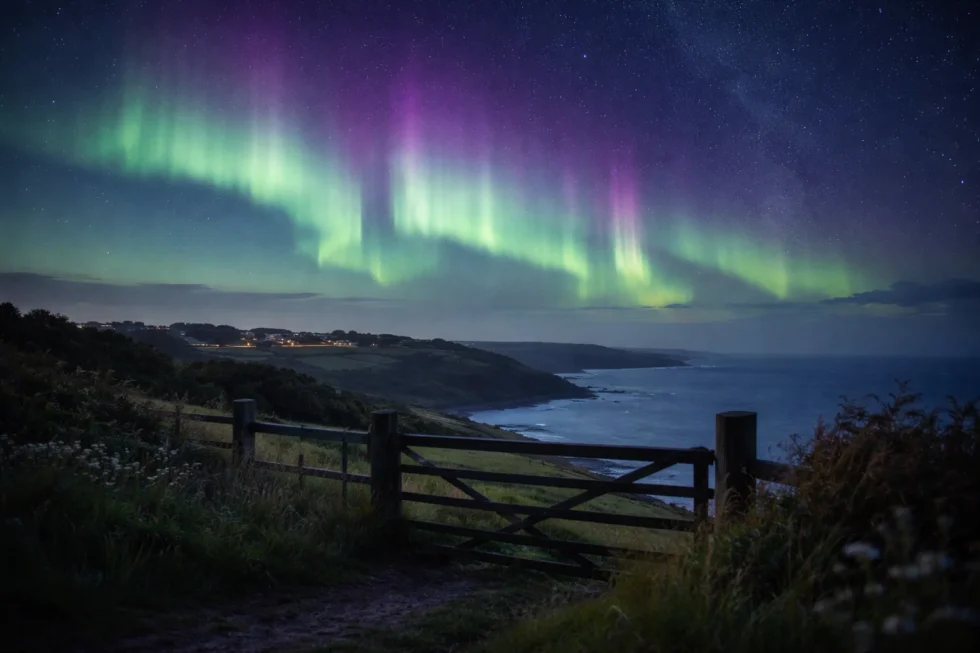
For most people in the United Kingdom, seeing the aurora is usually a rare event that requires travel to northern destinations such as Iceland, Norway or Canada.
This week, however, a significant geomagnetic storm gives UK residents a genuine opportunity to experience the northern lights aurora borealis much closer to home. Instead of long journeys abroad, sightings may be possible from local parks, coastal paths, rural viewpoints and even back gardens.
To make the most of the opportunity, experts recommend a few simple steps. Choose a dark location away from street lighting, face north with a clear horizon, and check live aurora forecasts before heading out. Using a smartphone in night mode or a camera with a long exposure can help capture faint colours that may be harder to see with the naked eye. If skies stay clear and geomagnetic conditions remain strong, the coming nights could offer practical and accessible chances for people across Britain to witness one of nature’s most striking phenomena without leaving the country.
Read about the life of Westminster and Pimlico district, London and the world. 24/7 news with fresh and useful updates on culture, business, technology and city life: Nasa Artemis II launch pad rollout begins as historic round-the-moon mission nears February launch